"If you want to be cited by ChatGPT, should you submit content or Bing SEO?" This question itself is wrongly set. ChatGPT's online search is based on Bing's index. Being included and ranked by Bing is the ticket. Whether the content is good enough determines whether it will include your sentence in the answer. Betting on only one side is equivalent to spending money to repair half of the funnel, while the other half is broken and leaking.
First understand how ChatGPT decides who to cite.
ChatGPT answers from two sources. One is the memory absorbed during model training. It will tell the content, but there is no link, and it cannot trace your brand; the other is an instant-triggered search. It will grab a few pages on the Internet, and after reading them, it will integrate a few sentences into the answer and put a source link next to it. The "citation" you care about almost always happens in the second type.
The key is where this search layer runs. OpenAI's web search relies heavily on Bing's indexing and ranking signals, which represents something that many Taiwanese B2B teams don't realize: Bing's rankings, which you thought were out of date, are the first door that determines whether ChatGPT can "find" you. Google ranks first, but Bing does not find this page. For ChatGPT in search mode, you just don’t exist.
The two roads are actually the front and rear sections of the same funnel.
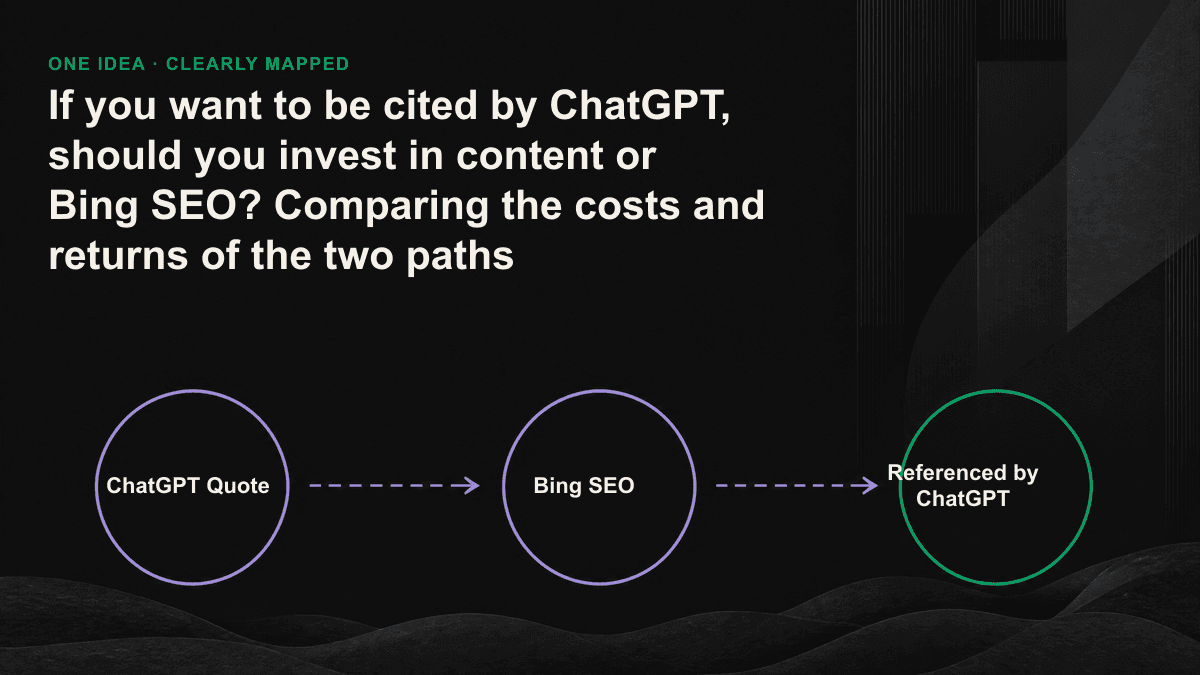
It will be much clearer if you break down the quote. It is divided into two actions: retrieval (retrieval) determines whether you will be included in the candidate list, and selection (selection) determines whether you will be selected for the quoted sentence. Bing SEO manages the former, and content quality manages the latter. This is why "investing in content or investing in Bing" is a false choice - the two are responsible for different stages of the funnel. If one section is missing, the investment in the other section will not receive a return.
- The page is indexed by Bing
- For the target question, the page has a visible ranking in Bing and is included in the search candidate list.
- Machine-readable page structure: put the main claim first and make each paragraph self-contained so a reader or model can understand the point without reading the entire page.
- In this sub-question, your content is more worthy of being cited than competing products that were caught in the same batch.
Bing SEO: low cost, quick results, but obvious ceiling
The advantage of this route is that it is cheap and fast. The technical foundation of most Taiwan B2B websites is adjusted for Google, and Bing has been neglected all year round: Bing Webmaster Tools is not submitted, IndexNow is not connected, robots and sitemap are not friendly enough to Bing crawlers. Completing these is mostly a one-time project. A large number of pages can be re-entered into the Bing index in a few days to two weeks, and you can go from "not being found in ChatGPT at all" to "at least getting into the candidate list". But the ceiling is obvious: being searchable does not mean being cited. When five or six pages of the same question are captured at the same time, ChatGPT will only pick one or two of the best sentences and put them into the answer. After the technology is completed, it will be handed over to the content whether it can be cited.
Content: High cost and compound interest will determine whether you are "that quoted sentence"
Content is expensive and requires continuous investment. What it wants is not more words, but words that are easier to extract: put the conclusion at the beginning of the paragraph, only talk about one thing in a paragraph, and put numbers and situations into sentences, so that the machine can safely quote a sentence without having to read the entire text. This way of writing is also more readable to human readers, but its real recipient is the model responsible for extracting the answer.
The returns on content compound. An article with a clean structure and an answer to a certain sub-question will be repeatedly included in different related questions; as the number of citations accumulates, the model's trust in the brand on this topic will also increase. When we built a GEO content engine for our clients, we saw it very clearly: in the same domain, pages written in extractable format are often cited several times more often than long articles in the old format, even if the two have similar rankings in Bing.
Costs and Returns: How to Match the Timeline
- Days 0 to 30: Completing Bing searchability is low cost and is a prerequisite. If you don’t do this, it will all be in vain.
- Days 30 to 90: Improve intent sub-questions, rewrite existing pages into extractable structures, or fill gaps in content
- Continuing after: Use AI visibility monitoring to track actual citations, see which issues have not been solved, and come back to feed content
Pages that Bing cannot see, no matter how well written they are, are just isolated islands for people to see, and they will never be able to get answers from AI.
So which side should you vote for first?
The order is clear: first use a small cost to repair Bing's searchability, which is a one-time prerequisite; then put the main budget on content compound interest, because that is the link that determines whether to be cited or not. The most expensive mistake is to do the opposite - spending resources to produce beautiful content, but Bing cannot see it at all, which is equivalent to printing a whole batch of flyers and locking them in the warehouse.
If you want to know what your page looks like now in the eyes of Bing and ChatGPT, whether the gap is stuck in retrieval or selection, you can book a 30-minute GEO diagnostic session, and we will dismantle the two sections of your funnel to show you.