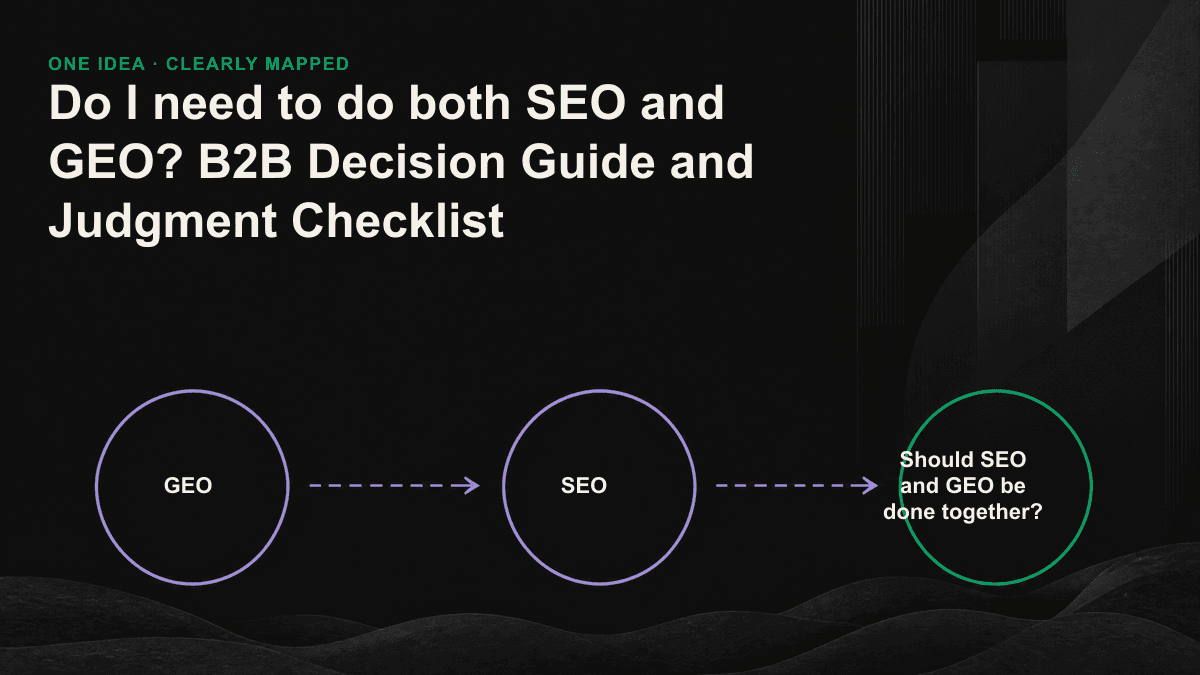
If you are running B2B or SaaS in Taiwan, the answer is almost certainly "do it together", but this sentence can easily mislead you, because it makes people think that SEO and GEO are two production lines that need to be started separately and each has a group of people. The truth is that they share the same content base. As long as you are responsible for producing content, you are already feeding both sides at the same time. What really needs to be decided is: whether the next budget and next month's production capacity should be "competing for ranking" or "competing for citations".
People will ask if they should choose one of the two, usually because they only have enough budget or manpower to focus on one thing. This concern is real, but the correct response is to sequence, not to cut off one side. A small number of companies can indeed only bet on one side for the time being, and we will explain which types they are later; if you belong to the majority, insisting on choosing one of the two will only make you save money in the wrong place, and then you will find out that you are a step slower when your competitor has been mentioned repeatedly by the AI.
Let’s make a clear distinction first: shared foundation, bifurcated play methods
SEO and GEO need 80% overlap: machine-crawlable pages, structured data, clear definitions of entities and nouns, consistent brand narratives across networks, and content backed by real experience. If you do this well, Google’s rankings and citations from the AI engine will benefit together. The bifurcation only occurs at the last mile: SEO requires you to direct people back to the website to complete the conversion, while GEO requires your content to be cleanly extracted by the language model and used as the basis for the answer. Also because most of the work is shared, the additional cost of "doing it at the same time" is far lower than you think. In many cases, rewriting a piece of content once can feed both parties at the same time.
- Shared foundation: crawlability, structured data, clear entities and positioning, E-E-A-T, consistent brand messaging across sites.
- SEO-specific: Keyword-specific landing pages, internal link structure, and page experiences designed for clicks and conversions.
- Exclusive to GEO: individually extractable answer paragraphs, clear facts and figures, direct responses to specific questions.
Three situations, three answers
Whether you want to put them in order or not depends on where you stand now. Rather than arguing abstractly, it is better to see which of the following you fall into, because the same sentence "do it together" has completely different execution orders in different situations.
- Organic search has not yet established itself: the official website has little traffic and almost no rankings except for brand words. First lay the foundation of SEO, because the crawlability and structure required by GEO are originally the product of this step.
- SEO has stabilized, but you are missing from the AI answers: Your competitors are repeatedly named in related questions on ChatGPT and Perplexity, but you are not. At this time, the marginal budget should obviously shift towards GEO.
- Neither side has started yet, but the category has already been AI-ified: buyers are used to asking AI first before deciding whether to see your website. In this case, don't put them in order, use the same set of content to lay the foundation on both sides together.
A checklist of judgments you can run yourself
Instead of dwelling on definitions, use questions to position yourself. For each question below, if you answer "yes", you will add one point in the direction of "GEO should be increased". If you answer "no", you will tend to add SEO first. After running, you will have a rough but sufficient judgment about your center of gravity.
- Post your three most important purchasing decision questions into ChatGPT and Perplexity. Does your brand appear in the answers?
- Same question, were the competitors named or quoted?
- Does your core product page rank in the top ten of Google for category keywords (non-brand words)?
- Is there a paragraph in your content that can be extracted individually to answer a question, or does it have to be read in full to understand?
- Does your official website have structured information (FAQs, products, organization), or is it just plain text?
- Are your positioning, product terms, and key figures consistent on different pages and external platforms?
How to divide budget and production capacity
For most B2B SaaS in the growth stage, our starting point is to roughly divide the content budget into a ratio of 7:3: 70% is invested in landing pages that share the same foundation and can be directly harvested by SEO, and 30% is invested in rewriting existing content into a format that can be referenced by AI, and locking in a few high-value questions. When you start to be quoted in these questions and can see your contribution from the Pipeline, then move the proportion to GEO quarter by quarter. This number is not a rule, but a starting point. The point is to use actual data to re-weight it every season, rather than betting on it all at once.
Under what circumstances can you really just do one?
In rare cases, you can only bet on one side temporarily. If your buyers rarely use AI tools for procurement research, for example, in industries that are highly regulated and only deal with existing relationships and bids, the short-term marginal return of GEO will be low. It is more practical to build up SEO and word-of-mouth first. On the other hand, if you are in a completely new category and there is no corresponding search volume on Google, doing traditional keyword SEO is waiting for a demand that does not exist yet. At this time, directly operating the visibility of the AI engine and letting the model mention you incidentally when explaining this new category will achieve faster results. In addition to most B2B, choosing one or the other is mostly to make excuses for short-term budget.
SEO determines whether you will appear when buyers search for them by themselves, and GEO determines whether AI will mention you when choosing for buyers. You won't want to miss these two moments.— Tenten GEO
From list to action
After running through the list above, you probably already know which side you lean on. The next thing to do is to translate "Which side" into specific production capacity allocation and rewriting order: which pages should be structured first, which questions should be cited first, and which content can actually be fed to both sides in one draft. If you want to avoid unnecessary mistakes, you can book a 30-minute GEO diagnostic session. We will use your own purchasing decision-making questions to show you the visibility gaps in the six major AI engines, and which one is most cost-effective to fill first.