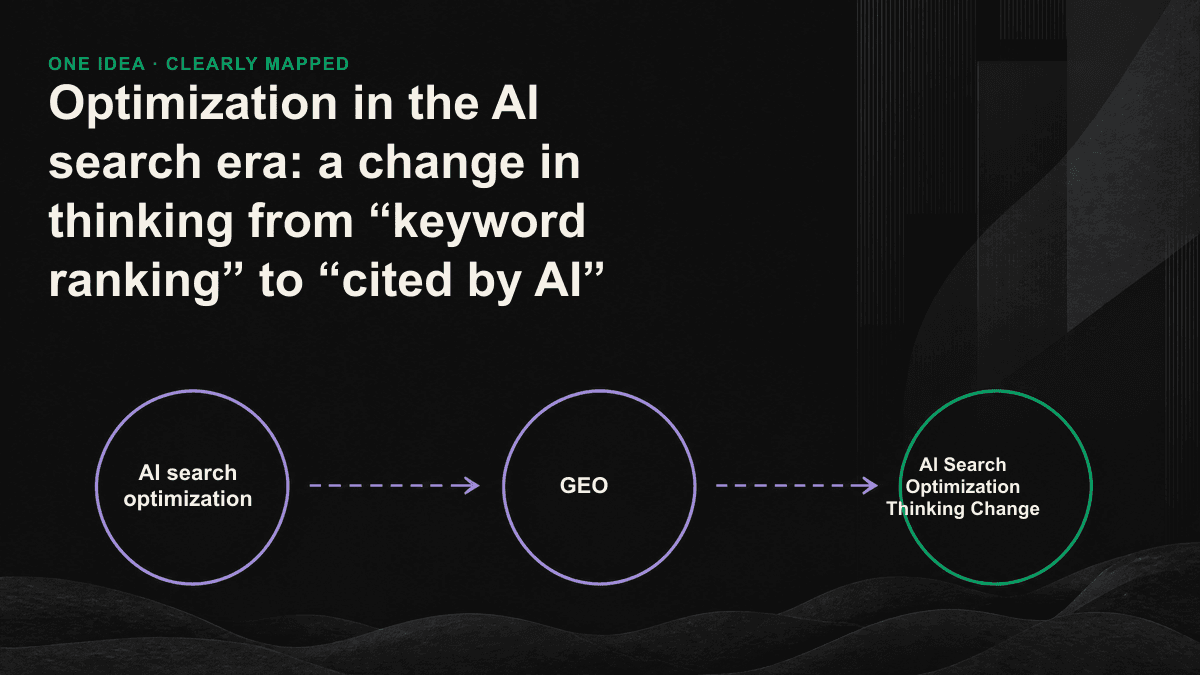
Ranking first in ChatGPT, Perplexity, or Google’s AI overview no longer makes sense because users don’t see that ranking list. What they see is a synthesized answer with three to five sources hanging underneath. What you are fighting for is no longer position, but a citation in that answer: whether your website has been read and whether it has been marked as one of the sources. This change is equivalent to rewriting the SEO assumptions of the past two decades.
The old ranking thinking has almost no focus in AI search
The entire set of operations of traditional SEO is based on the ten blue links on the search results page: tracking the keyword ranking, optimizing the click-through rate of the title, and finding ways to push the page up. AI search directly removed this result page. The language model reads in dozens of sources at a time and only responds to you in one paragraph after digesting them. At this time, whether you are ranked third or eighth is no longer the point. The key point is whether the model is willing to add your content into the answer and mark your name at the bottom. The opposite direction is also true: a page that had a low click-through rate in the past and was about to be deleted by you may suddenly become an object that is referenced repeatedly just because a certain definition is written cleanly. Position ranking and citations are two sets of logic that almost do not overlap.
Quotes are the first place in AI search
The unit of measurement of success has changed. In SEO, the unit is "how many times a certain keyword is ranked"; in AI search, the unit is "how many times have you been quoted as the answer to a certain question". Being cited means that the model trusts your statement, is willing to use your sentences, and helps you mark the source. The experience of this matter is closer to public relations and authority establishment, but far from keyword stuffing. Your goal is to make the model feel that the subject cannot be discussed without you as the source.
Three old indicators to replace
The change in thinking can’t just be a slogan, it has to come down to the numbers you look at every week. The following three sets of comparisons are the dashboard fields that we first ask our B2B clients to change when doing GEO audits.
- Keyword ranking → Citation share: Replace "Where do we rank?" with "Across AI answers to this class of question, how often are we cited, and how much share do competitors hold?"
- Natural clicks → Number of brand mentions: AI answers often do not include links, and users leave after reading them. Rather than just counting inbound traffic, track how often models mention your brand in answers. That’s where the impact really happens.
- Page residence time → Content extractability: The model will not "stay" on your page, it will only extract the few sentences that can be used. What should be measured is how much of your content can be cut out cleanly and used directly as the answer.
Content should be written for "extraction", not for "climbing up"
When writing content for rankings, it is customary to bury the key points after the introduction, first talk about the background, and then go around before giving the conclusion, because the past algorithm relied on the keyword density and dwell time of the entire page. The language model is just the opposite. What it wants is a paragraph that can be established independently and can be used out of the box. The first sentence of each section should be the answer to that section; the definition should be written as directly as in a dictionary, the numbers clearly mark the units and situations, and the paragraphs should be readable without context.
- Give a conclusion at the beginning of each paragraph, and then add the reasons, so that the model can draw the key points in the first sentence.
- Split "what, why, and how" into independent, clearly titled sections to facilitate correspondence to different issues.
- Important claims should be directly followed by specific numbers, time, or situations. Do not use vague "research shows."
- Use real terminology and questions about your industry, rather than just the keywords you want to rank for.
Change the keyword map to a "question-answer" map
SEO content planning starts with keywords: check the search volume, look at the difficulty, and create a keyword map. Planning for GEO starts with questions. The user will not type in the keyword "B2B SaaS import consultant" for ChatGPT. He will ask "Should our company import it ourselves or find a consultant? What is the difference between the two?" What you want to take stock of are these complete, spoken, situational questions, and then make sure that for each question, you have a clean, quotable answer on your website. This list of questions is the real content blueprint for the AI search era.
List the top fifty questions target buyers are likely to ask AI, then test them one by one in ChatGPT and Perplexity. Every answer that omits your brand or cites a competitor reveals a concrete content or authority gap.— Tenten GEO Audit Process
First make sure you are not being cited now.
You can change your mind first, but before taking action, you have to know the current situation. Most B2B website owners have actually never searched themselves in the AI engine, and they don’t know whether they were mentioned, whether the mentioned statement is correct, or who they lost on key issues. There is no shortcut in this matter, just throw the questions that customers will ask into the mainstream AI engine one by one, and record who is cited and where you are lacking. Tenten GEO's AI visibility monitoring turns this process into a dashboard that can be continuously tracked, allowing you to see how your citation share changes over time.
From keyword ranking to being cited by AI, it’s about changing a set of criteria for judging “what is success”, rather than merely about changing tools. The sooner you start taking stock of your position in the AI's answers, the more likely you are to block those key reference positions before your competitor can react. If you want to know where your current gaps are in mainstream AI engines, you can book a 30-minute GEO diagnostic session. We will use your real target questions to show you whether you are included in the answers.