Google AI Overviews does not leave the entire article to be rewritten by the model. It first breaks the sentence you typed into several sub-questions, then goes to the index to pick out the paragraphs that answer the sub-question, then picks out the content that can corroborate each other to form the answer, and finally only marks a few of the paragraphs with source links. This means that the key to being cited is not the weight of the entire site, but "whether a single paragraph can independently and cleanly answer a specific sub-question." Only by understanding this path can you know what to optimize.
What AI Overviews actually does
When a user enters a query, Google determines whether the question is suitable for answering using generative snippets. If appropriate, the system follows a "retrieval and then generation" process, which is what the industry calls RAG: search first, then generate. It first uses Gemini to extend your question into a set of related subqueries, search the index separately, capture the candidate paragraphs, and give them to the model to read, and then the model assembles a structured answer and attaches a few sources. The entire process model does not answer questions from memory, but is limited to drawing materials from the retrieved paragraphs. This is the biggest difference between AI Overviews and pure chat robots.
Query fan-out determines what you are compared against
Most people think they are competing with a keyword, but they are not. When a user asks "How to do content marketing in B2B SaaS", the system may expand into several sub-queries at the same time: the funnel stages of content marketing, common content types in SaaS, how to measure effectiveness, and how to allocate budgets. If your page only explains "what is content marketing" very well, but does not have a clear answer to "how to measure effectiveness", you will not be able to enter the candidate pool of that subquery. The prerequisite for being cited is that your content happens to hit one of the expanded sub-questions.
- Receive queries and determine whether to trigger generative summary
- Extend the original query into multiple subqueries (query fan-out)
- Each subquery searches the index separately and retrieves candidate paragraphs.
- The model reads the candidate paragraphs and filters content that can be mutually corroborated.
- Generate structured answers, annotate few source links
The unit of search is a paragraph, not a whole page
Google's passage-based indexing was launched long before the advent of AI summaries, and AI Overviews amplifies its importance. The system will cut a page into many semantic segments and individually evaluate whether each segment can answer a specific query. This brings about a very counter-intuitive result: for a page with an average overall rating, as long as one paragraph explains a certain sub-issue particularly clearly and completely, that paragraph may still be extracted as a cited source.
On the other hand, if your focus is hidden in a long paragraph of text that needs to be elaborated and lyrical, it will be difficult for the model to cut it out cleanly and use it as an answer. To be able to extract a paragraph, it usually has several characteristics: a conclusion is given in the first sentence, a claim is followed by specific numbers or conditions, it can be understood without relying on the previous text, and a paragraph only tells one thing. This is also what we almost always do as the first step when helping clients rewrite existing content - to bring the answer buried in the middle of the paragraph to the beginning of the sentence.
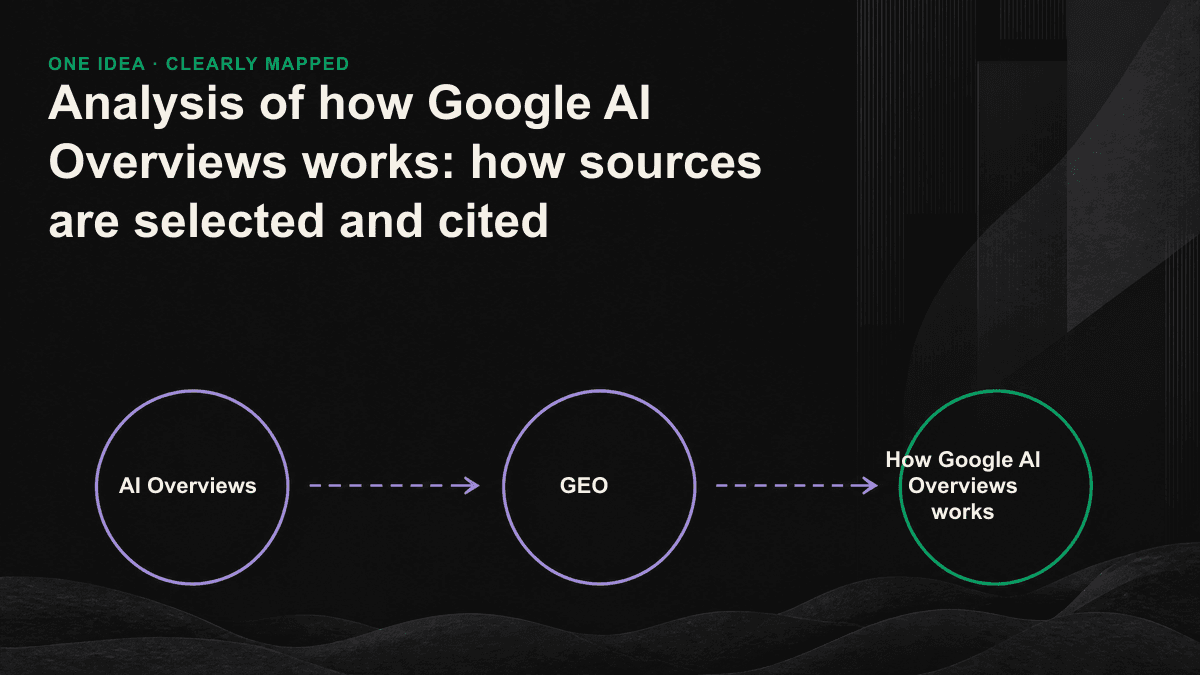
Why is it not necessarily the page that is cited that ranks first?
Traditional ranking and being cited by AI are two overlapping but not the same things. Ranking first means that the page is the most relevant overall; being cited means that a certain paragraph is most suitable for filling in a certain position in the answer and can be cross-checked with other sources. Google prefers to select passages that agree with each other and can be corroborated by each other, because this reduces the risk of the model saying the wrong thing. If your numbers or definitions are unique to the entire network and are not echoed by other sources, the model will be hesitant to adopt them.
AI Overviews does not select "the best page", but "the paragraph that can be safely placed in a certain position in the answer and is endorsed by other sources."— Tenten GEO Consultant Observation
Three things that really affect being cited in practice
When we track AI visibility for our B2B clients, we see over and over again that it’s not a metaphysics that affects the results, but a few actionable variables.
- Answer self-sufficiency: Whether each paragraph can answer a sub-question independently of the context is the threshold for whether it can be extracted.
- Factual consistency: Are the definitions, numbers, and steps on your page consistent with other credible sources in the industry? Only when they are consistent can they be easily cross-checked.
- Structural clarity: clear title hierarchy, question-and-answer paragraphs, necessary lists and tables, making it easier for the model to locate the correct fragment.
- Entity clarity: Whether brands, products, and characters have consistent naming and linkable entity information, allowing the system to confirm "who you are."
Things you can check for yourself right now
Pick three queries that you most want to be cited by AI, and actually search them on Google to see who is cited in AI Overviews and what kind of passages are cited. Look back at your page again: the same sub-question, is there a paragraph that you can use to answer it clearly without looking at the context? If not, it’s not a ranking issue, it’s a content structure issue.