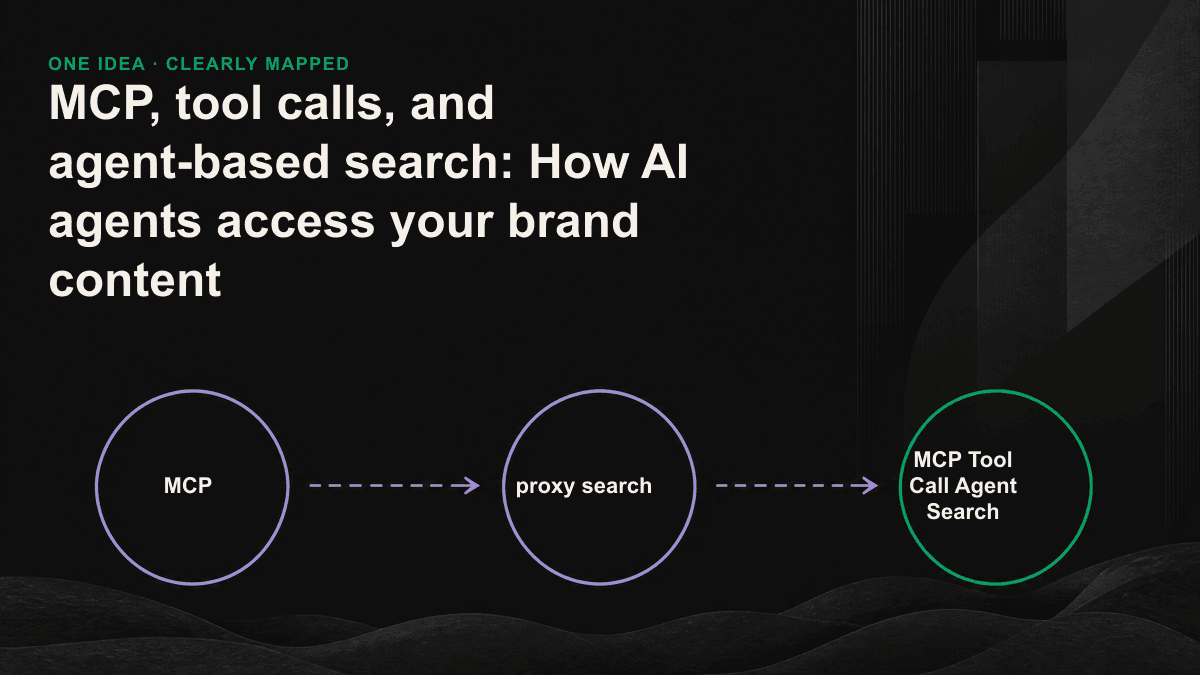
Google first crawls the entire website, builds an index, and then compares the rankings when users query. AI agents don’t work like this. After receiving the question, it temporarily decides which keywords to search and which pages to grab, and then synthesizes the answer on the spot after reading it. The answer to whether your content is included or not depends on three things: MCP, tool calls, and how agent-based search accesses it.
The cost of this transition is concrete. In the traditional ranking, there are still people who click on the eighth place; proxy searches usually only read five to ten pages at a time, and they don’t turn down after reading. Pages that are not read will not get a second chance and will not appear in citations. The question then changed from "Where am I ranked?" to "Can the machine read my page on the spot and grasp it cleanly?"
Agent-based search: Answers are assembled in the moment
The underlying methods of Perplexity, ChatGPT search, Claude, and Google's AI models are similar. When a user asks a question, the agent first splits it into several subqueries and searches them separately. After getting a batch of links, it picks out a few pages and actually reads the text, and finally combines the read content into an answer with the source. The key difference is in the timing: it reads the text captured at this moment, not the cached index a few months ago. You just modified a page yesterday. As long as you can capture it and read it clearly, it may be cited today. Even if a page is ranked very high, it will be empty when retrieved. If the agent cannot read it, it means it does not exist.
MCP: AI’s universal connector to your data
MCP is the abbreviation of Model Context Protocol, an open protocol released by Anthropic at the end of 2024. Later, OpenAI, Google, etc. also successively supported it. The problem it wants to solve is simple: in the past, every AI application that needed to connect to an external data source had to write its own set of integrations, which was expensive and difficult to maintain. MCP standardizes this matter. It plays the same role as USB-C to various devices. It has one interface and can be plugged in everywhere. You set up an MCP server and package the data and functions into a standard format that any agent that supports MCP can connect to and query.
For brands, MCP opens up a path that was not available in the past. For data that changes and requires accuracy, such as product catalogs, real-time pricing, inventory, and technical documents, you can directly open it to the agent for query through the MCP server, allowing it to read your authoritative sources instead of guessing what is written on a certain web page or quoting an old article from three months ago. When a user asks "Does this solution support a certain function" in AI, the answer can come directly from the data you maintain, instead of being relayed several times.
Tool call: The action of the agent actually reaching for the content
The language model itself is not online, and it cannot remember the price you adjusted last week. The tool calls to add this paragraph: the model outputs a structured request, such as "search this set of keywords" or "grab this URL", and sends it to the external system for execution, and then collects the results to form the answer. Searching, crawling web pages, checking APIs, and reading MCP servers are all tool calls running behind the scenes. This also determines one thing: whether your content can enter the answer, and whether it can be retrieved and parsed cleanly by a tool when it is stuck. The structure of HTML is confusing, key content has to wait for JavaScript to be loaded, important facts are only written in pictures, and when the tool retrieves it, it is often blank.
Three levels to make brand content “callable”
To enter AI’s answers, your content must pass three levels at the same time. Most brands only focus on the first level for people to see, leaving the last two levels almost blank.
- Crawlable: Key content is rendered on the server side, don’t wait for JavaScript to grow; semantic HTML, clear title hierarchy, and stable URLs that don’t jump around allow crawlers to get the text in one go.
- Parsable: Write facts such as price, specifications, applicable objects, and FAQs in plain text, and add Schema.org structured markup (FAQPage, HowTo, Product) so that the machine knows what each paragraph is about without having to guess.
- Connectable: For high-frequency and real-time queries such as pricing, inventory, and documents, consider opening an API or building a self-built MCP server so that the agent can directly read the authoritative data you maintain instead of grabbing a static snapshot of a page.
Where are most brands stuck now?
The common gap is not that the content is not good enough, but that the content is only designed for the human eye. The page looks decent to people, but when captured, it is a bunch of JavaScript to be executed; the core specifications are hidden in a PDF or interactive form; there is no structured information in the entire site; the answer to the same question can only be found by clicking on the three-level menu on the official website. The agent doesn’t have the patience to accompany you to click through the layers. It will refer to the competitor’s article that explains the problem clearly in one paragraph. The result is that you are blocked from the discussion of your own category by your own content structure. If you want to know whether AI is mentioning you now and who it is citing, using visibility tracking like Brand Radar can quantify this gap.
First make sure you are in the answer
You can't optimize an invisible gap. Before you get started, ask yourself three questions: Ask the most common question about your category on Perplexity or ChatGPT. Will the answer mention your brand? Is the referenced link your page or someone else's? Can a machine read your most important facts? If you fail to answer even one of the three questions, it means there is a specific gap in your visibility in agency-based searches. If you want to systematically find these gaps and prioritize their repairs, you can book a 30-minute GEO diagnostic session (/contact), and we will see what your content looks like in the eyes of AI.