Your keyword rankings are all on the first page, and your organic traffic is growing month by month, but a potential customer opens ChatGPT and asks "What project management software is suitable for small and medium-sized enterprises in Taiwan?", and none of the three brands listed in the answer is you - these two things can now be true at the same time. Rankings and clicks measure "where your page stands in the search results list." GEO indicators measure another thing: when AI directly generates answers, whether it counts you and how it describes you. For the same marketing performance, measuring it with the old ruler will give you a reassuring green light, but measuring it with a new ruler may give you a red light.
Where clicks disappear, the definition of effectiveness changes
The entire set of performance logic of traditional SEO is based on one assumption: users search, see a row of blue links, and click on the most relevant one. This path is being replaced by answers. Google's AI Overview will synthesize several sources into a paragraph and put it directly at the top. Perplexity and ChatGPT even omit the list of results and attach several citing sources to your conclusion. Users can get the answer and leave without having to click into your website. The higher the proportion of "zero clicks", the more distorted the world you see in terms of clicks and work stages.
Give us an actual situation we encountered. For a customer who makes HR software, the brand words and several core keywords are ranked on the first page, and the exposure and clicks on the Search Console are healthy. We threw their ten most important purchase intention questions into the ChatGPT and Perplexity tests. Seven out of ten answers did not mention the company at all, and two of the three that were mentioned misstated the product positioning. What buyers see during the initial screening is this list of "without them", and this entire process will not appear on any SEO report.
Four indicators of traditional SEO, why they started to lie
The metrics still work; they simply cover a shrinking share of the buyer journey. Put them side by side and the blind spots become clear.
- Keyword ranking: tells you the position of the page in the blue link, but does not tell you whether AI Overview has cited you. You can be ranked first, but the answer box is filled with competitors.
- Natural traffic: only counts people who click into the website, and does not see potential customers who have read your information in the AI answers but did not click in. A drop in traffic is not necessarily a drop in visibility, it could be that clicks are being eaten up by answers.
- Click-through rate (CTR): It is based on the premise that "there is a link that can be clicked", but there are no links at all in zero-click searches, and the denominator of this ratio is shrinking.
- Conversion and residence time: Only those who have entered the site are measured, and the losses of those who were "eliminated in the AI dialogue and never entered the site" are completely indifferent.
GEO Indicators: The focus of performance shifts from “ranking” to “cited”
The question GEO wants to answer has changed: not "Where am I ranked?" but "How should AI choose me when generating answers? How should I be mentioned?" One of the most core metrics along the way is citation rate: the proportion of AI responses that listed you as a source or mentioned your brand in response to a set of purchase intent questions. Citation is the GEO world ranking, and other metrics fill in the details around it. It is especially critical for B2B, because what buyers often ask AI is not a single keyword, but judgmental questions such as "Which company is suitable for my size?" "What is the difference between A and B?" The model chooses who to include in the list, which is equivalent to helping the buyer to screen first.
- Citation rate: The proportion of AI answers that quote or mention you among a set of target questions. This is the first indicator of GEO.
- Share of Voice: In the same batch of questions, the number of times you are mentioned relative to your competitors shows your relative weight in the eyes of AI.
- Answer Presence: Across ChatGPT, Perplexity, Google AI Overview, and Gemini, you appear in answers on how many platforms and how many methods of asking questions.
- Description accuracy and emotion: When the AI mentions you, does the positioning, function, and price mentioned are correct? Is the tone positive, neutral, or does it treat you as a counterexample? Being mentioned but misspoken about is sometimes more hurtful than not being mentioned at all.
- Source attribution: Is the AI citing your official website, your blog, third-party reviews or community discussions. This determines what type of content you should enhance next.
Comparison of old indicators and new indicators
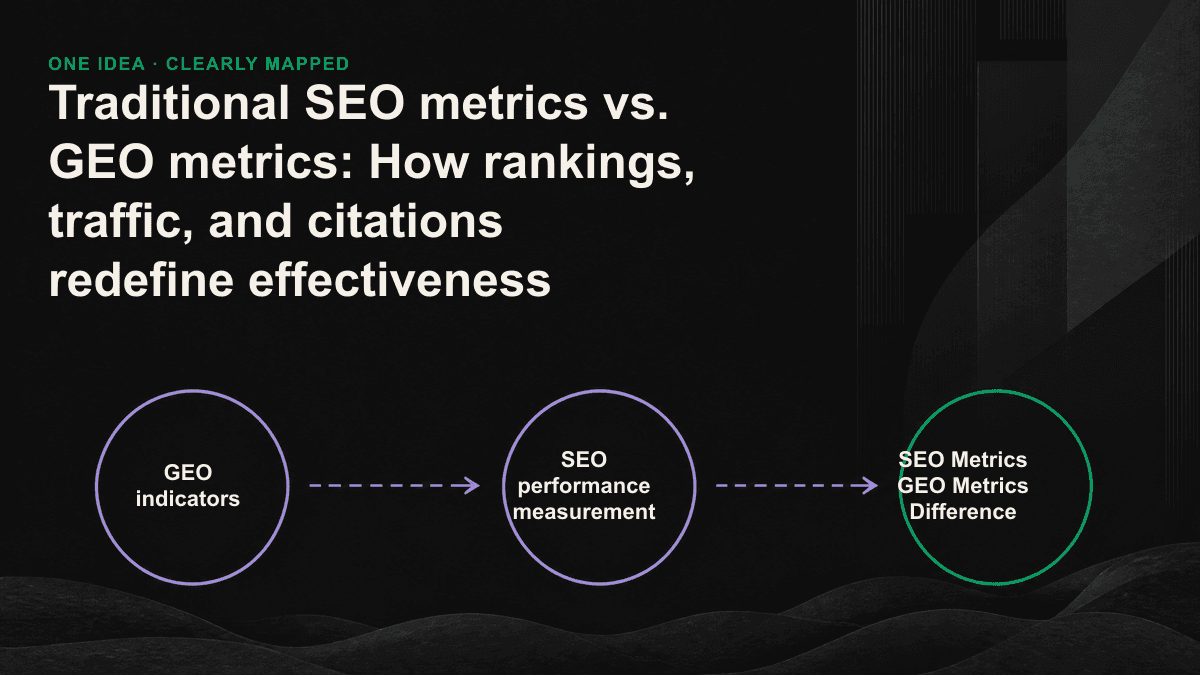
Putting the two sets of rulers together, the corresponding relationship is roughly as follows: keyword ranking corresponds to citation rate, natural traffic corresponds to answer exposure, click-through rate corresponds to voice volume ratio, and conversion rate corresponds to "high-intent inquiries brought in by AI recommendations." The difference lies in the angle of the question: the old indicator asks whether users can find me, while the new indicator asks whether AI recommends me. In the former, you rely on content and links to compete for a position. In the latter, you need the model to be able to clearly understand, trust, and correctly repeat your information.
The two sets of indicators should coexist, not replace them.
Don’t throw away your SEO dashboard in a hurry. For most B2B websites, Google’s traditional search still brings considerable traffic and listings, and rankings and organic traffic still have to be taken into consideration. The real change is that you have to set up a second set of dashboards at the same time to continuously track the citation rate, voice share and description accuracy, and retest it regularly across platforms, because the AI's answers will change with model updates and content changes. The person who quoted your question this month may be replaced next month. This is also what we use AI visibility monitoring to help clients do: turn AI visibility into a curve that can be seen every week, rather than relying on impressions that people ask once in a while.
If you only have a set of SEO reports now, the most pragmatic first step is not to rewrite the strategy, but to measure the gaps: how many times your brand has been cited and what it is said about in the questions that buyers will actually ask the AI. If you want to know where your citation rate and share of voice volume fall, you can book a 30-minute GEO diagnostic session. We will use your most important questions to test them for you, and then judge together whether the gap is worth filling.