The AI engine does not "read the entire web page and then decide whether to quote you or not." It refers to the winning bit of text that has been shredded, vectorized, and sorted for retrieval. No matter how well you write the entire article, as long as you close the team at any of these six levels, the final answer in ChatGPT, Perplexity or Google AI Overviews will be your competitors, not you.
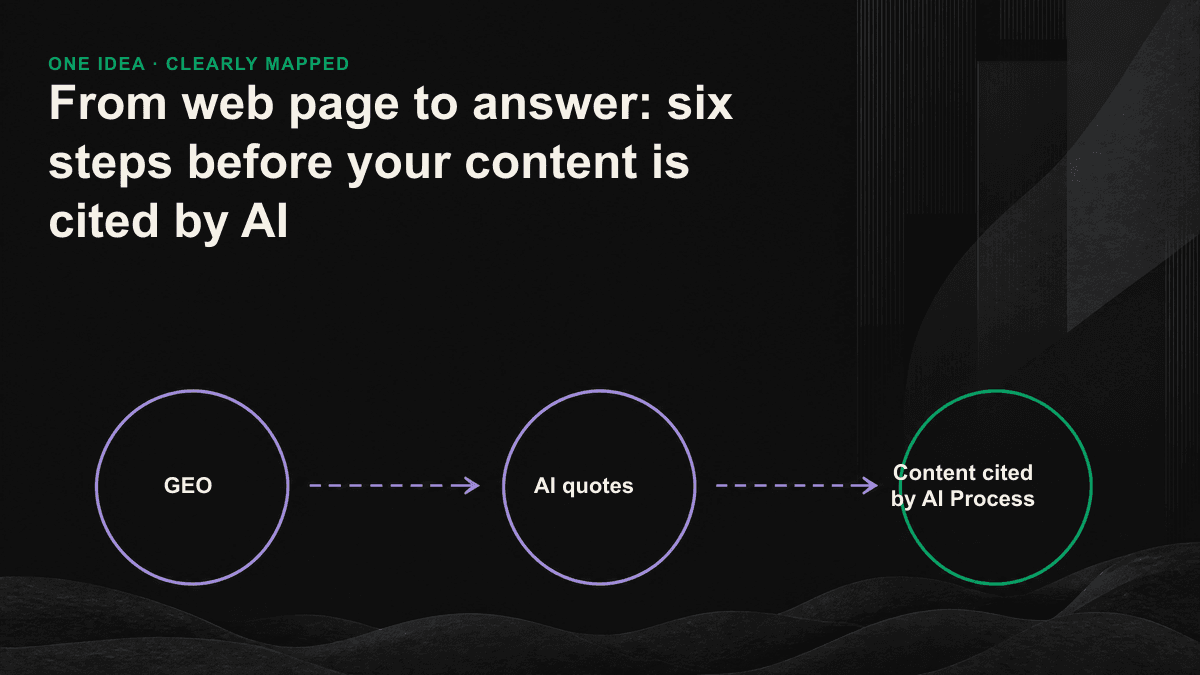
To be referenced by AI, content must first go through a fixed pipeline: crawling, parsing and chunking, vectorization and indexing, retrieval, rearrangement and filtering, and generation of annotations. Each step has a clear failure mode and corresponding optimization actions. If you take this path apart, you will find that "content is cited" is not a metaphysics, but a series of engineering issues that can be checked step by step.
The first step: capture - AI must first get your source code
It all starts with crawlers. Agents such as GPTBot, ClaudeBot, PerplexityBot, and Google-Extended will crawl your page. If not, there will be no subsequent steps. There are three most common ways to die here: robots.txt directly blocks the AI crawler, key content is rendered by front-end JavaScript and the crawler gets an empty shell, or the content is hidden in tabs and accordions that need to be clicked to expand. When we do audits for clients, the first most common gap is that the product comparison table and FAQ are dynamically loaded using JS, which is visible to the human eye, but the HTML captured by the crawler is blank.
The checking method is straightforward: save the source code of the page (not the rendered image) and search for the sentence you want to be quoted in plain text. If it can't be found, it means the AI can't get it either.
Step 2: Parsing and chunking - your article will be cut into pieces of a few hundred words
After capturing the HTML, the engine will peel off the navigation bar, footer, and advertisements, extract the main content, and then cut it into chunks. This is the most neglected but most critical level. The system will not understand your "entire argumentative structure", it will only get individual pieces of text. If the meaning of a certain paragraph depends on the first three paragraphs to establish it, it will be incomplete and cannot be quoted if it is cut out separately.
- Each paragraph is self-sufficient: one paragraph makes one thing clear, and the proposition, conditions, and figures are written in the same block, and it does not depend on the context.
- The title should be able to be used as an index: H2 and H3 directly write the questions that readers will ask, so that the block boundaries are cut at places where the semantics are complete.
- Answer prefix: Give the conclusion in the first sentence of the paragraph. Don't hide the key point after the fourth sentence - the second half may be cut off when dicing.
- Make good use of structured blocks: clear lists, tables, and defining sentences are easier to cut out and quote cleanly than long narrative paragraphs.
Step 3: Vectorization and indexing - semantics are compressed into a string of numbers
Each chunk will be converted into a set of vectors by the embedding model, which is a series of coordinates representing semantic meaning, and stored in the vector database. Contents with similar meanings are close to each other in this space. This step determines whether your paragraph will be considered relevant when users ask questions. The focus here is different from the intuition of traditional SEO: precise keyword stacking is meaningless, but semantic coverage is meaningful. You need to make all kinds of questions, synonyms, and actual usage scenarios of a topic appear in the content, so that the vector will fall in the right position.
Step 4: Search: Your paragraph needs to be shortlisted
When the user asks a question, the engine converts the question into a vector and retrieves a batch of chunks with the closest semantic meaning from the index. This is the retrieval link of RAG (Retrieval Enhancement Generation). Most systems run vector retrieval and keyword retrieval at the same time and then merge them, so both precise terminology and semantic coverage must be taken into consideration. In practice, the candidates picked out are usually dozens of paragraphs. Your content must be included in this shortlist before you have a chance later. I can’t get into the list, and no matter how beautifully written the model is, I can’t see it.
Step 5: Rearrange and filter - select a few paragraphs from the candidates that will actually be read
The candidate list will go through another round of reranking, and the system evaluates which paragraphs can best answer the current question, leaving only the top few paragraphs to feed the generative model. This level compares "how direct and credible the answer is in this passage." Authoritative signals come into play here: clear author and professional background, verifiable specific figures and sources, clear last updated date, and paragraphs that are highly aligned with the issue. Vague, ambiguous attribution, and random content will be deleted here.
Ranking in the top ten is no longer the end point. The real battlefield is whether your piece of text has been selected by the rearrangement model into the three to five blocks that are finally fed to the generation model.— Tenten GEO Audit Team
Step 6: Generation and annotation - the model rewrites your paragraphs and decides whether to attach your links
Finally, the generative model writes an answer based on the selected paragraphs and determines the sources to cite. It does not copy verbatim, but rewrites and synthesizes. Whether you can get that linked citation annotation depends on whether your paragraph is clear enough for the model to "confidently attribute this claim to you." A sentence with a complete structure, specific figures, and can be independently established is easier to be picked out and quoted than a whole paragraph of gorgeous elaboration. This is why the same topic, written in different ways, can be cited several times differently.
What this means for your content strategy
Traditional SEO optimizes "the ranking of the entire page for the entire keyword"; GEO optimizes "the probability of winning a single paragraph for a single question, retrieval and re-ranking". The granularity is completely different. You are no longer just writing a good article, you are writing a set of paragraphs that can be extracted, stand on their own, and can be quoted. If you go back and check the same piece of content using these six steps, you can usually find three to five specific loopholes that originally got you eliminated.
If you want to know at which level your content is stuck and what the AI engine actually captured and cited, you can book a 30-minute GEO diagnostic session. We will use AI visibility monitoring to track your visibility in various AI engines, and then compare these six steps to point out the gaps that should be filled first.