Your next B2B customer will most likely have asked in ChatGPT "What manufacturers do this in Taiwan" before clicking into your website, and then got a list of three to five companies. If you’re not on the list, you won’t even notice that you lost the round: the comparison won’t generate any traffic to the site, and you’ll see nothing in your analytics tools.
This is not a prediction. When working on projects for SaaS and B2B customers in Taiwan over the past year, we repeatedly encountered the same scenario: the company's organic search traffic remained flat or even dropped slightly, but new customers increasingly said "I asked ChatGPT first, and it recommended a few, and you are one of them" during the first call. The starting point for buyers to collect information is moving, but the marketing dashboards of most brands are still stuck on the old map.
The first stop for buyers to purchase has quietly changed.
The first step in traditional B2B procurement is to open Google and search "XX system recommendation" and "XX service comparison", and then compare back and forth between the search results, review articles, Dcard and community discussions. This habit has not disappeared, it just has a faster entrance. When the person in charge of procurement has limited time and is too lazy to spell out the answer from the ten blue links himself, he will ask the AI: "I am an e-commerce company and want to find a subscription management tool in Taiwan that can transfer money and open APIs. What are my options?" 』After a few seconds, a compiled list with pros and cons came out.
The focus is on the back. When a purchaser gets a list, he usually does not click on every one. He will only pick one or two from the three to five names that the AI has screened and summarized for him to learn more about. Whether AI can be included in that list is almost equivalent to whether it can be squeezed into the candidate circle of this business. Brands that are not included are not even qualified to be compared.
The illusion that traffic has not increased but business is running away
AI answers directly in the dialog box, and the user leaves when satisfied without necessarily clicking into any source. This is zero-click. To your website analytics tools, this interaction never happened: no visit, no time spent, no conversion recorded. As a result, two opposite but equally dangerous illusions will develop. The first type is that the traffic is slowly declining. You think it is the off-season or the algorithm fluctuates, but it is actually because buyers ask AI instead and AI does not recommend you. The second one is even more counterintuitive: for some brands, the traffic to the site is declining, but the number of transactions is increasing, because the people recommended by AI have clearer intentions and are closer to placing an order. For the first time, traffic and revenue are so clearly decoupled. If you still regard "traffic growth" as the only health indicator, you will make a wrong judgment in both situations. Instead of focusing on traffic, look at the following three signals.
- Mention rate: In relevant purchasing questions, does your brand appear in the AI’s answers?
- Recommendation rate - being mentioned and being put on the shortlist of "recommended for consideration".
- Citations: Whether the AI links to your page and treats you as a credible source of support.
The B2B decision-making chain is naturally suitable for AI to take over the front end.
Why is B2B procurement so easily blocked by AI? Because its preliminary homework is heavy and complicated. An enterprise purchase often involves multiple decision-makers, who have to compare functions and prices, see if there are any successful cases in the same industry, and confirm compliance and system integration conditions. These are exactly what language models are best at: gathering and aligning data scattered everywhere into a readable comparison table.
In the past, buyers had to spend two or three hours doing the initial screening, but now AI can provide a draft in a few minutes. It is efficiency for buyers, but it is a new gatekeeping barrier for suppliers. No matter how beautiful the official website is, as long as the AI cannot catch you when compiling this summary, cannot understand what problem you are solving, and cannot find specific facts to cite, you will not appear on that table. The decision-making power has moved from "will the user click in" to "can the AI understand you when reading the information?"
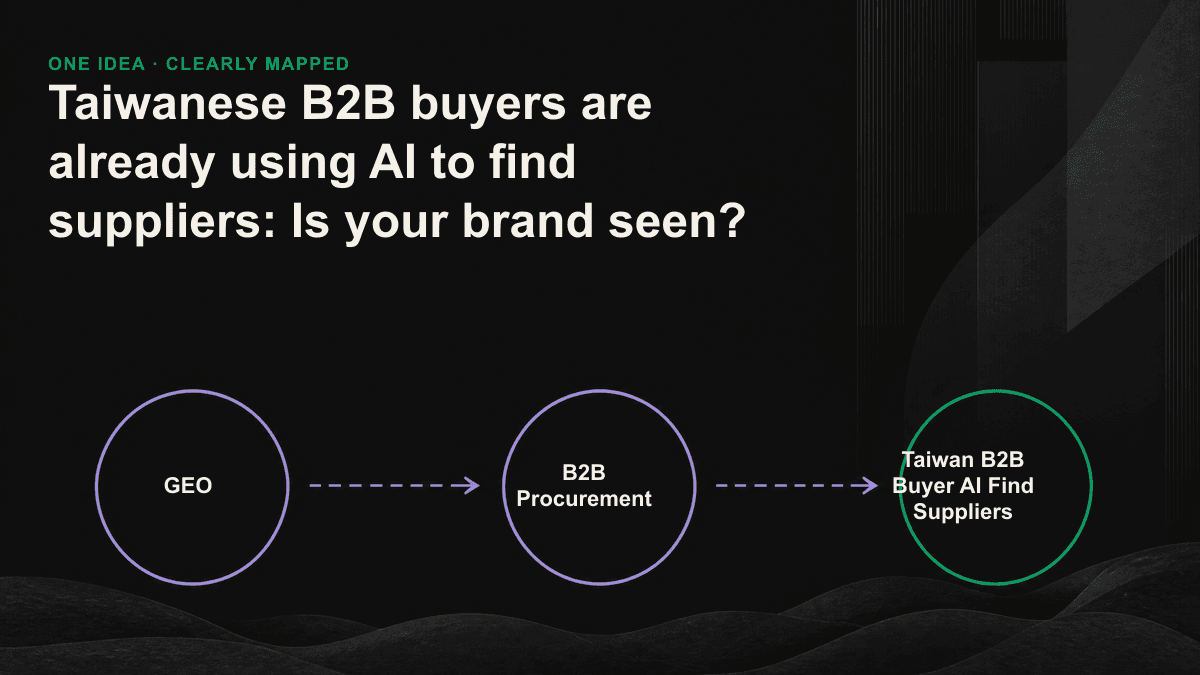
Don't believe me, ask yourself
The best way to verify this is to take five minutes to run it yourself. Open ChatGPT or Perplexity and ask a question in the tone your ideal customer would use, such as "What are the B2B vendors in Taiwan that provide XX and are suitable for medium-sized manufacturing industries?" 』Look to see if you are included in the answer, if there are any competing products of yours, whether the AI’s description of you is accurate, and whose page it cites. By changing your questions and trying a few more engines, you will soon be able to draw a map of your own visibility in the AI world.
Being seen by AI is different from being found by Google
Some people may think that if I do a good job in SEO, AI will naturally be able to read me. It's the right direction, but it's not enough. When AI selects sources, it looks at keyword rankings and cares about whether your content can cleanly extract a fact, whether the brand narrative is consistent on different websites, and whether there is a third party to endorse your statement. Google may reward an article that is filled with keywords for ranking but without a clear stance, but the AI will not know which sentence to quote after reading it. Our starting point for client projects is to use a batch of questions that are close to real purchasing situations to measure the mention rate and citation rate of the brand in the six major AI engines, and find out the gaps that "should appear but do not appear" - this is the question that GEO audits must answer first: given your category, can AI see you now?
In a world where AI helps buyers make lists, if it’s not included in the answer, it’s as if it doesn’t exist. You won’t receive a “you were unsuccessful” notification, business just flows quietly to the people on the list.— Tenten GEO
Three things to do now
If that five-minute test makes you a little uneasy, don’t rush into a major website overhaul just yet. First, list your three to five core procurement questions, ask the AI one by one, and write down the current situation. Second, check whether the official website has written "What problems do you solve, who do you serve, and how do you differ from others?" into clear paragraphs that can be used by AI, instead of being buried in beautiful marketing words. Third, find at least one place where the AI obviously made a mistake or missed you, and prioritize adding facts that can be quoted. You can start these three things by yourself; if you want to see the whole picture faster - how much your brand is seen in the six major AI engines, where are the gaps, and which piece should be filled first - you can book a 30-minute GEO diagnostic session, and we will walk you through it with your real purchasing questions. The buyer is already asking the AI. What you can decide is whether the AI can tell you your name when it answers.