The biggest advantage of Traditional Chinese content in AI search is not that it is written better than others, but that no one is writing it seriously at all. When ChatGPT, Perplexity or Google’s AI Overviews want to answer a B2B question with a Taiwanese context, there are actually very few clean Traditional Chinese sources that they can cite. This vacancy is the reference position that Taiwanese brands can now grab at a low cost.
Traditional Chinese is a thin layer in AI training corpus
Most of the Chinese that large language models eat is Simplified Chinese. There are approximately 23 million people in Taiwan who speak Traditional Chinese. Together with Hong Kong and overseas Chinese communities, the overall volume is far smaller than the content output of the Simplified world. Reflected on the training corpus, after the three layers of filters of "Traditional Chinese characters", "Taiwan context" and "specific industries" are stacked together, only a small amount of content is left. It’s not that the model can’t read Traditional Chinese. The problem is that the density of Taiwanese professional content it has read is too low, when it encounters a sufficiently specialized topic, it doesn’t actually have a few decent reference materials on hand.
This thinness is not felt at all on consumer or general topics. Ask "How to cook a bowl of beef noodles", there is so much information available, and the AI can answer it clearly. But if the questions are changed to "Taiwan's SaaS subscription system, how to issue invoices and business taxes" and "What should we pay attention to in data protection clauses when importing B2B software into contracts?", the authoritative Traditional Chinese sources that can be cited quickly collapse. The pattern is clear: the more specialized the industry, the stronger the geographical context, and the more local practical knowledge is needed, the greater the gap in traditional Chinese content. These are questions that B2B buyers will definitely ask before making a decision.
When AI answers questions about Taiwan, it often “borrows” from the wrong source
When there are insufficient sources, the AI engine will not give you a blank, it will find substitutes to fill it in. This is exactly the gap that Taiwanese brands should keep an eye on. When we do visibility tracking for clients, we repeatedly see several predictable inaccuracies:
- I directly changed the source to Simplified Chinese and copied the terminology - "software", "video", "network" and "database" popped up in the answer. You can tell at a glance that it is not written for Taiwanese users.
- Applying mainland China's regulations, cash flow mechanisms or market practices to answer Taiwan's business problems, the details are completely misplaced, but the explanation is very confident.
- Return to the English source for real-time translation. The terminology is blunt and there are zero local cases. It reads like an operation manual translated by a machine.
- By conflating the Traditional and Chinese contents of Hong Kong or Singapore and Malaysia, prices, access, and compliance standards are all incompatible with the actual situation in Taiwan.
For the user, this is a poor experience; for the brand, this is a wasted opportunity that was not named. The absence of you in the answers generated by AI means that before the buyer clicks into your website or even hears about you, you are no longer in his initial understanding of "who to contact for this question." This is more dangerous than the ranking falling to the second page, because many people will stop searching after reading the zero-click answer.
Scarcity is Opportunity: Quoting the Arithmetic of Shares
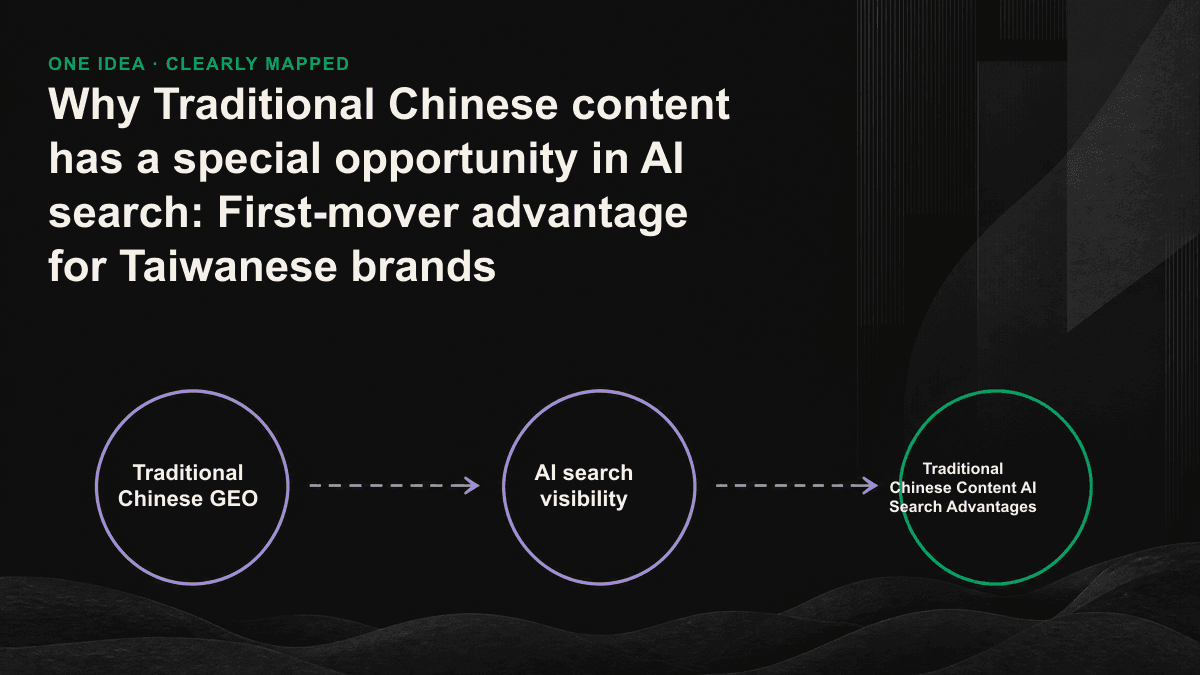
Traditional SEO is to compete with thousands of web pages to grab the ten blue links on the first page. Traditional Chinese GEO is exactly on the opposite side: on a sufficiently specialized topic, the number of sources that can be cited cleanly may only be in single digits. When the number of candidate sources drops from 10,000 to five, as long as you make the content right and ensure that the entire paragraph can be extracted, the probability of being cited will jump by an order of magnitude instead of staying the same by a few percentage points. The same force is used to focus on scarce problems, but the leverage is completely different.
Three things Taiwan B2B brands should do now
First-mover advantage will not come to your door by itself. It only rewards those who get the basics right first. For Taiwan B2B brands, there are three areas of focus that can be started immediately:
- Use Taiwanese language to write Taiwanese answers. The terminology, regulations, financial flows, and local cases must all be correct, so that the model has no reason to jump to Simplified or English sources. This is the first step in turning a gap into an advantage.
- Write the content into a shape that can be extracted. Only answer one question per paragraph, put the conclusion first, and give specific numbers and situations, so that AI can cleanly quote you in the entire paragraph, instead of breaking your sentences into pieces and piecing them together with others.
- Measure your appearance in AI answers. You must be able to track whether you were named on ChatGPT and Perplexity, what was said when you were named, and which competitors are standing next to you, so as to know whether the content is actually stuck in the reference position.
The third point is most often skipped, but it is the most critical. Content online does not mean it is quoted, there is a black box in between. When we do AI visibility monitoring visibility tracking, we open up this black box - we ask each AI engine the questions that buyers will actually ask, and record whether the brand has been mentioned, how it was mentioned, and who is standing next to it. Without this layer of measurement, you are writing content with your eyes closed, and you don’t know whether it hit the mark after writing.
This time window will not stay open forever
Scarcity is temporary. Taiwanese companies' awareness of GEO is rising rapidly. Once more brands begin to seriously produce structured Traditional Chinese content, this "almost no one competes" topic will be filled one by one. The brand that gets stuck in the AI citation position first will accumulate the model's familiarity with it along the way - the more it is cited, the easier it will be to be cited next time. The latecomers often have to use several times the amount of content and a longer period of time to recover this kind of compound interest from the first movers.
Rather than waiting for the market to mature before entering the market, it is better to occupy the position while the vacancy is still open. If you want to know whether your brand has been mentioned when the same buyers ask questions on the AI engine, and where the gap is, you can book a 30-minute GEO diagnostic session. We will take real problems in your industry and run a test to show you on the spot.