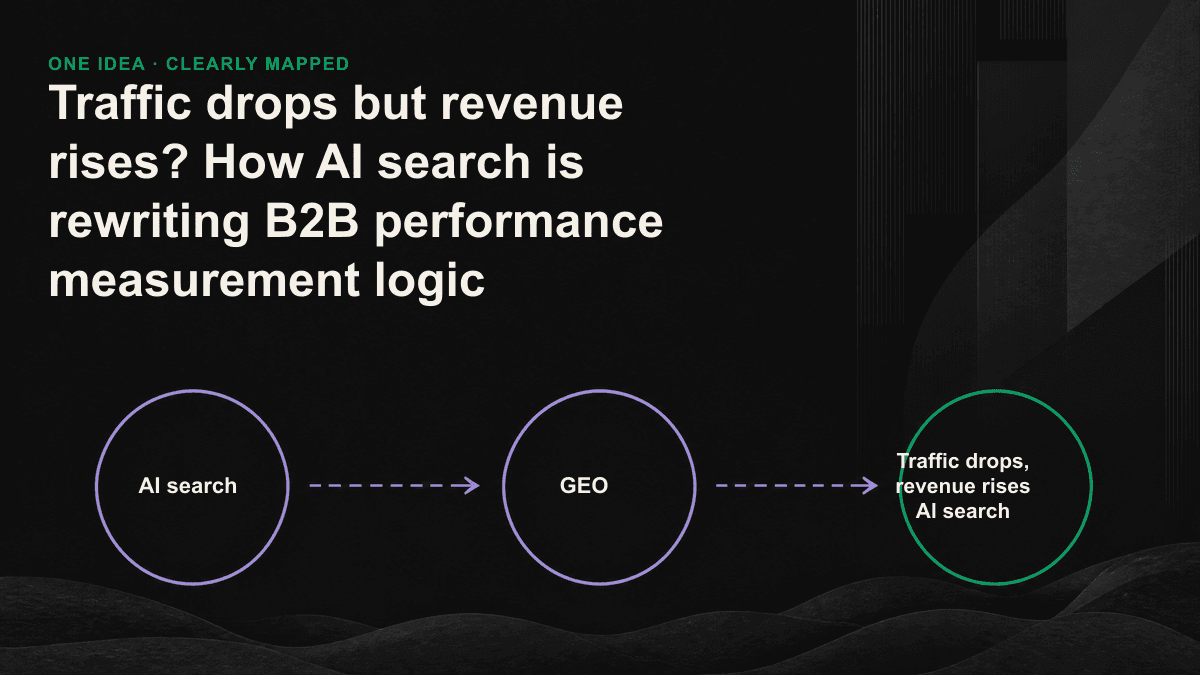
The traffic dropped by 20%, but the number of transactions was more than last year. This is not because the report is wrong, but because the front part of your funnel has been taken over by AI search. Buyers have done their homework in ChatGPT, Perplexity, and Google AI Overviews. By the time they actually click on your website, they are often already ready to talk. The number of sessions becomes fewer, but the quality of each person who comes in is higher. These are the two divergence curves that many B2B teams are now staring at at the same time.
Why traffic and revenue began to decouple
Over the past decade, we have assumed one thing: more traffic equals more business opportunities. This equation holds true in an era when keyword ranking determines everything, because users have to click on a link to get the answer, so traffic is almost equal to attention. Now there is an extra layer in the middle. The AI engine first reads a dozen sources for the user, organizes it into an answer and presents it directly in the dialog box. The user gets the conclusion without having to visit those websites one by one. Clicking this action changes from "the only way to obtain information" to "a choice you make only when you want to go deeper."
As a result, your content is still doing its job, it just happens outside of your website. It has been included in AI’s answers, included in recommendation lists, and used to answer questions like “What are these tools?” These impressions won’t show up in your Google Analytics, but they will actually push buyers towards you. What you see is that the traffic is dropping, but what you can’t see is that the same batch of content is working for you elsewhere.
Why old indicators start lying to you
If you still treat organic traffic as your only health metric, AI search will make your dashboard read like a decline this year. The problem isn't the business, it's that you measured the wrong thing. Some of the most reliable numbers in the past are now the most misleading:
- Number of natural sessions: AI answers intercept information-based queries, taking away a group of people who would never convert in the first place. When sessions are lost, the quality of inbound business opportunities increases instead.
- Keyword ranking: You may be ranked third, but AI Overviews has taken up the first screen, and the truly cited source is the new “number one”.
- Bounce rate and dwell time: fewer people are entering the site but more accurate. The meaning of these two numbers is completely different from what it was three years ago.
- Last-click attribution: The buyer gets to know you in the AI conversation, is persuaded outside your website, and finally directly searches for the brand name and enters the website to make a deal. All credit is given to the "brand's natural traffic", and the contribution of AI is completely invisible.
Which part of the funnel does AI search take over?
To sum it up in one sentence: AI has taken over the “research and preliminary screening”, which is the segment at the top of the traditional funnel that consumes the most traffic but is least likely to make a deal on the spot. In the past, a B2B buyer had to compare five suppliers and might visit 20 or 30 pages and open a bunch of paginations; now he asks the AI "What are the X tools suitable for medium-sized SaaS and what are their strengths?" and gets a candidate list and a comparison of advantages and disadvantages in one go. Those twenty or thirty visits will no longer enter anyone's traffic report.
B2B SaaS Particularly Obvious Reasons
B2B SaaS has a long procurement cycle, decision-making is completed by a committee, and the process is highly dependent on data checking. These three characteristics just magnify the impact of AI search. A project may span several months from the first contact to the signing of the contract. In the middle, it will be handled by the technical director, finance, and actual use team. Each role will ask AI independently. Whether you are included in the answers they ask and where you are placed determine whether you will be brought to the table for internal discussions. By the time someone actually clicks on the official website to look at the pricing and clicks to reserve a demo, the decision-making process has actually been more than half completed. The visit on your website is just the tip of the iceberg.
Look at these performance indicators instead
The measurement method should be moved along with the displacement of the funnel. Instead of staring at the total traffic, it is better to ask a more accurate question: During the period when buyers use AI to do homework, did I show up and did I show up well enough? The following indicators are closer to the current real results:
- AI citation and mention rate: The proportion of your brand being mentioned and cited when answering questions in your category on ChatGPT, Perplexity, and Gemini.
- Positioning in AI answers: Whether you are regarded as the first choice recommendation or a foil at the end of the list, the tone and ranking must be looked at together.
- The quality of the brand’s natural traffic: more people are searching for the brand name directly and reaching the pricing or contact page faster. This usually means that the AI has already warmed up the site for you.
- Assisted conversion and self-reward: Ask "How did you first know us" in the closing interview, and AI recommendations will start to appear in the answers, which is the most honest signal.
- Coverage of cited content: Which of your pages are being used by AI, and which high-value issues do not yet have your voice.
How to establish a set of measurement methods that can keep up
The first step is not to change tools, but to accept that traffic is no longer the protagonist. Split the dashboard into two layers: one layer still looks at website behavior, such as transactions, demo reservations, and brand search volume; the other layer is dedicated to tracking AI visibility, that is, how you are mentioned and quoted in major engines when answering category questions. Comparing the two levels, the superficial contradiction of "traffic drops, revenue rises" can be explained. Tenten GEO's AI visibility monitoring complements the second layer. It constantly monitors your visibility changes under different AI engines and different key issues, and spreads out the half of the battlefield that cannot be seen in traffic reports.
Don’t rush to cut your content budget just because the traffic graph is going down. When that line drops, it’s probably evidence that AI is starting to do the early convincing for you. What's really dangerous is another situation: traffic is dropping, and you can't be found in the AI answers at all. If you want to know whether your brand is recommended, ignored, or overshadowed by competing products in AI searches, you can book a 30-minute GEO diagnostic session. We will run a test using actual problems in your category and point out the gaps to you.