AI visibility does not measure your ranking on Google, but whether ChatGPT, Perplexity, and Google AI Overviews will actively mention you, quote you, and list you as a trustworthy source when answering user questions. Ranking No. 1 but completely disappearing from AI answers is something that happens every day now, and most brands don’t even know they’ve disappeared.
What is AI visibility really about?
AI visibility (AI Visibility) refers to the degree to which a brand, product or content is retrieved, cited and recommended in the process of generating answers by a large language model. Traditional searches return a string of blue links, and users can click on them to compare. AI answers directly synthesize the conclusions and give them to the users, and most people leave after reading that paragraph. Whether your content has entered the synthesized answer determines whether you still exist in the user's decision-making vision.
It is not a number, but the result of three layers stacked up. The first level is whether the AI knows you, that is, whether you have entered its training data and real-time search index. The second level is whether the AI mentions you, that is, whether you will be recalled when relevant questions are asked. The third level is how the AI describes you, whether the quote is correct or not, and whether the tone is positive or vague. Only when all three floors are connected can we really have visibility.
Why AI visibility and search ranking are two different things
SEO pursues links to be clicked, while AI visibility pursues content to be synthesized into answers. The mechanisms of the two are different. When the AI engine answers a question, it will first break the question into semantic fragments, retrieve the paragraph that it thinks can best answer the question directly, and then reassemble it into a paragraph. It does not pick the brand with the highest domain authority, but the content that best answers this sentence. Therefore, a brand with a high DR, if the content is convoluted and the conclusion is buried in the fifth paragraph, is likely to lose to a small website that puts the answer in the first sentence.
- Ranking depends on domain authority and external links; AI visibility depends on whether a single paragraph can independently explain the problem clearly.
- The ranking results are relatively stable and can be tracked for a long time; the source of AI answers may change every time they are generated, and the same question will be asked three times and there will be three sets of answers.
- Ranking directs traffic back to your website; AI visibility is often zero-click, and users will remember your name in the answer and may not necessarily click in.
- Ranking can rely on technology and external links; AI visibility depends more on the clarity, structure and fact density of the content itself.
What constitutes AI visibility?
Taking it apart, whether a brand can be stably referenced by AI depends on several factors that are independent of each other and add to each other. You can't just do one of these and expect to be cited, but as long as one is noticeably missing, overall visibility will be held back.
- Searchable structure: clear title hierarchy, each paragraph is self-contained, and questions and answers are taped together so that searchers can cleanly cut out quotable snippets.
- Fact Density and Concreteness: Paragraphs with numbers, definitions, and clear claims are easier to recall than paragraphs with stacked adjectives.
- Semantic coverage: Focusing on a topic, write all the possible questions that users may have, rather than just focusing on one keyword.
- Third-party evidence: If your name appears in other people's reviews, lists, and discussions, AI will regard this as a signal of credibility.
- Structured data and machine readability: Schema, FAQ markup, clean HTML to reduce the chance of AI misreading your content.
How to measure AI visibility
You can’t see AI visibility in Search Console, you have to ask. The method is to list the purchase decision-making questions that users will really ask into a fixed set of prompts, and regularly ask ChatGPT, Perplexity, Gemini and AI Overviews. Each time, three things are recorded: whether you are mentioned, the order in which you are mentioned, and whether the description of you is correct. After running for a few weeks, the baseline and trends will emerge, and you will know which changes are really effective.
This is what GEO wants to achieve
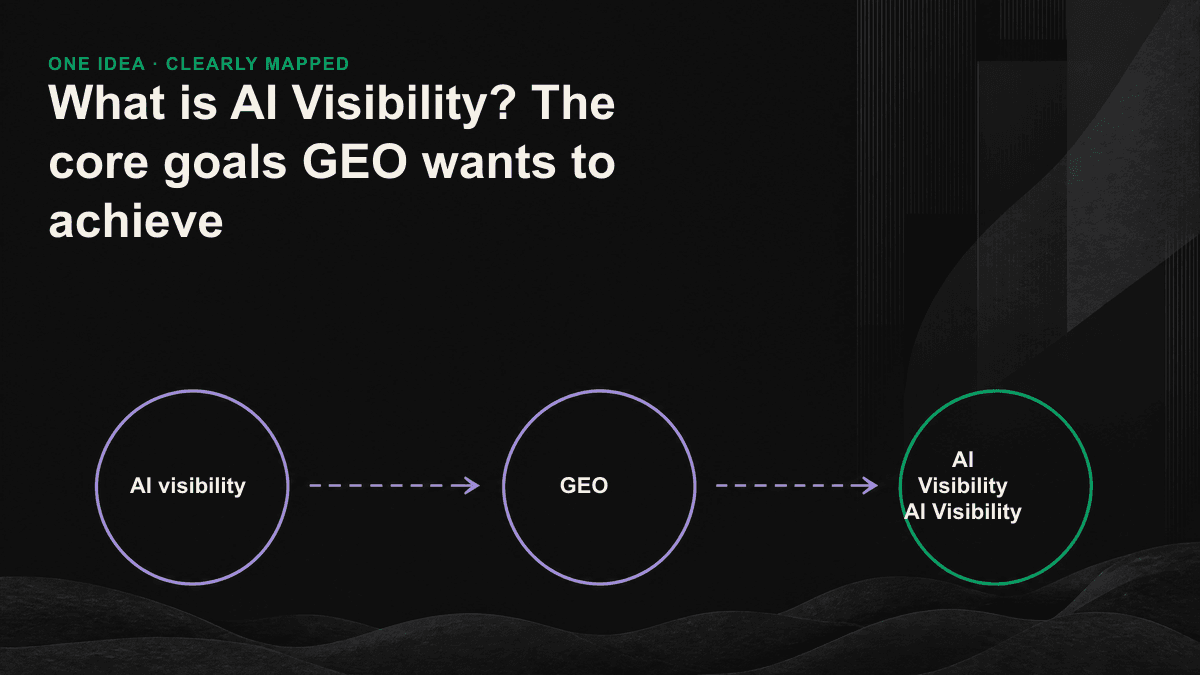
Ultimately, all actions in GEO (Generative Engine Optimization) lead to the same goal: increasing AI visibility. What the content engine does is to rewrite your expertise into fragments that AI can cleanly quote; what the GEO audit does is to find out which issues you are currently overshadowed by competing products; what Brand Radar does is to make the entire process numerically acceptable. The point here is not to please the algorithm, but to have your name happen to be present at the moment when the user uses AI to make a decision.
First figure out how many times you have been mentioned now
The problem for most brands is not that they don’t take AI visibility seriously, but that they simply don’t know what their numbers are now. You can do one thing yourself first: ask ChatGPT and Perplexity the five most important purchasing decision questions and see who they mention and whether they mention you. If it doesn't happen even once, that's a gap. If you want to do this more completely and get an executable list, you can [book a 30-minute GEO diagnostic session](/contact). We will run a test with your brand and tell you which problems do not currently exist.