If the budget is only enough to stabilize an AI engine to be quoted, that engine is probably not Gemini, or Copilot. As a result, most of the Taiwan teams have allocated resources to an average of five engines, each of which has been stopped "sometimes mentioned." AI, you don't have to feel it. It can be calculated in a matrix. First figure out which engine users are close to your deal, then press 70%.
One thing first: you don't have the resources to do five engines at the same time.
Moving from near-zero visibility to appearing consistently in an engine's answers takes a body of well-structured, extractable content, not a few title changes. Each engine also selects sources differently. ChatGPT favors pages with clear answers and self-contained passages. Perplexity cites sources frequently and responds well to fresh, specific, verifiable material. Google AI Overviews draws heavily from pages that already perform in organic search. Gemini and Copilot still have relatively limited reach for Taiwan B2B queries. One article rarely satisfies every engine equally well.
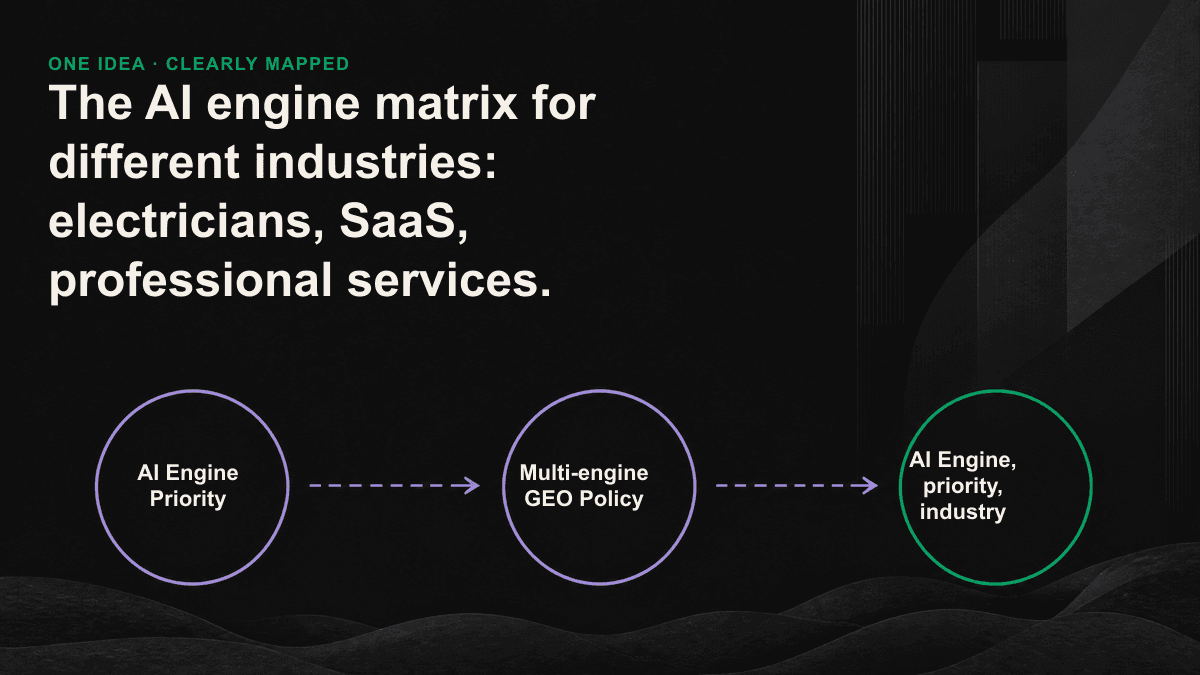
So when we do the GEO audit for our clients, the first step is not to list all the engines, but to ask two questions: When your buyer makes the decision, which engine is it? How powerful is the engine to direct the users to a deal? These two questions are the two axes of the priority matrix.
How do you draw the two axes of the priority matrix?
The axis is "Query": your target buyer is on a shopping trip, actually opening up an engine and entering a problem. Even though the axis is "terminator's distance": how far is the user from paying for the engine after it was quoted? An engine, even if it's high-flowing, if its answer is only to defend religious curiosity and to leave after the user has read it, it's worth less to you than an engine with a small flow, but every queryer is serious about the price. The five or six engines in your hand are scoring the two axes, which you should have done first.
- Rate of actual use of the engine by the target buyer: source of customer service, business returns, referral from the back of the website.
- In your class query, will the engine name the specific brand or product directly?
- After being quoted, the user will click on your website or will stop on the answer page?
- Whether or not the engine's answer is attached to the source link (Perplexity almost all attached, ChatGPT depending on the circumstances)
- How far does your existing content asset fit with the engine's preferred format?
Ecommerce: First attack the shopping engine. Answer
The buyer's journey is short, and inquiries are often carried directly with the intent to buy. Some ask "the best dehumidifier within 30,000" that the engine directly lists the items and compares, and that this query is very close. So the first position of the ecommerce is Google AI Overviews, which at the same time eats a general query and shopping module; ChatGPT's recommendations, comparative queries are closely followed; and Perplexity is suitable for routine verification and box opening problems. If you have a large access route, the AI assistant on the platform (e.g. the Rufus of Amazon) has important rights up because the user there is already on the shopping cart.
- First inch: Google AI Overviews, general query and double over
- Second inch: ChatGPT, recommendation and comparison questions
- Third order: Perplexity, with routine checks, boxes and evaluation queries
- By Luga code: You have a platform on board, on the site AI Assistant
SaaS: ChatGPT and Perplexity are home
The buyer of B2B SaaS is in the evaluation phase, used to use the AI engine as a consultant. They will ask ChatGPT, "What's the project management software for the 10-person team?" and use it to find out what's the difference between Notion and ClickUp and ask for a source. These two engines are particularly expensive for content with clear comparisons, price fixing, integration lists, and real use situations, which are the most appropriate part of the SaaS network. Google AI Overviews continues to be important in branding and teaching-type inquiries, ranking third; as for Gemini and Copilot, unless your buyers stay in Google Workspace or Microsoft in large numbers, do not rush to invest.
In other words, if SaaS is to feed the main field engine, it is possible to get a clean comparative table, a transparent price statement, a complete integration list, and a clear picture of who fits and who doesn't. Once these contents are in place, ChatGPT and Perplexity will have a significantly higher chance of quoting you in a related query than a competition that only sells labels.
Professional service: Trust queries, engine combinations and a new set
Professional services such as law, accounting, consulting, medical care, and so on, the buyer’s question itself carries the risk costs. He asked for more than an answer, but whether he could believe it. In this query, ChatGPT and Google AI Overviews are the main points of exposure, while Perplexity, because each response is linked to the source, has a particularly strong impact on buyers who need to identify their expertise. It's decided that you won't be quoted, and it's often not the keyword density, but the author.
Most common error: mix engine with content format
When many teams heard that the engine had to be prioritized, they thought they had to write a set of contents for each engine, so they broke the budget into five pieces and each one didn't go deep. In fact, a well-structured, self-contained, cleanly extracted content would have served many engines at the same time. What you really decide in the first place is whose type of query type design and paragraph structure you start with: the ecommerce starts with a comparable price structure, SaaS supplements the comparison and pricing, and professional services strengthen authors and cases. The base level of content is the same set of quality standards, different from which one you take care of first.
The engine changes, rankings move, but the sequence of "terminating distance, redistributing power" is not over. To know what kind of engine you're dealing with, what kind of engine you're being quoted to now, we're going to run your real quality check-up, and we're going to tell you the difference between the engine and the content.