If only one pointer determines the AI traffic, do not click on the referral point. The B2B buyer in Taiwan sees you in the AI answer, remembers you, calls directly or fills out the forms a few days later, which is much higher than he is now connecting to the answer point. The transfer flow is the tip of the iceberg, and it's really a trade, is it the engine that tells you in the answer?
Referral traffic is less than AI visibility
Most AI answers produce zero clicks. A user can read the synthesized answer, remember a brand, and never open a link. In GA4, referrals from chatgpt.com and perplexity.ai often represent only a small percentage of total traffic, making it easy to conclude that AI contributes nothing. That conclusion is usually wrong. A buyer may ask ChatGPT for B2B GEO agencies in Taiwan, note your name, and search for the brand two days later. Analytics records that visit as branded search or direct traffic, so AI receives no credit. The click did not happen during the answer, but the influence was real.
So "what engine to throw" can't just read the report. There are two things that should be asked: which engine will actually send the buyer to my website and which engine, if not traffic, will endorse me. The former looks at the transfer, the latter at the reference. Once quoted, it may affect a decision-maker who has not yet been hit, but is comparing to the supplier.
Taiwan, B2B, the engine that really touches.
It's pointless to list every AI tool in the world, only those with physical contact points for Taiwan B2B. User base numbers, interfaces, and buyers' practical usage habits determine their respective weight in your strategy.
- ChatGPT: Taiwan's largest user base AI assistant, built-in search will capture the web page with its source, which is the main source of reference that can be accessed.
- Google AI Overviews and AI Mode: At the top of your original SEO search, touch the widest, but click zero.
- Perplexity: Place the source of the reference in the most visible position, with a high number of hits in the single session, mostly for research and technical buyers.
- Microsoft Copilot: In Microsoft 365 and Edge, users within the industry meet, in small numbers, but in decision-making.
- Gemini and Claude: The situation for direct dialogue with suppliers is increasing, with fewer hits of traffic, but with a plastic buyer's candidate list.
Transmission of engines: Who actually sent people to your website?
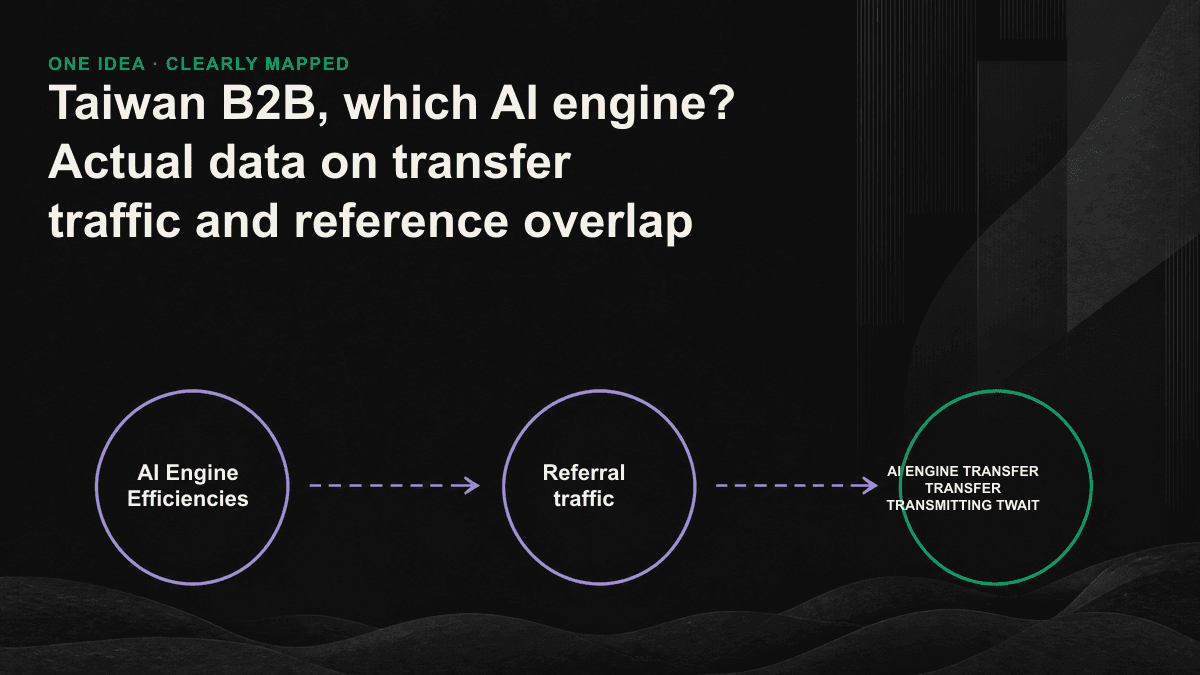
In our pursuit of Taiwan's B2B site, the AI engine brought a clickable referral in a fairly consistent order. ChatGPT is clearly top of the list because of its large user base, which is the only source link attached to the built-in search. After that, it's often more efficient than ChatGPT, because the page is a direct source. In front of the user, the point source is its default interaction. Google AI Overviews, which has the widest reach, has barely been able to click, but has eaten a piece of the search traffic that would otherwise have reached the site, a place where many sites have been able to find no reason for the decline in organic traffic in recent years.
There's an easy point to misjudge. Perplexity’s absolute transfer is usually small, but it often sends visitors who stay longer, look at more pages, and come closer to asking, because users come with clear questions. Prioritize only with flow size, underestimating its value to B2B. The referral needs to be both quantitative and qualitative.
Don't ask which engine is in the highest traffic, which engine is the closest to the next list.— Tenten GEO consultant team
Quote overlap: Winning the next one, often equals winning the second half.
The good news is that these engines are highly replicated. If a page is selected as a source because it is well structured and the answer can be directly extracted, it is not as likely to be cited by ChatGPT and Google AI Overviews, because the web index behind it is similar to the preferences: it can be quoted, structured and powerful. In our tracking, the cross-engine references under the same set of questions overlapped, roughly half to 70 percent. But the overlap is not full. Perplexity prefers new, time-efficient content, Google AI Overviews more trusting in long-run, high-powered domains, ChatGPT walking in the middle. The correct solution is not to write one for each engine, but to make a text that is sufficiently qualified to be quoted by any engine, then fine-tune it by difference.
What about the budget and the strength?
Most Bay B2B teams have limited resources and share them on average, rather than investing in the following sequence, then building the foundations. Each step is based on the results of the previous step and is not individual.
- First of all, make the most recalcitrant content: clear questions, clean answers, paragraph extracts and structure markers. This step also feeds all engines.
- Take care of Google's line: AI Overviews has the widest touch, and its preferred domain authority is the very foundation of the traditional SEO, reporting the most stable.
- For Perplexity Plus Time Signal: Distribution and Update Date, Data Source, Validable Numbers, in exchange for high-intensity visitors.
- Magnify the volume with ChatGPT: Confirm brand name, product name correctly depicted in the conversation, which is the largest base number and first contact with buyers.
- And finally, one by one, Copilot, Gemini, these long tail engines, which are usually done in the first four steps, bring them along.
A priority for Taiwan's B2B.
Summarizing the sentence: using Google as a foundation, using quoteable content as a common base for five engines, using Perplexity as a high-profile visitor, using ChatGPT to zoom in. It's not the engine that really needs to be looked at, it's the same key, I've been quoted several times in five engines, I've been told several times, and that's what Brand Radar is tracking. You want to know where your brand is right now, with a 30-minute GEO diagnostic session, and we'll run you over your own key questions.