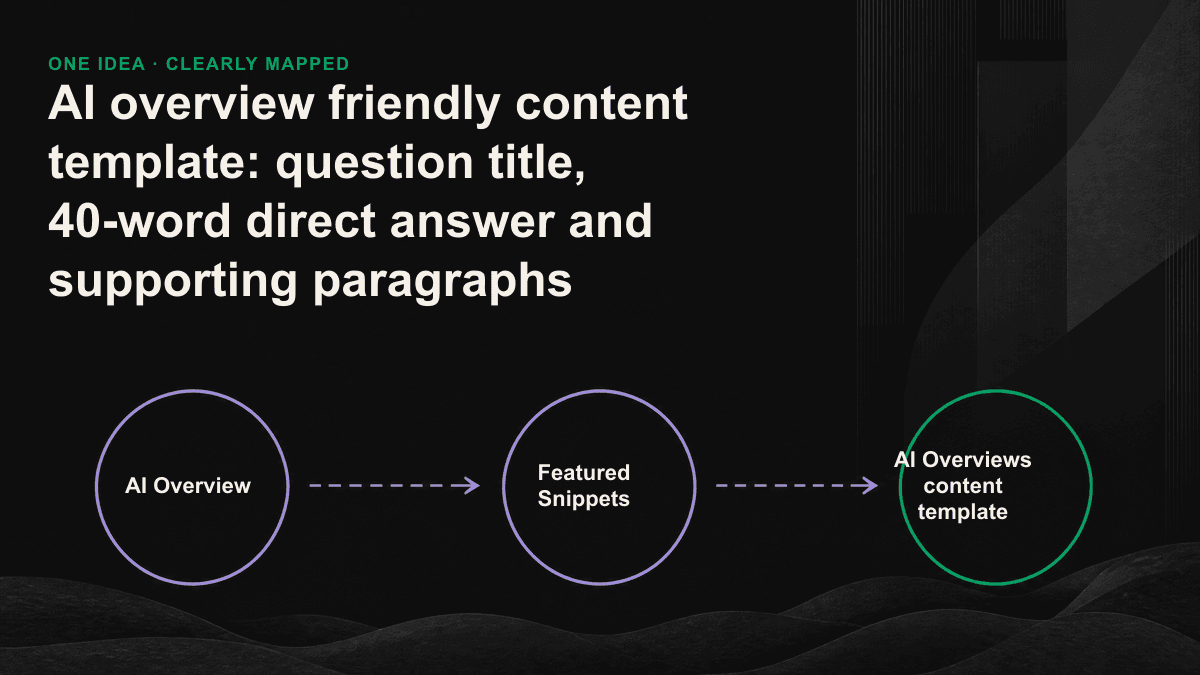
If you want to be cited by the AI Overview, the most effective way is not to write a long article, but to transform each section into an answer unit that can be extracted separately. The title uses a question that readers will actually type into the search box. The first sentence directly below the title uses about 40 words to give a complete and independently established answer, and then expands the supporting paragraphs. This structure is directly inherited from the logic of featured snippet and passage ranking, and is currently the most stable AI Overviews content template.
Why this template works: From featured snippets to paragraph ranking
Google's AI overview is not generated out of thin air. It draws from existing highly relevant paragraphs in the search results and rewrites them into summaries. Most of these selected paragraphs are the content that could win featured snippets in the past. After Google introduces passage ranking in 2021, the system can independently evaluate a certain paragraph on a page - even if the topic of the entire page is not completely correct, as long as a certain paragraph accurately answers the query, that paragraph has a chance to be singled out. The AI engine follows the same set of extraction logic: it reads paragraphs of content, not the narrative of the entire article. This brings a very practical conclusion: the smallest unit you want to optimize is the paragraph, not the article. A long article with a loose structure and scattered answers may lose the extraction value to a cleanly written short answer.
The three-layer structure of the template
- Question title: Use the sentence that the reader actually enters into the search box as H2 or H3, such as "How long does a GEO audit take?" rather than "Auditing schedule description."
- 40-word direct answer: In the first sentence directly below the title, use one to two sentences and about 40 Chinese characters to answer the question completely. The sentence itself must be able to stand on its own.
- Supporting paragraphs: expand after the direct answer, and add numbers, steps, premises, and exceptions for readers who want to go deeper, and for the engine to judge the credibility of the paragraph.
If the order is reversed, it will fail. If you lay out the background first and hide the answer in the middle and later paragraphs of the paragraph, the first sentence extracted by the engine is often not the answer, but an introduction without information, such as "This is something that many customers will ask." Putting the conclusion at the beginning of the sentence is equivalent to making a summary for the engine; it hardly needs to understand the entire paragraph to directly quote your first sentence. This is the old principle of the "inverted pyramid" of news writing, but this time the readers are replaced by a language model.
How to write a question title
The title should be a question, and it should be in the reader's words, not your internal jargon. Open the query report of Google Search Console, or review at the "related questions" popped up by the AI engine, and move the actual question sentences in as the title. Avoid marketing-style noun titles: Change "Service Advantages" to "What Problems This Service Solvees?" and "Comparison of Plans" to "Which Plan A or Plan B Should I Choose?" One H2 only corresponds to one question. Do not cram two questions into one title, otherwise the direct answer below will be forced to bifurcate, and it is easy to break in the middle when the engine extracts it, and the reader will get half the answer.
How to write a 40-word direct answer
The key to direct answers is to be self-sufficient: put the subject into the sentence, and don't use "it", "this" or "above" to refer to the previous part. The wrong way to write it is "It usually takes three to four weeks"; the right way to write it is "A complete GEO audit usually takes three to four weeks, covering technical inspection, content extraction rate analysis and competitive product visibility comparison." When the former is taken out alone, the reader has no idea what "it" refers to; the latter is true no matter what situation it is put into. The most stable word count is between 35 and 55 Chinese characters: if it is too short, it will not contain enough information and cannot form an independent sentence; if it is too long, it will exceed the scope of the abstract and will be easily truncated. After writing, post this sentence somewhere else and read it once. If you can still understand it, it has passed the test.
What to put in supporting paragraphs
Supporting paragraphs are written for two audiences: readers who want to go deeper, and engines that judge your credibility. Include specific numbers, operating steps, applicable prerequisites and exceptions. Instead of writing "usually very quickly", write "most pages will see a change in the extraction rate within two weeks, and sites with a large amount of content will take about a month." With numbers and conditions, engines are more willing to accept it, and readers are more willing to stay. But each paragraph should still be self-sufficient, and don't tie the paragraphs to each other with "as mentioned before" or "mentioned in the previous section" - when the engine takes away this paragraph, all those references will become decapitated sentences without an object. Write each paragraph as an answer that can be forwarded individually.
To determine whether the content is AI-friendly, just do a test: copy any paragraph in isolation, does it still read completely? If you need to look back at the previous paragraph to understand it, this paragraph will not be clear.— Tenten GEO Content Team
The four most common mistakes
- The title uses nouns instead of questions, so that the engine cannot guess what question this paragraph is answering.
- The answer is buried in the middle of the paragraph, and the first sentence is an introduction rather than a conclusion.
- Pronouns are stuffed into direct answers, and the semantic meaning is incomplete when extracted alone.
- The answer is only given once at the beginning of the entire article, and the rest of the sections are all narrative, which means there is only one extraction point in the entire site.
Turn templates into habits
The value of this set of templates is consistent across the entire site, rather than merely a single article. When each section follows a question title plus a 40-word direct answer, your website changes from "an article that is occasionally quoted" to "a library of answers that can be extracted from everywhere." The cost of modification is actually not high - most of the time it is just a matter of rearranging the order of the existing content and putting the answers at the beginning of the sentence, rather than rewriting the entire article. If you want to know how many paragraphs in the existing content have reached this standard and which topics the gaps fall on, you can book a 30-minute GEO diagnostic session. We will use your actual page to demonstrate: which paragraphs are extracted cleanly, which ones are broken as soon as they are extracted, and which questions should be filled in first.