The AI overview does not select "website", but "paragraph". If you rank first in organic search, you are not guaranteed to be cited; a piece of text with a clean structure that directly answers a certain sub-question may be included in the answer even if it comes from a page ranked second. Once you understand this, you will stop pursuing full page rankings and start working on paragraphs that can be extracted.
The source of the AI overview is a direct descendant of the featured snippet
To understand how to select sources for AI overview, first return to the featured snippet. For the past ten years, Google has been doing one thing: extracting a piece of text from the web page that directly answers the question and placing it at the top of the search results. Featured snippets are the first generation product of this machine-extracted answer logic: a question, a source, and a framed text. AI Overview follows the same lineage, just scaled up.
The difference is in the synthesis. The featured summary only extracts a single paragraph from a single page; the AI overview extracts multiple paragraphs of text from several pages at the same time, and gives them to Gemini to reorganize into a coherent answer, and then marks the source corresponding to each sentence next to it. Therefore, pages that can stably get selected excerpts are usually the most frequently cited objects in the AI overview. When we take stock of visibility for our clients, there is always a high degree of overlap between the two lists.
The first threshold: first enter the searchable collection
The prerequisite for being cited is to be found. AI Overview does not generate sources out of thin air. Its candidates almost all come from Google's existing search index and ranking results. This means that traditional SEO has not disappeared, but has become an admission ticket: the page must be correctly indexed and have the ability to be ranked in the top section under relevant queries, so as to have a chance to enter the candidate pool that is drawn.
- The page is correctly indexed by Google and is not blocked by noindex, robots or incorrect canonical.
- In the case of the target query and its synonyms, the natural ranking is in the upper stage, or it already has a Featured Snippet.
- The content is highly semantically relevant to the query, not just the literal match of the keywords.
- The crawler can successfully obtain the complete content without being stuck by JavaScript or loading issues.
Query fan-out: a problem is split into more than a dozen sub-problems
There is an easy overlooked mechanism behind AI overview and AI Mode: Query fan-out. When users ask a slightly complex question, the system does not run a single search, but tears it apart into multiple sub-surveys (synonyms, extension, implicit back-and-forward links), to search separately, and then aggregate the paragraphs of the results.
The implications for content strategy are straightforward: you might be cited for a sub-question that you never intentionally targeted. An article about pricing may be included in an answer about the procurement process because of a paragraph explaining how long it takes to import. On the other hand, a page that only focuses on a single primary keyword and leaves surrounding sub-questions blank will miss a large number of citation opportunities brought by fan-out.
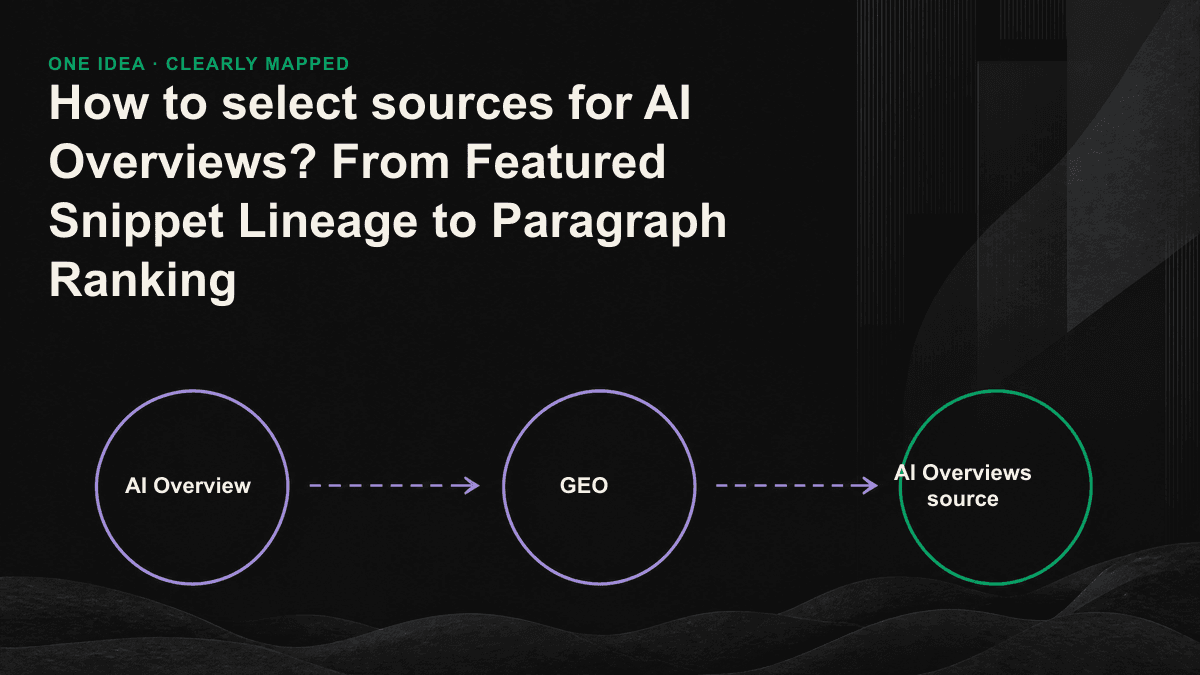
Paragraph ranking: AI extracts paragraphs, not entire pages
Google imports paragraph index (passage indexing) from 2021, allowing the system to independently evaluate a section of the page, even if the whole page theme is not fully aligned. AI Overview takes this to the extreme: the Basic unit it counts and screes is a paragraph, not an entire article.
Therefore, the ranking of this page is no longer the only question. What is more important is whether there is a paragraph on this page that is clean enough to be picked out as the answer. An ideal paragraph can stand on its own: the main word is clear, one paragraph tells one thing, the conclusion is placed at the beginning, and it is understandable without relying on the context. Lists, definitions, clear numbers and steps are all easier to extract than lengthy narratives.
Why are some pages referenced and others ignored?
Even a clear passage can be skipped. A factual claim is more likely to appear with a citation when several sources corroborate it; isolated, unsupported content receives less trust. Entity and brand authority also matter because Google's understanding of the brand, author, and domain affects whether it is willing to use them in an answer. Recency is the third factor: for topics that change over time, substantively updated pages have an advantage.
- Enter the candidate pool: be correctly indexed, have front-end ranking or featured snippets for relevant queries.
- Paragraph match: A self-contained text that directly answers a query or subquery.
- Mutual corroboration: The claim is consistent with other credible sources and is not isolated.
- Physical authority: Brands, authors, and domains carry identifiable trust signals.
- Timeliness and specificity: Time-sensitive questions are kept updated, and the answers have clear numbers and conditions.
Turn blood relationships and paragraphs into executable actions
Landing is actually not mysterious. First, take stock of how many selected snippets and front-end rankings you have on the main topic, which is your existing capital to enter the AI overview; then break down the important pages into paragraphs of text that can answer sub-questions on their own, and fill in the surrounding questions that were ignored by the query; finally, continue to track which questions you are quoted in, and who overshadows them. If you want to know whether your current paragraph has a constitution extracted by the AI overview, you can book a 30-minute GEO diagnostic session, and we will run through the gaps with your actual query.