"XX Alternative" is the closest search in the entire B2B funnel, but is the last in most SaaS content plans. The person who typed it already knew that there was a product and why he wanted to leave. It, all he lacks is an alternative to convince himself. This page now has an additional role: it happens to be the format most cited by ChatGPT, Perplexity, Google AI Overseas.
The searcher for Alternatives has already got an answer.
It's the most common error to make the Alternatives search the top of the funnel. Those who really hit out of the "Notion Alternative" "Salesforce Alternative" are usually stuck in three situations: there are tools to raise prices, the team is not working properly, or the last round of due diligence before buying. These three types of people don't need you to start teaching them what CRM or the knowledge base is, they want a list of what they're feeling, and a "no value in exchange." If the underlying concept is still being explained, the content would be tantamount to pushing back the flow of the closest deal.
- People who are fleeing a tool: mostly because of higher prices, kidnappings, or suspension of functions, they want to confirm that the exit option exists and is mature.
- People who have not bought and are making final comparisons: there are two or three candidates at hand to cross-check their comments with alternative pages.
- Helping the supervisor to find the handler of the case: Need a photo that can be posted directly and concluded with numbers.
- People checked by AIS Assistant: They don't connect themselves, get ChatGPT or Perplexity to help organize, can your page be quoted and decide whether you will not appear in the answer.
What's an alternative page that can be extracted clean by AI?
When the AI engine extracts content, preference is given to a clear and independent page for each segment. If the alternative page is written in a scribble software, it is difficult for the engine to clean out the replicas that can be quoted; it is written as a skeletal match that the entire section is moved into the answer. The skeleton is actually only five.
- Start with 40 to 80 words: "Who is the best person to use this tool, and under what circumstances, should consider alternatives, and start with conclusions.
- An honest comparison: set the price, the difficulty, the key function, the size of the appropriate team, and contain a stronger field than you.
- The situation is different: "If you value X, choose this; if your team is Y, choose that," so that the different readers can have their seats.
- The migration cost explanation: whether data can be exported, how long will it take, and whether there is an available migration tool, is the point of real anxiety among decision makers.
- A fair assessment of the original tool: acknowledging its strength makes your recommendation more credible.
Put these five together, you'll get a page that can be scanned and quoted by the machine as a whole.
Why is GEO particularly interested in alternative pages?
When an LLM answers a question such as "Is there a better tool than X?", it looks for a source that has already organized the options and supplied criteria for judging them. An alternatives page naturally provides that structure through a list, direct comparisons, and relevant situations, effectively preparing the answer in advance. Brand Radar data repeatedly shows that AI engines name a strong alternatives page more often than a higher-traffic general article on the same site.
Most of the alternatives died on these three things.
- Just exaggerating: The whole page is talking about good home-grown products, none of which is really comparing, readers look at it as a match, and AI has decided to be a low-information source.
- Overdue information: priced, functional columns haven't been updated for six months, one mistake caught by the reader and the whole page's trust collapsed.
- There is no conclusion: to list ten alternatives but not to say who's right, to throw back to the reader the most difficult judgment is not helpful.
Honesty is the strongest switch.
To admit that the competitor is in a better position in some scenes, sounds like a push-out of business, which actually works the opposite. When you're willing to say, "If your team is only three people, and the budget is tight, the original tool is enough," the readers will believe that the rest of your recommendation is true." The decision maker never bought more than a function, but "will this company be honest with me?" An alternative page that says it's not suitable for anyone, and the missing one is a customer who would not have made a deal, leaving behind a customer who has a high degree of pairing and who will not regret it.
Willing to write down the page "We're not fit for anyone" is more likely than any boasting to let the right client decide.— Tenten GEO
From one page, it grew into a whole group.
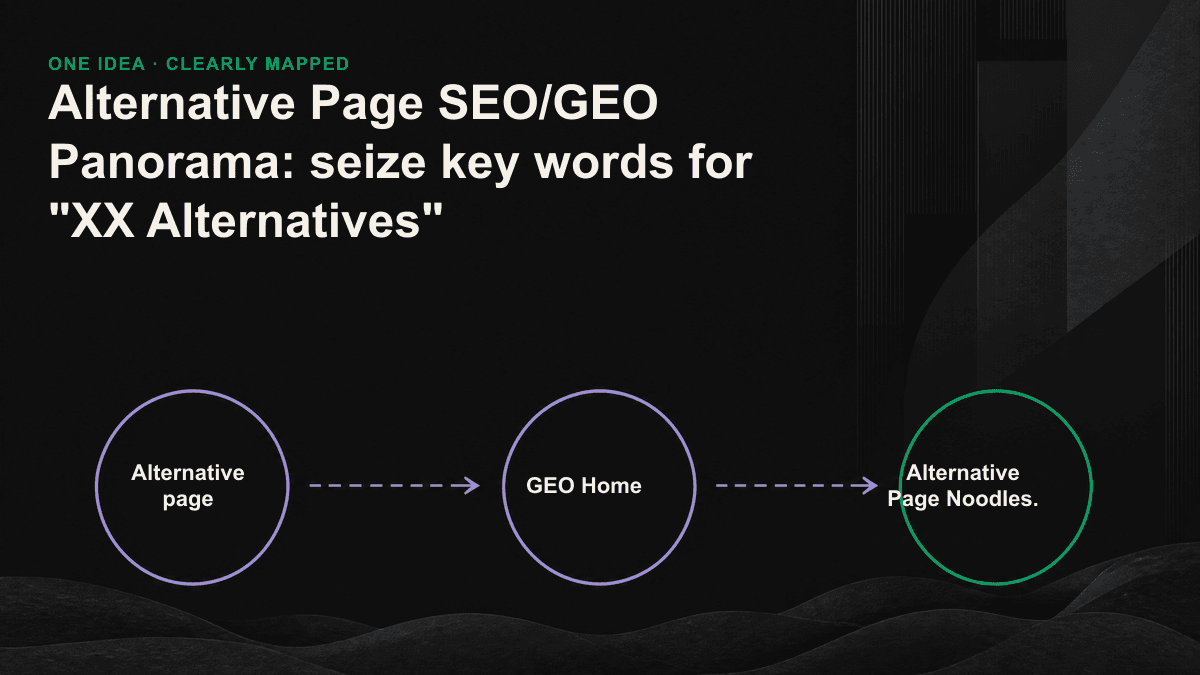
One alternatives page may rank for one query. A connected set that covers major competitors and links to use-case and comparison pages can appear throughout the decision stage in both search and AI answers. That is the GEO content engine: build the nearest useful decision page instead of publishing disconnected articles. In a GEO diagnostic session lasting an estimated 30 minutes, we can identify the structural and content gaps in your current alternatives pages.