Most B2B teams throw their budget at educational funnel top articles, but what really pushes readers through the decision line, which at the same time is most frequently cited directly by ChatGPT and Perplexity, is the bottom of a funnel like the comparative page, the alternative formula page and the use of the usual page. These pages are often used as an accessory to the product pages and are written in the best form. Write the BOFU content right, which equals the conversion and AI visibility at the same time.
Let's find out what the BOFU is answering.
Readers at the bottom of the funnel already know what they're gonna do, and the rest is the choice. Instead of asking "what's business automation", they asked "Who's HubSpot and Brevo are the right ten-person team" "Is there a cheaper and more useful option than Salesforce" "where do we get this kind of electronic commerce card?" These problems are accompanied by purchases and specific restrictions: team size, budget, existing tools, industry. The answer was close enough, and the reader now had a reason to act; the answer was vague, and he would only go back and compete.
Why is AI engine particularly fond of BOFU content?
When the AI engine produces the answer, it selects a clear structure, responds to a single question, and gives a paragraph that makes a verifiable comparison. Some ask, "Notion and Coda, which of the small marketing teams fit " , and the model needs a piece of content that has been sorted out and clears out, and a good page is just doing it. In contrast, a top article that talks about "Why are the tools of production important" will hardly be drawn out as a source of reference, because it has no questions and no conclusions.
- Each section responds to a clear problem, and the engine can be extracted cleanly without having to collage.
- Specific contrasting dimensions, such as price, integration, start speed, can be verified.
- With clear positions and concessions, the model prefers to refer to "conclusions" rather than to simplistic paragraphs.
- Often contains structured information such as tables and lists, which machines can interpret easily.
You need at least four BOFU content
- Compare page (X-Y): Directly responding to "what's better" search and query is the entry point for the highest intentions.
- Alternative page (X's alternative): Catching people who are dissatisfied with existing tools and are looking for replacement readers, who are the closest to the deal.
- Use the official page (to a certain type of team or function): To match the product to a specific situation, such as the "Program for a B2B SaaS sales team" and to get readers in the room.
- Integration and migration page: Answer a question like "Can I connect to my existing system" "How many jobs it takes to move in?"
These four page types assume the reader is evaluating options rather than browsing. You no longer need to explain the basic concept. Reduce the cost of choosing by stating who the product fits, who it does not fit, and what each option trades off.
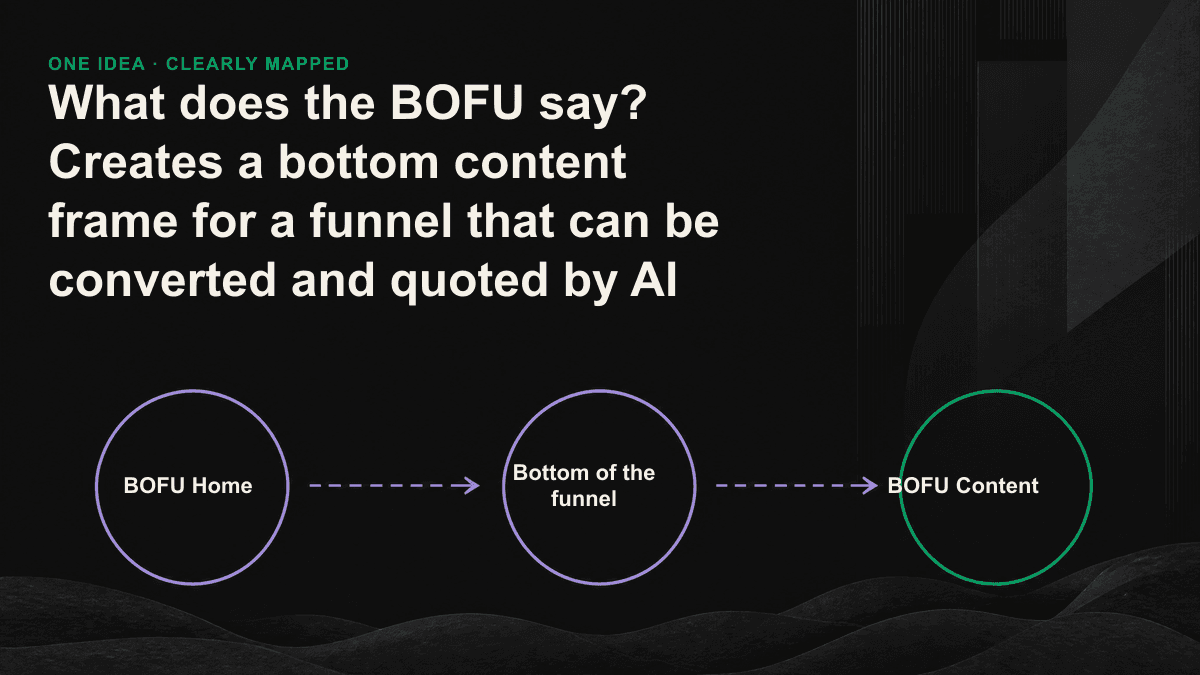
A BOFU framework that can be converted and quoted simultaneously
- Start with the answer: The first 40 words directly answer the reader's question, and don't lay it down, which is the one most easily taken out by AI.
- Define the language of the reader in a more specific dimension: list the three or five things he really cares about, not the functions you want to show off.
- State where a competitor is the better fit. A sentence such as "Choose the other option if you need X" gives readers a credible boundary and shows the model that the comparison is not disguised sales copy.
- Respond to the specific team profile: clearly identify who's right and who's not, and allow readers to sit in the seat or exclude themselves.
- A testimonial: a number, an interface screen, a real process, instead of an empty adjective.
- The next step in low friction: giving a clear, low-promise move, such as an appointment for a diagnosis, instead of pushing for an immediate purchase.
The counterintuitive step is to describe a competitor's strengths honestly. Teams often hide those strengths because they fear sending buyers elsewhere, but readers recognize the bias and AI systems have less reason to trust the page. If another tool is better for progress reporting, say so. The admission makes the rest of the recommendation more credible and helps the right buyers self-select.
Three common errors that invalidate the content of BOFU
- Just bragging and not writing about the good points: Readers don't believe and AI decides not to quote.
- The dimension is what you're trying to say, not what the reader cares about: the function is so much that it doesn't work.
- When it's finished, it's not updated: prices, programs, integrations are over, content can undermine trust, and AI can also quote the wrong information.
How do you know if BOFU is doing something?
Judge BOFU content by its influence on a decision, not by pageviews alone. Track at least three signals: conversion, such as the time from reading to booking a meeting or closing a deal; diagnostic or trial requests attributed to the page; and AI citations when buyers ask ChatGPT or Perplexity related questions. Tenten's AI visibility monitoring measures the third signal by tracking how often and in what context major AI engines mention the brand and its content.
Think of BOFU as an asset, not as a product page attachment.
The bottom of the funnel is not a supplement to the product pages, but an asset where a few of you can influence "people's decisions" and "AI's answers." Start by taking a look at what's missing on each of the four BOFU pages in your hands and what's missing in terms of what's not on the reader, and then add it to the frame above. If you want to know what your visibility gap in the AI engine is, what kind of BOFU content is best suited, you can schedule a 30-minute GEO diagnostic session, and we can identify where to start.