The first move of most teams in GEO, when the results were less than expected, was to rewrite the old article in its entirety. This is usually the most expensive and easy to waste. You've got 30 to 40 percent of the content that's very close to being cited by AI, which is only fine-tuning the density and structure of the facts; it's really worth rewriting from the beginning, which is less than 20 percent. You know how many books you're supposed to place in the budget, instead of spilling the entire library on average.
Rewrite is instinct.
Rewrite is tempting because it gives people a feeling of being in action. Opens an old, unreadable text, from the title to the endword, which will be finished in the afternoon. The problem is that you may have changed the paragraph that the AI engine is willing to take, and the real reason for this low visibility -- lack of a verifiable number, weak physical connection to brand name, buried after the fourth paragraph -- you didn't touch one. Lots of moves, little shifts.
An audit turns "this does not feel right" into specific answers: what is wrong, how much it matters, and how long each fix will take. Once every piece has a status and priority, rewriting becomes a schedulable, testable project instead of an anxious reaction. With the same 10 days of work, teams that audit first can usually advance two to three times as much citable content because they do not waste effort on pages that are already adequate or should be retired.
Four questions for a GEO review.
The review does not give a score for rereading each article, but answers four questions to each page. These four issues determine whether it should be retained, modified or withdrawn.
- Which real question is this page answering? If an article does not respond to a specific query from the user or AI about the exit, it has almost no drops in the generated search, nor can it be quoted as beautiful.
- Can the answer be clean? The core conclusions are whether they appear in the first two paragraphs, whether they are self-contained, whether there are verifiable numbers and entities. The AI engine prefers to move the entire section without having to cross-complex content.
- Is the density enough? How many specific, comparable information (years, proportions, product names, process steps), is available in a text? A broad view cannot be invoked and is covered by more specific sources.
- Is there a strong connection between brand and theme? Does this page tie your brand name to the same credible link you want to be remembered for? This decision, Brand Radar, will you be classified under the right topic.
The contents are divided into three categories: retention, modification, exit.
After the audit, each piece falls to one of three barrels. The reservation has already been invoked, or the structure has to be complete only by regularly updating the content of the facts, leaving it alone and destroying the existing reference relationship. These are the areas with the highest rates of reporting and the undervalued assets of most teams. What goes back is that the theme has no search needs, or has nothing to do with the old text that is now located, leaving you with only a dilution of the theme in the eyes of AI, which should be merged or mounted, not rewritten.
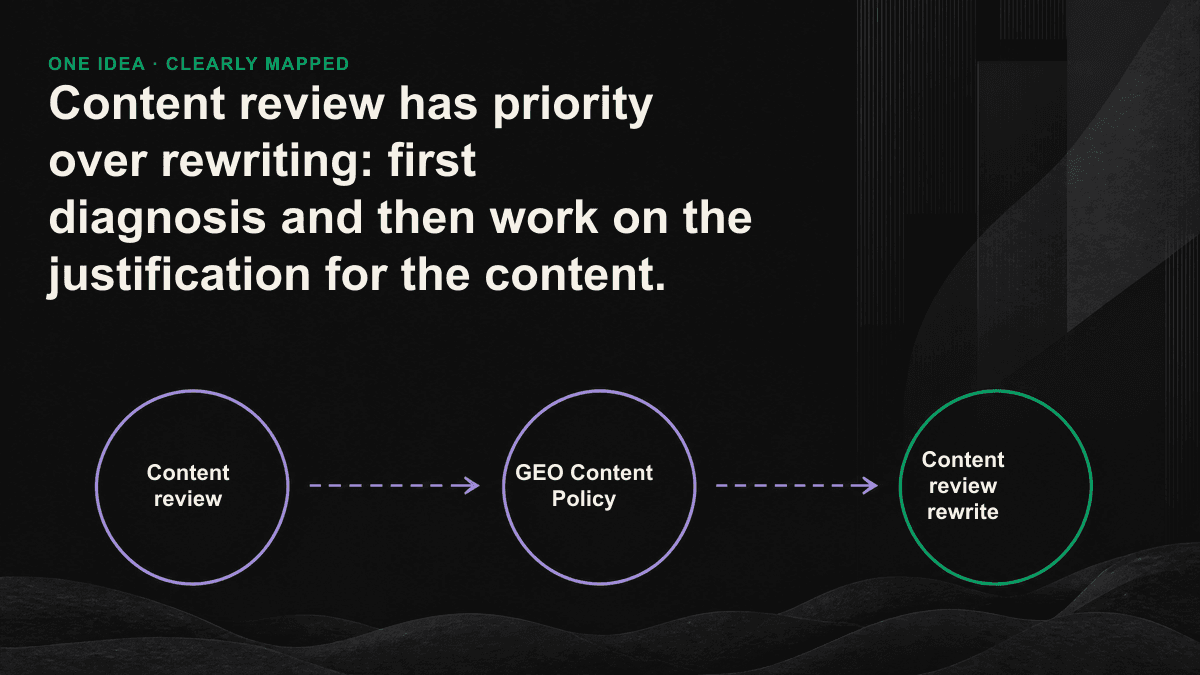
Classes are themselves savings. If there were 80 articles in a repository, 30 reservations, 20 exits, and 30 changes left. You've only got thirty copies of your time, and most of them are partial patches, not rewriting. The workload gap is several times greater than the "all back" announced at the beginning, but the results are more concentrated.
Change order: first fact density, then structure, then text
Determines that the sequence of action will have a direct impact on efficiency. Most people get used to the word of decorative, which is just the least effective step for GEO. The correct sequence is reverse.
- Complementing factual density: Adding specific numbers, years, physical names and context to each paragraph with hard information that can be quoted.
- Reconstruct the structure: refer the core answer to the front, let each sub-title respond to a clear query, and break the long paragraph into a unit that can extract the entire paragraph.
- Finally, the text was transcribed: remove the adhesion, betrothed and empty, and make it direct. This step enhances readability, but it has the least impact on whether or not to be quoted, so put it to the end.
What really should be rewritten?
An audit keeps rewrites focused on pages where they are worth the work; it does not prevent rewrites altogether. Rewrite when the article rests on an obsolete premise, when the topic no longer matches the product's position, or when filling the factual gaps would take more work than starting over. That decision should come from the audit, not from your first impression when you open the document.
Articles that can be judged "should be rewritten" usually make up only a small fraction of the repository; when you find that you want to rewrite much more than this, most of them represent audits that have not been done or that are not specific enough.
Start with the audit, not the keyboard.
GEO's cost is not to write good, but to spend the power in the wrong place. First, you get a sort of list of pages that don't touch, which numbers can be quoted, which really should leave. This is much more practical than rewriting it, and it is easier to explain to the team or manager what is changed in each division of labour. If you want to know what pages are stuck in your database in the state of being "almost able to be cited by AI", you can book a 30-minute GEO diagnostic session, and we'll use Tenten's trial to mark your gaps and decide which ones to fix first.