Before the AI engine decides whether to quote you, it will ask a question: who wrote this article and why trust him. Most of the B2B sites either have blank columns or have only one name added to the title, which is the same as having the reference given to the location. For competitions who explain the author's background clearly. Author authority is not a vanity indicator, but an AI filter that is actually used when selecting the source of the answer.
"Who wrote this?"
When the generator answers a question, it's responsible for every sentence that it's given. It tends to refer to real and verifiable author content, as this reduces the risk of giving false information. Google’s E-E-A-T framework places experience first, and that is what it says: an article on taxation, from a professional accountant, and an anonymous writer, is much less credible. ChatGPT, Perplexity, Gemini, when selecting a source, gathers the author's signals (name, professional domain, past postings, cross-post identity), to judge that the source value is not worth the answer.
When we're doing GEO audits for our clients, the most common loophole is not that the article is not well written, but that it's like an "unowned work." The same senior consultant wrote 30 in-depth articles, each without his name, his professional background and his link to LinkedIn, which the machine could not tie to a credible expert. Your expertise is scattered in the eyes of algorithms, unable to return.
What's the actual length of a reference to an author's file?
The author's file (Author Bio) is not self-presentation, but is at the same time proof of credibility for machines and readers. It has to answer three questions: who are you, why are you talking about the subject, where are you going to find you? A valid bio usually falls between 60 and 120 words, specific, verifiable, and not a stack of adjectives.
- True name and clear title, no pen name or "editor" account
- A word of expertise and seniority, with quantifiable experience, for example, having served a few SaaS, having worked with one of those specialties. Case
- There is at least one verifiable external identity link: LinkedIn, membership, previous office.
- Representative books or statements, such as speeches, interviews, co-signed reports
- A real, clear, personal photo, used on all platforms
- Construct data tags so that machines can read every one of them.
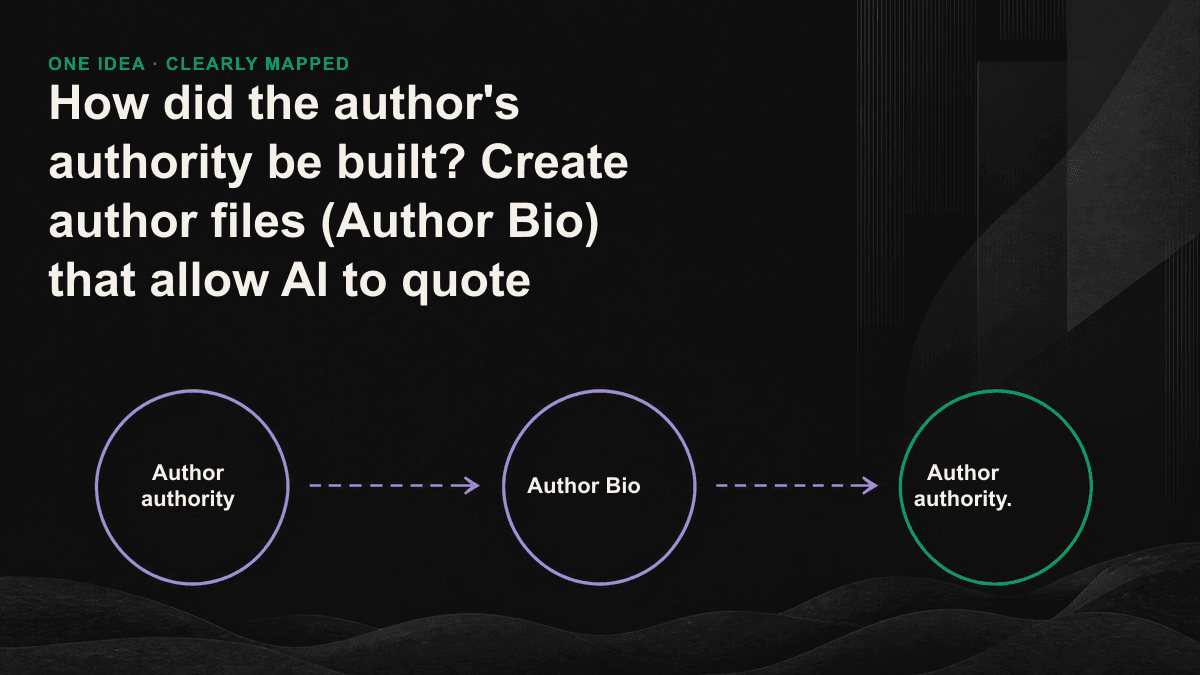
From web to knowledge: connecting machines
People can read Bio, not necessarily machines. To allow AI to interpret your author's identity as an entity, you need the schema.org's Person structured data and bind the content to this Person in the article with the author attribute. The key fields are SameAs - add the author's LinkedIn, personal website, academic files, company pages. This link tells the machine that these scattered identities point to the same person. When search engines or large language models create knowledge graphs, these consistent signals are cross-referenced, and your author upgrades from "one name" to "a recognized expert node".
Coherence is more important than gorgeous. The same name, the same photo, the same group of professional descriptions, the re-emergence of the website, LinkedIn, the industry media and the speaking page, is one of the strongest signals that the machine has determined that "this is not the same credible person."— Tenten GEO
Three common mistakes that cost author power.
Many websites, instead of having no content, have left their already accumulated authority out of detail. The following three practices are encountered almost every time.
- Use "editorial" or "selling team" as author: The machine can't attribute content to any real person, which means abandoning all author signals.
- bio writes only headlines without proof: a sentence such as "Advisory, Precision Digital Marketing" does not have any verifiable information, and AI is unverified.
- Author identity is inconsistent across stations: this is Wang, and this is David Wang, and the picture is changed, and the machine will take you as a few different people, whose authority is diluted.
Create order of author authority from scratch.
This doesn't have to be in place once. In this order, every step of the way can have an effect, and you can prove it.
- Write a specific, verifiable bio to each of the true signatories, with their real names and photographs.
- Puts the bio into every article page of the author and creates an independent author page on the website.
- Add Person to the structured data, fill out the sameAs and string up all external identities.
- Allows authors to accumulate externally verifiable footprints: input from industry media, interviews, speeches, public statements.
- With AI visibility monitoring, you can track changes that your author and brand have mentioned in the AI answer.
If you are unsure which author signals AI systems can verify, set aside 30 minutes for a focused review. We will show which credentials and identity links are missing, which details are not machine-readable, and which fix offers the best return first.