When content is of similar quality, the AI engine gives priority to the page "Access to the author and his identity can be verified by the machine." A good article in the name of the company, unsigned and unauthorised, often skipped in the form of a creative answer, allowing a common article with clear signatures and external endorsements to take the reference.
Why does "the author" influence AI's citation choices?
When AI produces the answer, it is important to find a "bold source" for each name. When the model and the search level are sorting out the selection paragraphs, they refer to a set of trusted signals: the content itself is unclear, there are no structured data on the page, and how many verifiable traces of this source are on the Internet. The author's signature also hit the latter two. When a text is followed by a real, verifiable person, it is easier to judge that this is not the farm, and the risk of invoking it is low.
This is also the direction of Google’s repeated emphasis on E-E-A-T: Experience and Expertise need to be carried by people. The difference is that the tradition of SEO is to show real readers the author's page; to the GEO situation, it's the machine that captures it. You have to write "Who wrote this and who he is" in a format that the machine can read, which is the structured data.
Person schema and sameAs told AI exactly what?
There's a column in the Article structure of an article with a value that should be a Person object, not a string of plain text names. The two most important properties of the Person object are name and SameAs. The name is the author's name; the sameAs are a set of URL arrays, each of which points to the "official status of the same person elsewhere". And you're saying to the machine, "This is Wang Xiaoming, the one on LinkedIn, the one on X, the one on the corporate team page."
SameAs' role is to tie scattered identities to the same entity. This link upgrades the term "one name" to "a person with background, work and community footprint." The more these links prove each other, the more stable the author's body and the easier to trust what is hanging in his name.
Which SameAs links should be put in?
- Author's page on his home site (like /author/... a stand-alone URL, also has a personal schema)
- LinkedIn Personal Files - B2B is the most important and easily cross-checked
- X (twitter) personal account
- Professional files with authority: e.g. Crunchbase, GitHub, ORCID from the academic world, author's page from the industry media
- If the author has a Podcast, a public address, or a Wikipedia, he'll add it. Enter
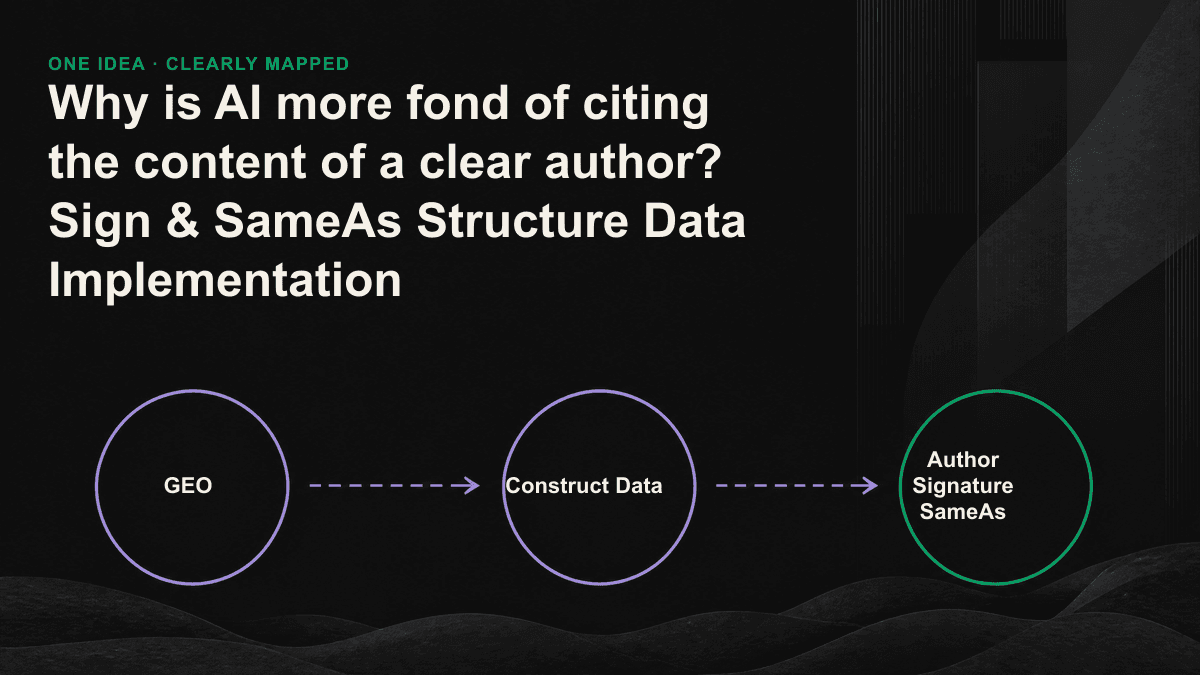
Make it four-step: write it as a machine-readable data.
Order is important. First there's a connected author entity, then there's the logo on the page, don't reverse it.
- Creates an independent author page for each lead author, which itself features Person Schema (name, JobTitle, description, image, worksFor, sameAs) and actually lists the articles he has written.
- Set author as a Person object in Article/BlogPosting JSON-LD on each page, url points to the above-mentioned author page and takes the same group of SameAs.
- Make sure that the page "where you can see" also has the same signature - the article begins or ends with a copy of the author's card showing the name, title, a short sentence and links to the author's page. The structured data must match the visible content and not be hidden in the source code.
- The three names are identical (see signatures, author pages, JSON-LD). Wang Xiaoming does not become Ming or an English name somewhere, otherwise the machine may tear the same person into two entities.
The four most common mistakes were made.
- Write the author into company names, not people. Organization can hang on publisher, but author if Person.
- SameAs pointed to a social account with little or no content or name, but instead turned negative.
- The author's page is empty, with only one photo, no list of works, and can't afford "this man is really writing."
- JSON-LD has a writer who can't see his signature on the page, which is inconsistent and can easily be convicted of simply plugging data for SEO.
How do you confirm that AI really recognized the author?
Adding the markup is not the end of the test. Search for the author's name and topic in ChatGPT, Perplexity, or Google AI Overviews, then check whether the model can identify who the author is, where the person works, and what the person has written. A correct answer shows that the entity signals have been absorbed. If the model cannot identify the author, the sameAs links may be too weak or external platforms may provide too little crawlable evidence. Add genuine author activity on platforms such as LinkedIn rather than more schema.
From the signature of an article to the authority of the author of the entire site
One piece with SameAs just starting. What really opens the gap is that a small number of signatories continue to produce on the same theme, and their names appear behind the quoted paragraphs. This is to treat the author's signal as an asset, not as a one-off mark. Tenten GEO’s content engine, while planning for its clients, lists who are well-known and missing external footprints before deciding how to write, because data tags cannot save an author who has no such person on the Internet. If you want to know if the author's signal is strong enough in the eyes of AI, you can book a 30-minute GEO diagnostic session, and we'll actually ask your articles about the engines to see if they recognize anyone who can write.