Build a content cluster by drawing the map first and creating each page from it, not by publishing a pile of articles and trying to connect them later. Many B2B SaaS teams do the opposite: they accumulate three or 40 scattered posts across loosely related topics. Google cannot tell where the site has authority, and AI engines cannot assemble a coherent chain of citable sources. This article uses a fictional HR product to build, from scratch, a cluster map that establishes topical authority and gives AI clean passages to extract.
First decide on the big issue of the pillar page. Contents
The beginning of the jungle is a pillar page that answers a big question that you really want to be remembered. In the case of this HR software, which we're demonstrating, it's based on the automaticization of small firms' work and pay, so the pillars should not be an empty "human resource management" that can't win HR encyclopedia; it should not be narrow enough to "clasker comparison" and can't afford an entire sub-theme. The appropriate pillar is "how small and medium-sized enterprises automate the process of pay-to-work" -- so big that you can grow a dozen sub-issues, so small that you have experience in the field. The pillar page itself is a complete guide, covering the whole picture, but each ring ends, leaving details for the sub-page.
Draw first edition of the jungle map using HR software as an example
The pillar is set, and then it's torn down to the question that the user would really ask. The approach is not based on ideas, but rather on the convergence of three sources: the most frequently asked questions in business, the re-emergence of questions in the client's list, and the extended questions that may emerge from entering categories on ChatGPT and Google. These are sorted, a first-page map is about this.
- Processes and systems: how to customize the travel system, how to calculate the hours worked, how to calculate overtime, how to calculate overtime costs, and how to trade off -- an answer to the search for what to do.
- Option and comparison: How HR software is selected, where the cloud is different from the ground, the self-format vs specialisation system, the main competitive alternative - the most recent decision-making content.
- Standard: Labor Law Hours, Personal Data Preservation, Tax Reporting and Health Care Ranges - the most confidence-building professional area for this software.
- Imports and integrates: How to move data into the system from Excel, how to connect to existing accounting software, how long to go online, how to go off-line, what to do when employees don't cooperate -- the anxiety of decision makers at the door.
- Results and measures: how much time is saved each month after entry, how much is lost in pay error rates - the digital content used to bind the funnel and most easily cited by AI.
These five categories are not beautiful, but they respond to the complete path of buyers from "aware to the problem" to "preparation for the bill." A good map is the characteristic of each cell that can be placed somewhere in the funnel, not all at the top of the teaching style.
Each sub-page corresponds to a search plan, not three pages. Yes.
After drawing the map, the easiest mistake was to put two or three sub-topics on the same page, often for the "relationship." It's not the same as the merger. When the AI engine extracts a section of its content, the page answers only one specific question, and it knows which query the page is for; the page cuts across the "how to calculate overtime" and "how to select HR software", and the tone is scattered, and neither query is included in the source. The sentence is simple: if you can't use a user's question as the title of the page, the page has not yet been taken.
- Compliance pages serve buyers who are already checking a rule and want to confirm whether their approach is correct. Give them the requirement and a worked calculation, then explain naturally at the end how the system automates the process.
- The comparison page faces the idea of a standard "assessment, preparation for selection": a factual chart with a situational deviation, and an honest picture of where the competition is strong.
- The entry page is subject to the "quickdown, only poor confirmation of feasibility" intent: a clear description of the pace of migration, time-consuming and commonly seen card points, and a reduction of last hesitation.
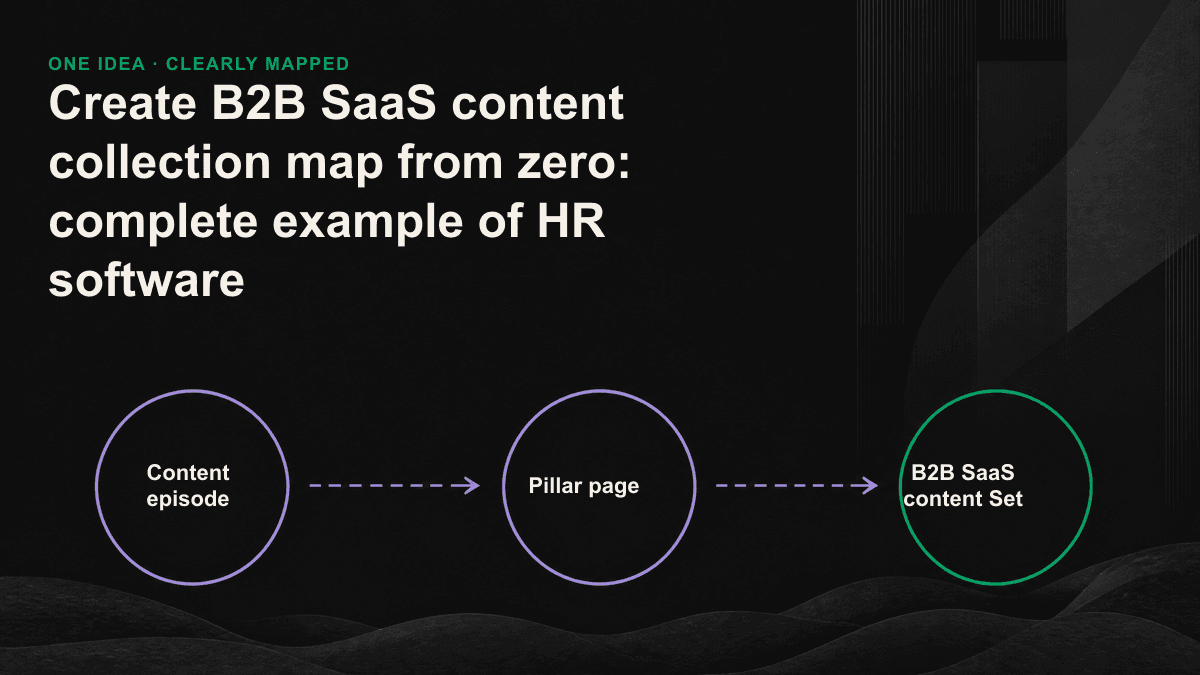
Internal connections are the real key to building a jungle.
A lot of people think that the episode is "a few more articles on the same subject" and that it's a link that determines whether it is valid or not. The sub-page is to go up to the pillar page and use descriptive anchoring, for example, when retrieving the pillar from the "overtime costing" page, the anchor is to write "the auto-mobilization process between pay and pay" instead of "point here". Support pages are also linked down to each sub-page. There is a cross-section of the same sub-topics, such as the Law of the Law, which goes on to "calculate overtime". The network's message to Google is: it's in systematic depth on this subject; it's more confident that the AI engine will help it understand the relationship between the pages.
Sequence: write which page first, don't give a fuck.
A map depicts a dozen pages, and it is impossible to start work at the same time and to sort. Three questions: who was quoted in your transactional record, whether you have a real case or a number to support this page? The three were "yes" first. In this HR software, the rule is usually the first to write -- it's professional, verifiable, and it's the bottom of the brand, and once AI becomes a credible source, it takes the rest of the pages of the jungle. On the other hand, "We're the ones who want to enter the new industry" should be in the back because there's no number, there's no number, there's no holes, there's no engine.
How do you know the jungle began to grow in power?
The effect of the jungle is not to read a single page, but to see if the whole page is stronger together. Three signals are worth pursuing: one is the keyword for the pillar, and whether the ranking is up in the whole order, rather than in one or two pieces; the second is the AI quote, which is the list of questions asked by the buyer to ask ChatGPT, Perplexity, whether your brand and page are mentioned as having an increase in the frequency; and the third is the number of consultations or applications brought in from this page. The second one was the hardest one in the past, and that's what AI visibility monitoring of Tenten is doing -- turning "AI" into a pointer for continuous tracking, not a sense.
Whether or not it's the subject of a stop, without reading a few pages, is whether the map behind it will survive this conclusion when any of the pages are pulled out alone.— Tenten GEO Content Engine Executing Principles
From zero, the most time spent in the preceding period was planning, not writing: matching the pillars, matching the sub-themes to real intentions, designing the link first, and then turning the content production into a renewable water line. If you've got a bunch of pieces on your hands and you don't know what you're talking about, Where you're supposed to be, you can book a 30-minute GEO diagnostic session, and we'll use your own kind of practical inquiry to see who's been quoted and what your map is missing.