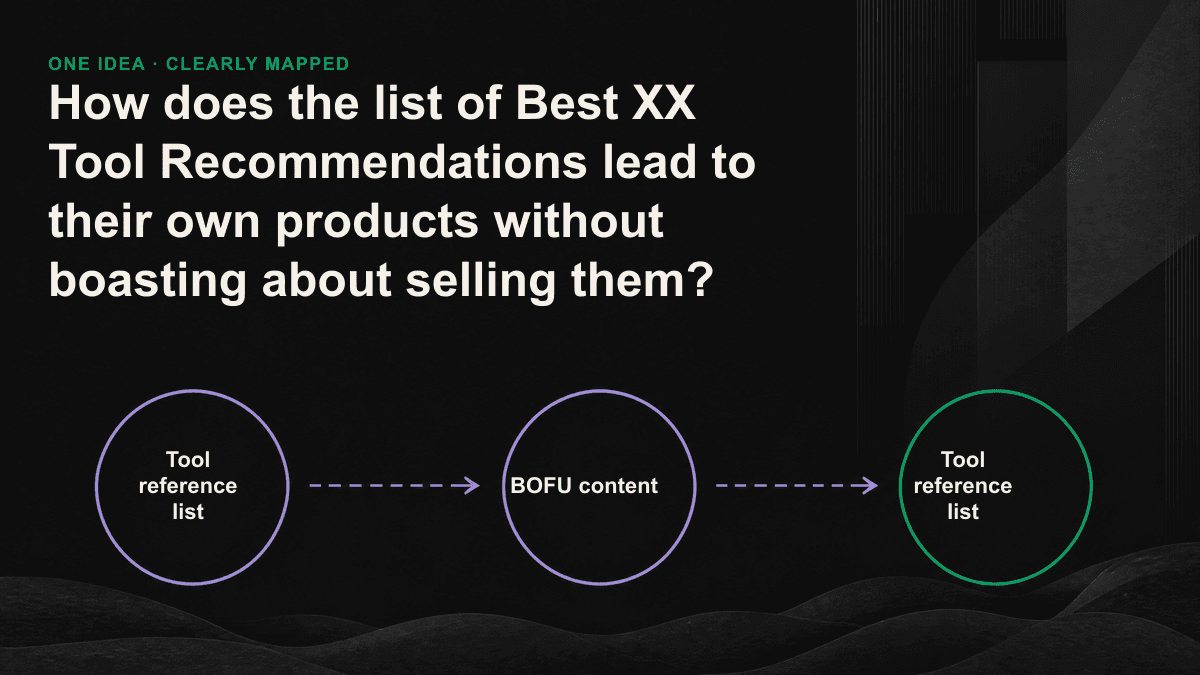
Put your own product on the list of "best XX tools" and fear the two most serious consequences: either you put yourself first, the reader sees it as a product for three seconds, the AI engine is judged to be biased; or you don't want to be bragged, you write yourself weaker than anyone else and send traffic to your competitor. It's in the middle -- you use a fair measure of all the tools to make yourself a natural winner in some real situation, and the readers believe, AI would like to quote.
Why is the list in the closest and most easily quoted format?
Those who search for the Best Project Management Tool, the Best CRM Recommended, have gone beyond the recognition level and are now on the waiting list. This query was accompanied by a clear purchase plan, and the list just sorted out the options, the more ambitious, the way things are, the way things are done, the way that ChatGPT, Perplexity, Google AI Overviews have half the answers. When someone asks AI, "What are the tools for a small team?", the model doesn't show up on your website, and it pulls out three to five options from a list of pages that have been captured and can be deciphered. Your product is not on that list, depending on whether it's neutral enough or not.
Selling three self-incriminating recognized signals.
Readers and models smell favouritism, relying not on intuition, but on a few specific failures. You go back and check the list, see if you've stepped on those points.
- Homemade products are always ranked first and for vague reasons: writing "the most complete function" is not appropriate for any situation, and this is the most typical industry code.
- There's a blank field or only a flaw in the field: paint people, tick themselves, and the information is worn at short notice.
- The ratings are all your strengths: the list is all you're good at, avoiding where you lose, and the readers wonder what you're hiding.
These three poor things in common are to treat the list as a single ad, not as verifiable data. They do not need to be rewritten in full, just to restore the fairness of the supplement.
Let yourself win by nature, not by force.
。 is the first to abandon the framework of the "General Champion". Instead of claiming that you are the best tool, the list should be defined as "the best solution for each without compassion" and ensure that there is a situation where you actually do better than others. You don't have to win all the dimensions, you just have to win in a specific scene that happens to be where your ideal client is.
- Let's start with a sentence to decide who's fit for who in most cases, so that the time-consuming readers and models can get their answers immediately, and don't lay them out.
- Using the dimensional ratings that readers care about, it's not the function you want to show off: price, speed, integration, support, fit team size.
- Each tool writes its most appropriate context, including the competitor -- the more honest you describe the competitor, the more credible your own win.
- Position yourself as the best solution to a certain situation, for example, "if you're within ten, you're in a team of SEOs and GEO's B2Bs" rather than the Sea."
- Distinction in the Situation: What's the situation, instead of a single conclusion, is the one most easily moved in by AI.
One of the most counterintuitive steps here is writing for the competitor. Many of the teams were afraid to guide the competition, and they were boasting, and the readers did not believe, and the model ruled that the content was biased. When you write, "If your main need is a progress report, a tool is doing better than we are," the readers believe the rest of your judgment, and the deal will end up with those who would have met your conditions.
Write the list as a structure that can be extracted cleanly by AI
Traditional listbooks are often written as an incitement, a picture and another paragraph for the purpose of smooth reading. To be quoted backwards: to cut each tool open with a clear title level, each tool is self-contained and begins with whom. Compare the numbers by writing paragraphs in plain text and identifying the time, and do not simply plug in the image table - the model does not read the cells in the image, the price is hidden in the image. Each key message is followed by a number or condition to get the text out of your website and into the AI answer.
Three restraining actions of the organic traffic.
The channel is not full of CTA, but gives the next step of a low friction after the reader has been persuaded by your honesty. Overselling will offset your hard-earned sense of neutrality.
- At the end of the situation that you won, the product was linked, not every tool was stuck in the CTA.
- Replace the "immediate shopping" push with the soft link "want to see more deeply about our complete dismantling".
- The end of the text gave a low-promised move, such as an appointment for a diagnosis or a test, to get people who are still hesitant below the steps.
The common logic of these three actions is that they appear after trust is built, not before. Readers are more willing to light it when they think you're really helping him.
How do you know if the list is working?
Don't just read the browsing. Three signals really need to be pursued: first, the number of diagnoses or applications that this page brings; secondly, the number of conversions that the reader will have to see; and thirdly, the number of AI citations, i.e., when someone asks ChatGPT, Perplexity about the tools, whether your brand is mentioned or not. The third signal was difficult to measure, and that's what Tenten's Brand Radar is doing: a weekly review of a buyer's real questions, turning "AI recommends me" into a traceable indicator, not a sense.
The list is one of the most recently written and often corrupted in the decision-making segment. Change it from a brazen ad to a fair comparison, and you take the trust of the reader and the AI quote at the same time. If you want to know what your current recommendation list looks like in front of some mainstream models and what's the gap, you can book a 30-minute GEO diagnostic session, and we'll just throw your page over the model and see how they read you.