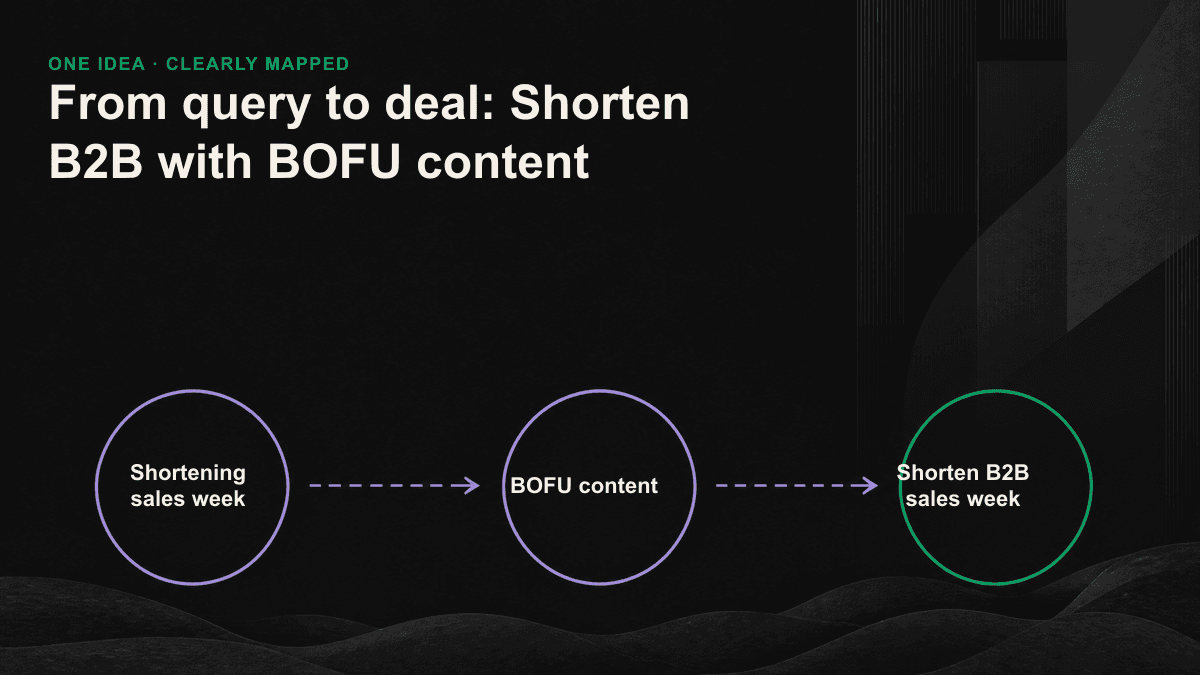
Shortening the B2B sales week, the most effective of which is not a business conversation, but a vacuum in the content of "after asking for a price, before signing a contract." Most of the SaaS teams pumped the budget at the top of the funnel, but left a buyer who had raised his price to convince the boss, the three of them, to evaluate the risks of migration, without a single data that could be posted directly. Every day this vacuum lasts, it's an opportunity for competition. To complete the content of the BOFU (the bottom of the funnel) would be to prepare a section of the road before the transaction.
The sales week is long. The card points are usually not on business.
Dismantling a typical B2B into a trade route: Buyer advice, Business contract, Demo, Buyer goes back to brief the manager, evaluates the tech colleague, spends the budget, asks three more details. Every time this road goes back to the interior, it's an out-of-control wait. The only thing the industry can control in that hour is demo, the rest of the time the buyer's got a little bit of power in the interior that you can't see, and the only ammunition he can use is what you can find on the Internet and copy it.
When we ran out of business for a B2B SaaS client in Taipei, we found that more than half of the parking cases were not priced or functional, but were stuck in "the window won't convince the inside." The window itself was convinced, but there was no material to answer the three questions of his supervisor: where is the difference with the tools available, how many jobs were spent in the past, and whether it worked with other people. The answers to these three questions are supposed to be three pages of BOFU content.
Let's get the BOFU content to answer "Inner Three."
Shorter periods are not abstract, that is, the question that the buyer must have been asked about in advance, which is a reversible page, so that the window does not have to wait for business to answer, and does not have to spell it out itself. In response to the questions from the inside, at least three pages should be in place.
- Comparative page (we now have tools): Answer "where is the difference and is not worth changing as compared to what is used?", so that the window can post the page in a brief and replace his own impression.
- Migration/direction page: explain how the data will be moved, how long it will take, where the card points will be, whether there are available tools to resolve technical colleagues and IT's concerns immediately, and to avoid "unsure it'll be difficult to assess"
- Empirical model page: Using specific examples of buyer-owned industries and competencies, with quantifiable results, allows managers to see "this is how our companies use it and get it" and lowers the psychological costs of tablets.
The logic of these three pages is to outsource the content of the internal communication that took the most time before the transaction. The window is no longer the only information sender, and your page is directly involved in those internal meetings that he does not see.
One puts 45 days down to 26 days. Order
Don't try to fill all the BOFU pages at once. When we actually bring our clients, we follow the order of which card points are the most expensive. The following is a four-week cut-off that can be followed directly, with each step tied to a verifiable check-point, instead of completing it.
- First week: The CRM case has been suspended and lost for almost six months, indicating which level each case is marked (price, technical evaluation, budget, migration). Validation: The top three card points are listed, and whether the ratio is overstretched.
- Second week: Write the BOFU page first on the most expensive card point, honestly write the situation and real migration costs of the competitor. Validation: Is it possible for industry to post this page directly to a stuck client without adding anything?
- Third week: Make this page a standard material for business and progress, clearly define which level and which dissent to send. Validation: If the response rate and push rate after sending is moved.
- Week four: add the second and third card points to the page and cross-link them to form a set of decisions. Validation: Calculating the average weekly period of the case, the baseline before the content is supplemented.
After the two-week run by the above-mentioned clients, the average lock-in week fell from about 45 days to 26 days. What really changed was not business changes, but the time at every level in the buyer’s home was shorter, because every answer to that question was already blocked by the content of the page.
This batch is also being cited by AI for you.
This work has another benefit. Buyers increasingly ask ChatGPT or Perplexity whether tool A or tool B suits a company like theirs, or how difficult it is to migrate from an existing system. Those questions match the BOFU pages written to shorten the sales cycle. When the page is clear, each section stands alone, and the comparison treats competitors fairly, a model can include the brand in its answer. The same content advances a deal on the website and places the brand in the buyer's first AI-generated shortlist. Tenten's GEO content engine builds decision-stage pages that serve people and machines at the same time.
How do you know it's really shorter than it really is?
Don't measure the content of BOFU with browsing, that's misleading. There are three direct links to the deal: one is the speed at which the case moves from the previous stage to the next when the page is sent out; the second is the average cut-off period for the lock-down industry, which is then compared; and the third is whether AI quotes the occurrence rate, i.e. when the buyer drops the selection issue to ChatGPT, Perplexity. The third sense of the past can now be followed by AI visibility monitoring, turning "Ai is talking for you" into a visible curve.
Businesses don't get a deal faster with a few more words; each key answer within the buyer lies ahead of the page, and the week is really shorter.— Tenten GEO Content Engine Executing Principles
From the page to the entire decision path.
Shortening the B2B sales week is not about finding a stronger trade-off. Instead, it is about getting the buyer from the price to every internal level through the signing of the date, blocking it with a page in advance. Starting with the most expensive card point in the CRM, writing a page can be directly posted by industry, and the BOFU content cited by AI can measure the changes in the calendar and then complete the entire path. You want to know what's missing on your cut-off path, which pages can't be drawn in front of AI, and you can book a 30-minute GEO diagnostic session, and we'll take your cut-off case and actual page and point out where you can move first.