The focus of the content cluster has never been the number of articles, but the structure. The search engine and the AI engine will determine that you are "incorporating" in this domain, rather than just a few. A single article is red and does not support the issue.
When the AI engine answers a question, it breaks a theme into small questions, looking for answers, and extracts paragraphs from its trusted sources. If your website has only a few pieces on a subject that are not connected to each other, it is hard for the engine to judge whether you are a reliable source of the subject. A set of links, complete coverage, and each piece answers a specific question directly, which is exactly what it likes to quote. This is also the biggest intersection between GEO and the traditional SEO in terms of content planning.
What's the content set, why is the AI engine special bill?
The content series is a content structure: one pillar page covers the whole subject, several sub-pages go into one specific issue each, all sub-pages go back to the pillar page and the pillar pages go out. This structure is friendly to readers, but what really makes it critical now is the capture of the AI engine. When the user asks a slightly more complicated question, the engine will be broken down behind the back into several queries, separately from the answers. If you happen to have a clean, direct page on every sub-survey, the chance of being quoted is much higher. This is not possible in one piece, because they cannot prove the breadth and depth of the coverage to the engine.
Step one: Choose a theme you can win.
Don't start with words like "content marketing" that you'll never win. The theme should be so narrow that you can write more than ten articles that are worth writing. There are three criteria: your product really solves the problem, you have first-line experience, and there are enough readers under this theme to really search or ask AI's sub-issues. For a B2B SaaS, it's better to do a "digital shift" than a "B2B SaaS self-help channel" that can prove authority. The more honest the theme is, the less energy it will take.
Step two: cross-reference the sub-topic with a real question, not a keyword.
The traditional practice is to lose a collection of key-word tools and search volumes. It's not enough in the AI era because the engine grabs questions and words, not strings. It would be better to collect the full answers that users really ask, and then to combine the overlapping words into a sub-topic of the answer. The source can be very specific:
- Business and client's question over and over again.
- Google's "Other People Ask" and search for automatic recommendations
- Just ask ChatGPT, Perplexity, "What's most popular about this subject?" and see who it quotes.
- Original language for readers in the community, Reddit, industry.
- Repeated objections and doubts in the sales newsletter.
Spread these questions and you'll see the natural subgroups. Each group is the subject of a sub-page, and the concept of ascending between the clusters and the groups is the scope of the pillar page. It's a step to help lay the foundations of the whole jungle.
Step three: Draw a jungle map and connect the skeletons inside.
Draw the map before writing. The middle is the pillar page, the surroundings are between 8 and 20 sub-pages, which point out who's connected to who. The principle is that each page goes back to the pillar page at least once, that there is a connection between the closely related sub-pages, and that the pillar page is linked to each subject with a meaningful narrative instead of a nudity. This map is also your internal link design and your editing schedule, so that you can know which articles you write first and how quickly you can "form" the jungle.
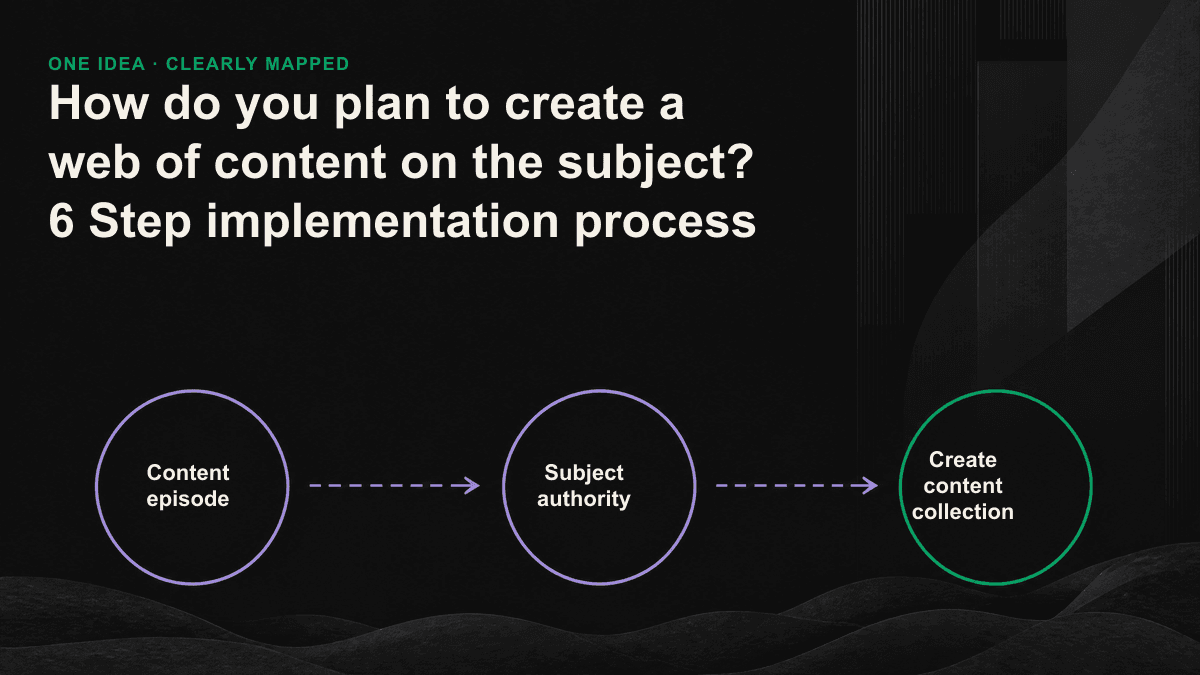
Step 4: Disaggregate the division of pillars and sub-pages
The two page types have different jobs, and combining them weakens both. A pillar page gives readers the full view and guides them through the topic. It is usually longer, more general, and aimed at a broad term. A cluster page answers one narrow question in enough depth to stand on its own and target a long-tail query. The common mistake is turning a pillar page into a grab bag that touches everything but explains nothing. Let cluster pages carry the depth while the pillar page acts as the hub.
Step 5: Write every piece as a clean answer
That's GEO's most working step. Every sub-page starts with 40 to 60 words to finish the core answer so that the engine doesn't have to guess. The paragraph is self-contained, and it's true that one thing is taken out alone. The possibility of being quoted is enhanced by organizing comparable information with clear subheadings to the reader, a list of suitability and tables, and FAQ structured data. Writing is like a consultant giving answers, not an encyclopedia.
Step six: On-line after-track visibility, continuous hole-up
The jungle isn't over. There are two things to go after when you go online: the rank and click of the traditional search, and the visibility of the AI engine: whether your brand and page are mentioned and linked in the ChatGPT, Perplexity, Google AI overview. That's why AI visibility monitoring is a tool. When you see a question that you have not been quoted, you add a page or rewrite it; when you see a page that brings a reference, you expand it to its neighbor. As the hole grows, so does power.
The difficulty of the content collection is not written, but the planning: select the theme, break the issue, link the structure. It's a three-step thing to do. I want to know how far I'm going to go and what the value is. There's no voice at all, so we can schedule a 30-minute GEO diagnostic session, and we'll go through the gap with your real theme.