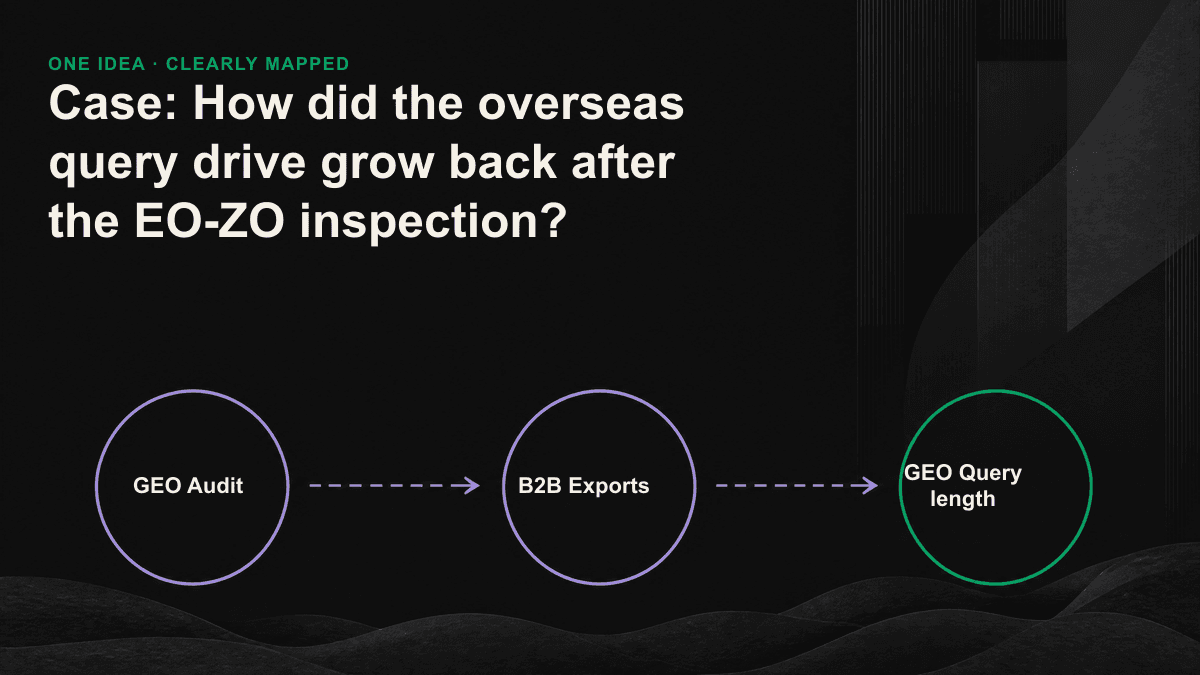
A medium-sized electronic Zero exporter, Google, did not drop the keyword, but the overseas information drive went down for two consecutive seasons. After 30 days of auditing the GEO and repairing a few broken mouths, the next season is about 40% of the overseas consultations, and for the first time a buyer has appeared in a letter saying, "I saw you on ChatGPT." The problem is not that the content is inadequate, but that the product and energy information cannot be extracted from the AI engine.
Background: The rankings are stable, while the query disk is shrinking.
This client has been in the area of active parts and connectors for more than a decade, working side by side with his own brand, with the main market being small and medium-sized facilities in Europe and South-East Asia. The site has a page in English, a model PDF, Google, and most of the search categories and rules are on the first page. The source of the query was simple: Google Search, Business Card Show, Old Client Referral. Since the second half of 2025, there has been no significant change in website traffic, but the table sheet has been reduced by more than 20% each season.
Business is more direct. The buyer's letter used to say, "I've found some of your series," and more and more people started talking, even though two or three suppliers had to compare, as if the shopping exercise had been done before we were contacted. Those homework, a lot of them are done in the AI assistant. The buyer asked ChatGPT, "What are the European Code, the current range, and the connectors that can produce small quantities?"
Audit, 30 days, three holes.
We broke the audit into two things: first, the real visibility of the company in the mainstream AI engine (ChatGPT, Perplexity, Google AI Overviews, Gemini) and using Brand Radar to track down a group of buyers who would really ask for a shopping interview; and second, the web site and data structure, why the content went to Google and failed to get an AI answer. Three cracks quickly surfaced.
- Key rules are locked in PDF. The current, voltage, work temperature, and containment dimensions of the product are in the model PDF, and the HTML page has only one distribution description. It is not possible for AI to obtain comparable parameters when capturing them, and naturally it is not possible to quote them in a question such as "suppliers meeting these criteria".
- The product page does not contain structured data, nor does it have an independent response paragraph. The whole page is like a brief, and AI will skip if it's too expensive and risky to quote itself.
- No third-party language is endorsed for it. The brand name is almost non-existent in industry media, B2B directories, and standard comparisons, and AI lacks cross-references and is afraid to put it on the list.
These three points together explain that contradiction. Google recognizes the old site by matching the weight of the link with the keyword; the AI engine wants a structure that is directly readable, cross-checked, and safely quoted.
What surgery did you have in 30 days?
The audit is over without a report. We're in the first place, starting with the highest three things. First, move the key rules of the main product line from the PDF into HTML, make a readable parameter table and add a structure and FAQPage label. Second, write a self-contained paragraph for each product category, "Who does this series fit, who doesn't fit, who does it?" so that AI can draw on it. Thirdly, three high-intensity English-language queries are locked, content engines are used to produce comparative and applied articles, and brand data are simultaneously added to several related B2B directories and business records.
I thought I was going to throw money into a new site, and what really worked was to change the rules that we already had to read them.— The client's sales manager.
90 days later, the volume and quality of the query board changed.
We didn't stop after the operation, and we continued to use Brand Radar to track down the quotes every two weeks. The first 30 days of seeing the AI quote show up: Perplexity started to list the product pages as a source in a few standard questions, and ChatGPT's answer will be branded. The changes in the query drive are slower, but they will be reflected in the next season.
- The offshore billboard is about 40 percent higher than the previous season, with a significantly higher number of new arrivals.
- Starts to appear on the buyer's `see on ChatGPT, Perplexity' query, which was zero before the audit.
- Query quality improved: the ratio of ‘payable prices’ (with clear parameters and numbers), has increased, and the cost of pre-business communication has decreased.
It's cause and effect that deserves to be made clear. We didn't increase the ad, we didn't change the price, and the show was the same as last year. The only major variable of this season is that the product information becomes read and quoted by the AI engine. Query growth is not a genre. It is the entry point for buyers to do their homework, extending from Google only to AI assistant.
Can this copy your product line?
If you also encounter "Google's ranking is still on, and the board is falling", the problem is probably that you can't be seen in the section of the AI engine. If you want to know whether your product information is being used on ChatGPT, Perplexity, or where it is missing, you can schedule a 30-minute GEO diagnostic session, and we'll use your real shopping sentence to make a real round and tell you what to do first.