A Taichung precision-parts manufacturer won a six-figure annual order after a North American procurement engineer asked Perplexity which Taiwan suppliers could produce custom connectors in small batches. AI named the company. Trade shows, cold outreach, and a first-page Google ranking were not the starting point. The same query did not surface the company three months earlier; a GEO audit and three months of execution changed the result.
Before the Audit: A Strong Factory Invisible to AI
The company had produced precision connectors for 20 years. Its yield rates, certifications, and lead times compared well with industry peers, and overseas customers rarely left. The problem came before retention. New business depended almost entirely on trade shows and referrals, while the website served as an online catalog. Over the past two years, more procurement teams have started by asking ChatGPT or Perplexity to list suppliers that meet a specification. At that stage of research, the company did not exist.
The owner was skeptical, so we demonstrated the gap on the spot. We tested eight questions drawn from three key product areas in mainstream AI engines. The brand was never mentioned, while two smaller competitors with more active content earned repeated citations. The owner chose to audit the problem before spending more on advertising.
Three Gaps Revealed by the 30-Day Audit
A GEO audit measures whether AI engines can understand and cite the company, not a vanity ranking. After the audit ran for 30 days, the problem had narrowed to three fixable gaps:
- Content was not extractable: product pages consisted of catalog specifications and marketing adjectives but did not answer procurement questions about minimum order quantity, customization lead time, certification scope, or suitable industries. Without a clean answer, AI would not use the company as a source.
- Machines could not identify the company: the official site had almost no structured data. Without Organization and Product schema, AI struggled to confirm the company's identity, product lines, and credibility.
- Brand visibility was nearly zero: AI visibility monitoring tested eight core procurement questions and found a mention rate of 0/8. Competitors controlled the answers to every related question.
Closing the Gaps: Turn the Catalog into Extractable Answers
Once the direction was clear, execution was straightforward. We kept the existing site and changed only what mattered. First, we rewrote core product pages as self-contained Q&A passages: the opening sentence gave the answer, followed by the relevant specifications and use case. Second, we added Organization and Product structured data so machines could identify the company and the boundaries of its capabilities. Third, the GEO content engine answered real procurement questions, such as how to select materials for small-batch custom connectors and which certifications matter for medical-grade connectors. Buyers ask those questions before ordering; they do not ask how impressive the factory is.
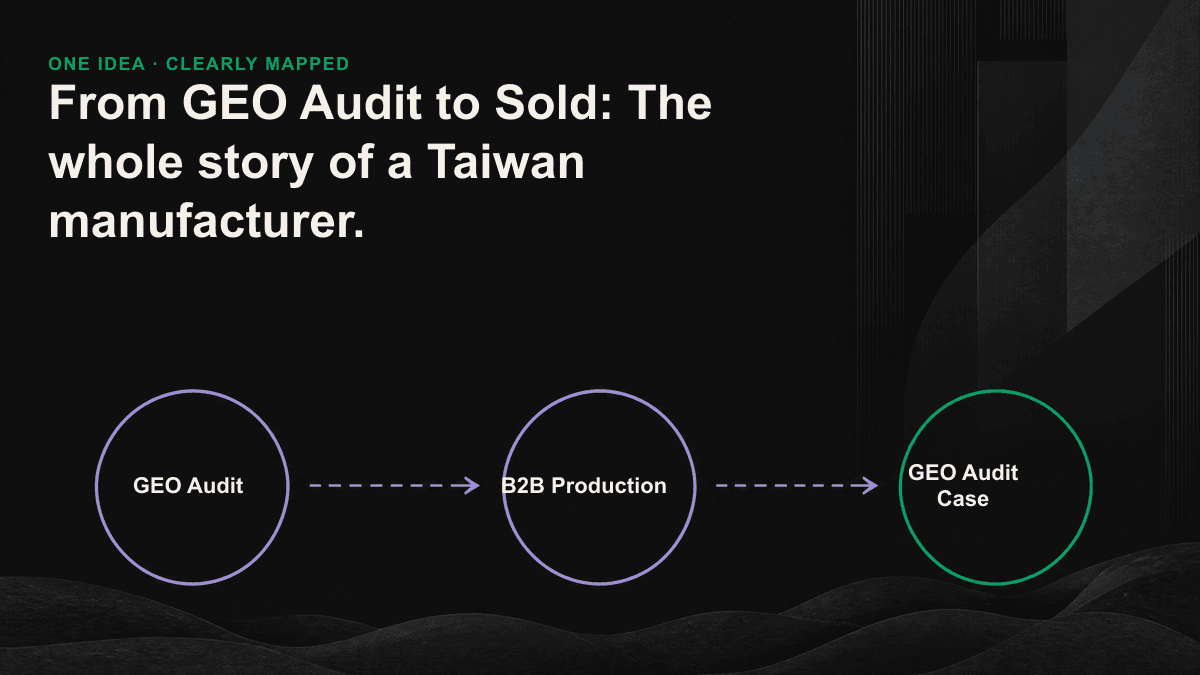
We completed the rewriting and markup for three core product lines in the first month, then added a new set of answers every two weeks. There was no magic. We took expertise that already existed inside the factory and presented it in a format AI could read and procurement teams could use. The technical leaders held the most valuable knowledge, but it had lived only in quotation emails and phone calls rather than in citable assets.
What AI Visibility Monitoring Revealed
Visibility must be measured, not felt. Every week, AI visibility monitoring tested eight core questions across ChatGPT, Perplexity, and Google AI Overviews. On the 30th day, the brand's mention rate rose from 0/8 to 3/8. At 60 days it reached 5/8, and after three months it stabilized at 6/8. For two questions, Perplexity linked directly to the site's FAQ page. This measured whether AI named the company when a potential customer asked, not whether a traffic report looked encouraging.
How the Order Arrived
The path to the deal was clear. A North American procurement engineer used Perplexity to find an Asian supplier. AI cited the manufacturer's article on material selection for custom connectors and linked to the official site. The engineer opened the FAQ, found explicit minimum-order and prototyping timelines, and submitted an inquiry immediately. The content had already answered the early questions, so the lead arrived with a lower trust barrier. Sales completed the prototype, quotation, and order within 30 days. The owner summarized the difference plainly:
A trade show used to cost hundreds of thousands of dollars and produce a stack of contacts that required months of follow-up. This customer found us independently and arrived already inclined to trust us because the AI answer matched what our site said.
Can Another Manufacturer Reproduce This Result?
Yes, if the product is genuinely strong. The audit did not create expertise; it uncovered the company's buried knowledge and translated it into language AI could read. Content cannot sustain a weak product. Taiwan nevertheless has many technically capable B2B manufacturers that remain invisible in AI because machines cannot identify their strengths. An audit shows where that recognition gap sits and whether it is worth fixing before the company spends heavily on content or advertising.
To find out whether AI will name your company when a customer asks which suppliers can meet a requirement, book a 30-minute GEO diagnostic session. We will test several questions from your own product lines and show you the answer.