ChatGPT does not "read" your web page like a browser does. It retrieves a piece of fact that can be quoted cleanly from its own search index and then spells it into an answer. The value of structured data and entity tags is not to help you "rank", but to save the machine from having to guess: what your product is called, what category it belongs to, who provides it, and what problem it solves, all written down in machine-readable form. Without this layer, ChatGPT can only make inferences from the text you have scattered all over the page. Once the inference is wrong, the references will also be wrong.
ChatGPT reads facts, not layouts
First figure out how ChatGPT gets your content. When a user triggers a search in ChatGPT, OpenAI's OAI-SearchBot will crawl the HTML of the page, together with the existing web index, select several sources and feed it to the model to generate answers. There are two practical limitations to this process. First, what it gets is mostly initial HTML, and a lot of content that relies on browser-side JavaScript is often not captured; second, what the model wants is not your carefully laid out layout, but facts that can be extracted in one sentence and quoted directly. Structured data such as JSON-LD can write "This is a product with the name
Let’s be honest here: structured materials are not a magic switch to citations. The pattern we see when we perform GEO audits for B2B SaaS customers is that the schema itself rarely directly determines "whether it is cited or not", but it almost determines "when it is cited, whether the facts are correct or not." If you state the same set of facts clearly in the visible text and mark them once with JSON-LD, it is equivalent to giving the model two clues that corroborate each other. If you only mark the facts but leave the text unclear, the effect will be greatly reduced.
Minimum viable setup: three schemas are enough to get started
It is not necessary to upload all types from schema.org at once. If you want ChatGPT to understand a B2B product, you must first make the three tags correctly, and it will be 80% effective.
- Organization: Place it on the homepage of the website or share it throughout the site. Write clearly the brand's full name, logo, official website, and the most important sameAs - connect your authoritative pages such as LinkedIn, Crunchbase, and Wikidata (Wikidata). This is the anchor point for the model to identify "who you are."
- Product or SoftwareApplication: placed on the product page. Fill in name, description, brand, and offers (pricing or plans); if there are real reviews, add aggregateRating, if not, don’t fill them in.
- FAQPage: Place it on the product page or description page, and use real questions and answers to present the three to five most frequently asked questions by users. This is the format that is easiest for ChatGPT to extract directly as an answer, because it is an inherently clean pairing of questions and answers.
All three types of tags are written into the page using JSON-LD. Do not use Microdata, which was scattered in HTML tags in the early years, because it is costly to maintain and prone to errors. Each piece of JSON-LD must match the content visible on the page: if the tag says there is a rating, the page must actually have a rating; the price of the plan written in the tag must be consistent with the product page. If the mark is inconsistent with the text, it is invalid and may be judged as manipulation.
Physical markup is the real leverage
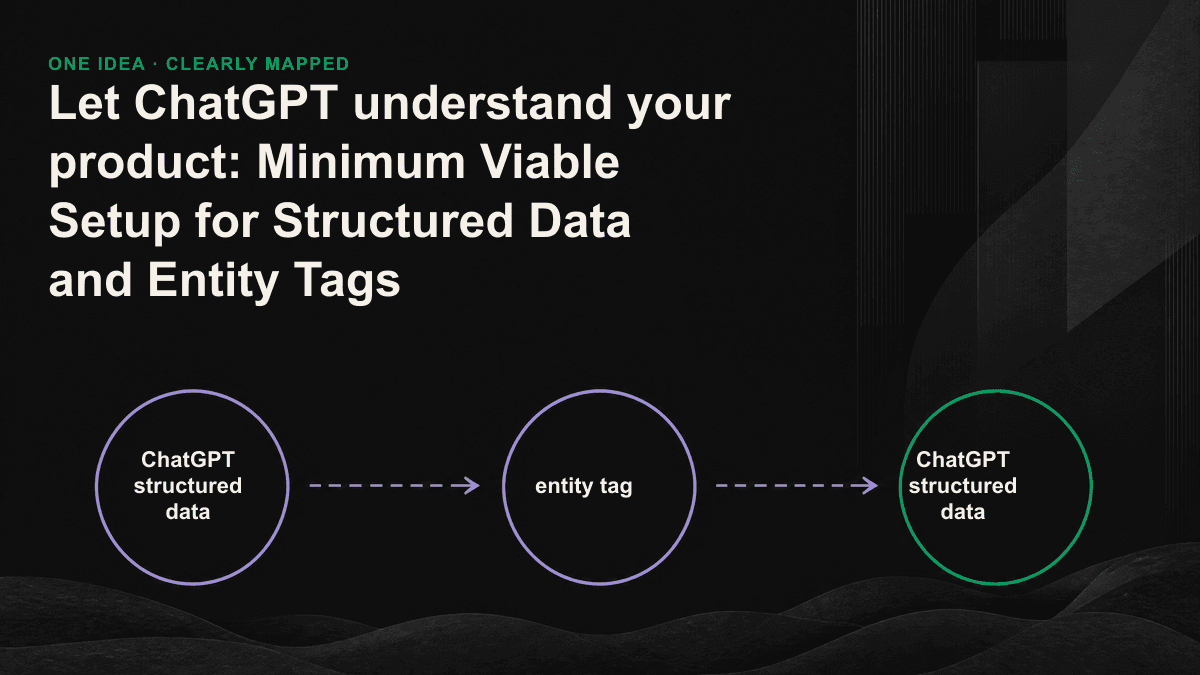
Most people stop using structured data as Product, but to make ChatGPT "recognize" your brand instead of just "reading" a certain page of yours, it relies on the entity layer. The core job of entity tagging is disambiguation: there are dozens of products called "Radar" on the market, and you have to make the model 100% sure that when it references you, it is talking about yours, not another company with the same name. Without disambiguation, no matter how much content you contain, it will only accumulate vague impressions for others.
The setup has three parts. First, use the same full brand name on your official website, social profiles, directories, and press releases. Do not alternate between “Tenten GEO” and “Tenten.” Second, build an entity graph with @id. Give Organization a stable @id, such as https://yoursite.com/#organization, then point Product.brand and Article.publisher to it. This lets the model connect facts scattered across different pages to the same entity. Third, use sameAs to link authoritative external sources, especially Wikidata, an entity database shared by many AI systems. A consistent entry gives the brand a cross-platform identifier.
Don’t let crawlers be kept out
No matter how beautifully written the mark is, it is useless if the crawlers cannot get in. This step is most often ignored, but most likely to cause problems.
- To allow robots.txt: Make sure that OAI-SearchBot (for ChatGPT search) and GPTBot (for OpenAI crawling) are not blocked. Wanting to be quoted but blocking both of them at the same time is the most common self-defeat during our audits.
- The key content must be readable in the initial HTML: if the product description is purely rendered by front-end JavaScript, the crawler is likely to get a blank. Use server-side rendering (SSR) or static generation to write core facts directly into raw HTML.
- JSON-LD doesn't wait for page interaction to be dynamically injected by a script: let it exist in the HTML of the first response, so crawlers can read it at first glance.
Verify before going online, don’t rely on feelings
It is much easier to complete a verification pass before publishing than to guess "why it was not cited" afterwards. Use Google's Rich Results Test or Schema.org official validator to first confirm that the JSON-LD has no grammatical errors and that all required fields are complete; then use the browser's "View Source" instead of the Elements panel of the developer tools to confirm that the markup really appears in the original HTML and is not added afterward by a script. The last step is the most direct: go to ChatGPT and ask "What does a certain product do?" and see which source it cites and whether the statement is correct. This is the acceptance test that is closest to the actual usage situation, and it often reveals the inconsistency between your text and markup just by asking.
Structured data and entity markup are the starting points. If you do it right, the facts will be correct when ChatGPT cites you; if you don’t do it, you won’t even be qualified to be cited cleanly. The gap in most B2B websites is actually not whether the schema is written or not, but the tags and text do not match, the entity naming is inconsistent, or the crawlers are simply blocked. If you want to know what your website looks like in the eyes of ChatGPT and where the gap is, you can book a 30-minute GEO diagnostic session. We will show you the problem points of extractability and entity clarity.