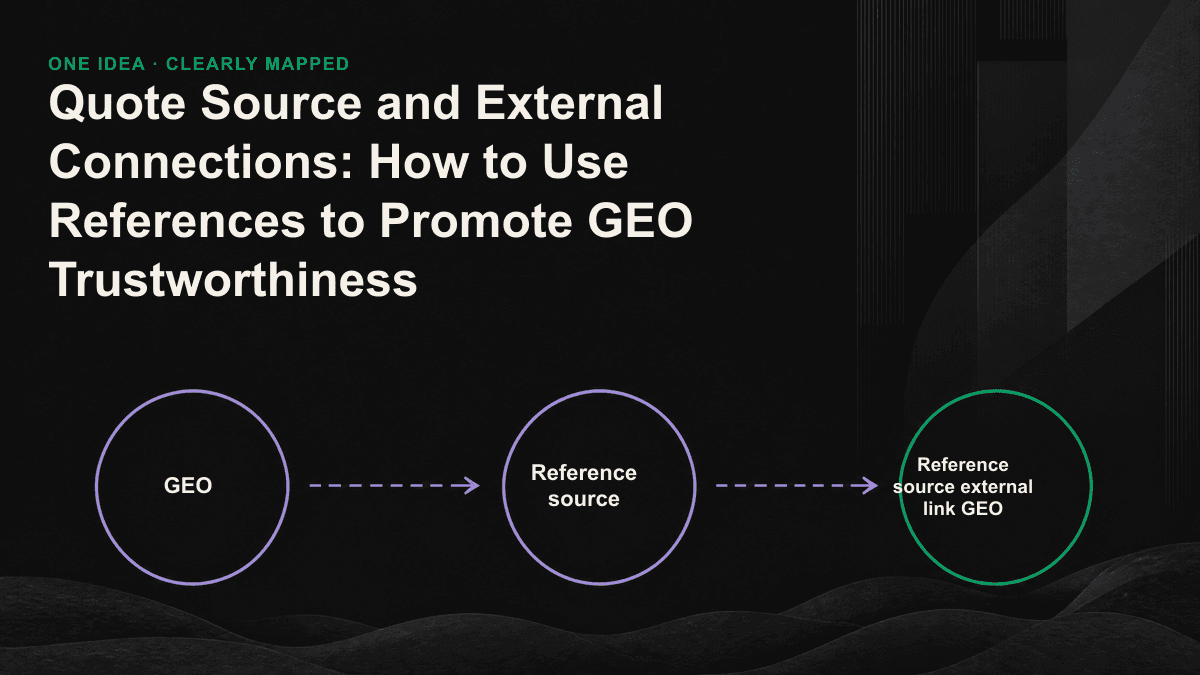
When deciding which text to quote, the AI engine will select the "exposed and cross-checked" paragraph first. In other words, every number on your page that doesn't have a citation source, and every conclusion that doesn't have a link, is telling the model that no one has endorsed it, so it would rather quote someone else. Quoting source and external connections is not an academic decorator, but a key signal from the GEO era that you will not be pulled out by AI and put in the answer.
AI, why does the engine care if you have a source?
When the generative AI engine answers the question, the worst thing to fear is to say the wrong thing. ChatGPT, Perplexity, Google AI Overviews are all watched by users, and once misinformed, it hurts their trust. To protect themselves, these systems prefer "low-risk" content when selecting the material: access to the headline, numbers to the original report, author identification. You open up the source, and it's like helping the model finish the check, and it's gonna cost you less. On the other hand, a beautiful but isolated text, models that don't know what to believe, is the safest way to skip.
AI, how do you know a source is not credible?
The model does not really click on every link word for word, but it combines several signals to estimate the credibility of the page. In fact, these are the most affected:
- Source authority: You're connected to original research, government or industry, or another blog post that has no place in it. The error is equivalent to endorsement of low-quality content.
- The fit between the headline and the source: the number, the conclusion, was not really in the data that you linked. A cow's head is not right in a horse's mouth, and a model is not consistent.
- The exact extent of the source: The writing of "a survey of the industry according to 2025" is far less than writing about who made it, when it was issued, and how much the sample was. The more specific, the more verifiable.
- The author and the website itself: Is there an author's signature, a history, a whole site that continues to be produced on the same subject? This is the floor of E-E-A-T.
Internal references and external links, doing everything.
A lot of people consider "connection" as a matter of fact different from the inside of GEO. External connections point to the source of authority, which serves as a guarantee for your master that the model will dare to quote; it serves the credibility of a single sentence. The internal link is to tie up the deep content of your own website and tell the engine that "I'm not just writing about this subject, I have a whole set of it" and that it serves the whole theme. And both of them are: there is only an outsider, as if you were trying to quote others, and there is only an insider, as if you were a self-confined, without external verification. A healthy page contains two messages and each points to the target.
Write the source into an AI clean extractable format.
It's not enough to mark the source, but the key is to get the machine to match the "propose" with "outside." The extract engine reads the paragraph structure, not your layout. The principle that we offer our clients is direct:
- The main idea and source are in the same paragraph, near the same sentence, and not in the second paragraph, but in the end of the text, the model is difficult to connect.
- numeric writing: Who comes up with this result at what level and at what point, and ends with a single sentence that remains valid when it is taken out alone.
- Linking text to describe the target, using the "Stanford GEO study" instead of the "point here," the anchor text itself is a text message for the model.
- Completing data (e.g. citation, author, date of release) on key facts so that the machine does not have to guess.
These methods of citation are deflated.
Adding sources in the wrong direction, worse than not. The first of the most common is the "false origin": writing "with research pointing out" without giving any agency, year or link, and the model reads this vague attribution and sees it as a lack of support. The second type is linked to pages that are no longer valid or whose content has already been modified, which is out of place and which, if judged inconsistent, would lower the credibility of the paragraph. The third type is to cut down on low quality sites and dilute the weight signal to counter the number of connections. The fourth category is more hidden: the entire section refers only to its own page and forms a closed circle, with no endorsement from the outside world. Quoting quality is always more important than quantity.
Instead of placing ten links in a single article, the three core themes should be matched by a source of right and right authority.
Where do we start?
If you want to do something, don't rush to change it all. Pick out the three or five articles that you most like to be cited by AI and check them paragraph by paragraph: each number has its origin, each sentence has its validity, the outside link is directed at the original authority or the second hand, and the author's identity is not checked. It is generally clear that the chances of being extracted can be increased by simply matching the sources of these pages and changing the causes of vague attribution to the physical source. It's not so hard to do it systematically. If you want to know where the credibility gap on your website is in the eyes of AI, you can book a 30-minute GEO diagnostic session, and we'll use a real engine to ask which pages you're missing and why.