The more you write competitions on your home site, the less you're going to be able to do it, the less you're going to do it, the less you're going to do it. The generative AI engine evaluates the neutrality of the content when selecting the source, and the reverse is more likely to be given less power to sell the material, the worst of which is to skip the whole page and replace it with a third-party evaluation or a competitor’s own document to answer the user’s questions.
How does the AI engine "smelt out" bias?
The language model, before producing the answer, will screen the selected source for a round of hidden quality. It doesn't just look like a key hit, but it doesn't sound like a strong seller. When a "A-B" article is published, each of the cells is a winner, a competitor is red, and the model will recognize the motive behind the symmetrical structure and keep distance when quoted.
This is practical. We've been tracking AI visibility monitoring for B2B SaaS clients. The same query, AI, citing the G2 summary, Reddit's discussion thread, or the price page of the counter-officer's network, omitted the comparison that the brand itself wrote the strongest and the SEO rankings. The reason is not that the article is not good enough, but that it is too much like an ad and lacks the kind of tension that models need to judge "credible."
The real meaning of E-E-A-T in the comparison
E-E-A-T is experienced, professional, authoritative and credible. Most people talk about SEO as a sub-point, and in a comparative situation it's actually a doorblock. Experience means that you have actually used, deployed, moved these tools, and you have written the details you know only in practice; credibility means that you are willing to speak honestly where you are not. A comparison that doesn't even admit its weaknesses is like telling a model: there's no first-hand experience here, only marketing.
Thinking backwards. A really client-selected consultant doesn't say that there's nothing wrong with a product. He would say, "This is a very flexible data export, but the team is less than five people; it's fast, but there's an extra fee to be paid for the progression. Such a judgment with reservations is what the model would like to quote, because it reads like people are helping to make decisions, not being closed down.
Which signals will make you biased?
- Each column of the comparative table is home-checking, cross-crossing, and none of the cells is won.
- Describes the competitor using only vague negative words ( "complicated" "not flexible") without giving context or condition.
- There's no mention of the appropriate boundary of the home product, as if it's the best solution for all sizes and budget teams.
- The quoted data is not available or the marketing material is packaged as an objective evaluation.
- The conclusion always leads to the same answer, regardless of the needs of the reader.
How to use comparatives to be quoted
Change the target from "win-win" to "help your readers make the right decision" and write it differently immediately. First, we define clear and comparable dimensions: pricing patterns, speed of start-up, integration, data portability, support response time. Every dimension gives verifiable facts, not adjectives. When you write "B product will export batches" when more than 10,000 data are available, this is a sentence that models can extract and reproduce cleanly; when you write "B product has bad experience", it doesn't help anyone.
The most counterintuitive, and the most effective, move is to mark where the competitor is better than you. If the competitor is in a better situation, write it down and explain where the line is. It's not going to lose a client, it's going to create a real reader for you, and it's giving the model a signal: it's the source who dares to tell the truth, it's worth quoting.
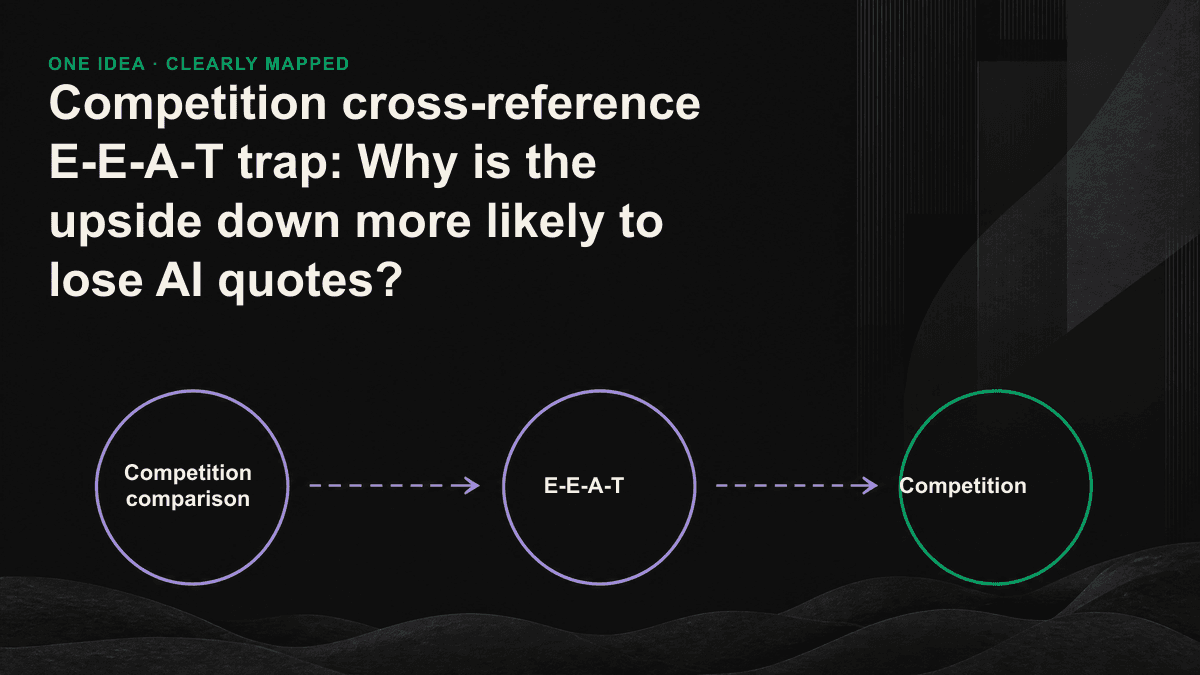
Make the structure "extractable."
After being honest, it's going to make the machine easy to read. Make each of the relative dimensions a stand-alone, self-contained paragraph, with a first sentence that leads to a direct conclusion, followed by a condition and evidence that allows the engine to respond to a specific question by just taking that paragraph. The table is marked with a real table, not a picture; the key judgment is written as a clear condition ( "If your team needs X, select A; if you care more, choose Y"). This writing also serves two types of readers: people who slide to the page and model the page for them.
The competition that is most easily cited by AI is compared to what you're selling, and it's like an honest fellow who's helping buyers to shrink.
Start with an honest comparison.
Back to check your current comparison, counting the numbers of the rivals. If the answer is zero, you're not dealing with the quality of content, but with a structural bias that will keep you out of AI. Change it to an option that you'd like to show to your friends, too. If you want to know if your comparison is actually quoted in or skipped in various AI engines, you can book a 30-minute GEO diagnostic session, and we'll show you the gap.