A consulting firm may spend five years building an SEO blog only to find that a single AI prompt has replaced the search journey. A prospect no longer searches Google for advice on choosing an M&A consultant; they ask ChatGPT or Perplexity which firms in Taipei are worth considering. Your article may help shape the answer without earning a mention. The solution is not ten more blog posts. It is to repackage the firm's expertise as a knowledge base that AI can quote and attribute.
Why Consulting Blogs Are Suddenly Producing Fewer Leads
The traditional consulting-content playbook was straightforward: publish enough depth for decision-makers to find the firm during research and let expertise create the inquiry. That worked well from 2015 to 2022. Now executives often begin by describing the situation in natural language and asking AI to narrow the options. This journey has no page of blue links, only a synthesized answer and a few cited sources. Your article can supply the raw material, but if its structure does not yield a clear, credible conclusion, the model will use someone else's words.
That is especially costly for consulting firms, which sell judgment and trust. When AI turns a distinctive point of view into a neutral rule of thumb, the brand, methodology, and case behind it disappear. The reader remembers the answer, not the consultant who developed it. Visibility must therefore be measured by how often the firm's name appears in relevant AI answers, not only by search position.
How an AEO Knowledge Base Differs From an SEO Blog
The two formats serve different reading behaviors. An SEO article is designed for human browsing, using a compelling title, narrative flow, and internal links to retain attention. An AEO knowledge base is designed for extraction. Each section must stand alone, answer a specific question directly, and make sense without the paragraphs around it.
- Paragraph structure: a blog may build a narrative; a knowledge unit states the conclusion first and then supplies the evidence, making the section easy to cite on its own.
- Heading style: a blog title may optimize for a click, while a knowledge-base heading uses the complete question a buyer would genuinely ask.
- Content unit: a blog is one long article; a knowledge base is a collection of answers that can each be retrieved independently.
- Trust signals: an author byline helps a blog, but a citable answer also needs specific figures, dates, methods, and sources that an engine can verify.
- Update cadence: a blog may sit untouched after publication, while a knowledge base needs regular revision so its claims remain current and internally consistent.
Turn Existing Articles Into AI-Extractable Knowledge Units
Most consulting firms already possess ample material, so they do not need to start from zero. The work is decomposition and reorganization. A typical article covers several topics and spends multiple paragraphs building to its point, leaving AI without a clean sentence to quote. Rewrite the material as a series of explicit questions, each followed by an answer that can stand on its own.
- Audit: list the articles that generated inquiries over the past two years and the ten questions prospects ask most often in initial meetings. Start with the topics that appear on both lists.
- Separate the questions: divide a multi-topic article into several units, each containing one question and one answer. Write each heading as the actual question.
- Lead with the conclusion: answer in the first sentence, then add conditions, evidence, and exceptions. AI often extracts only the first one or two sentences.
- Add verifiable signals: include concrete figures, scenarios, dates, and methods instead of unsupported phrases such as “many companies.”
- Add structured markup: use appropriate FAQ or Article schema so engines can recognize the material as referenceable question-and-answer content.
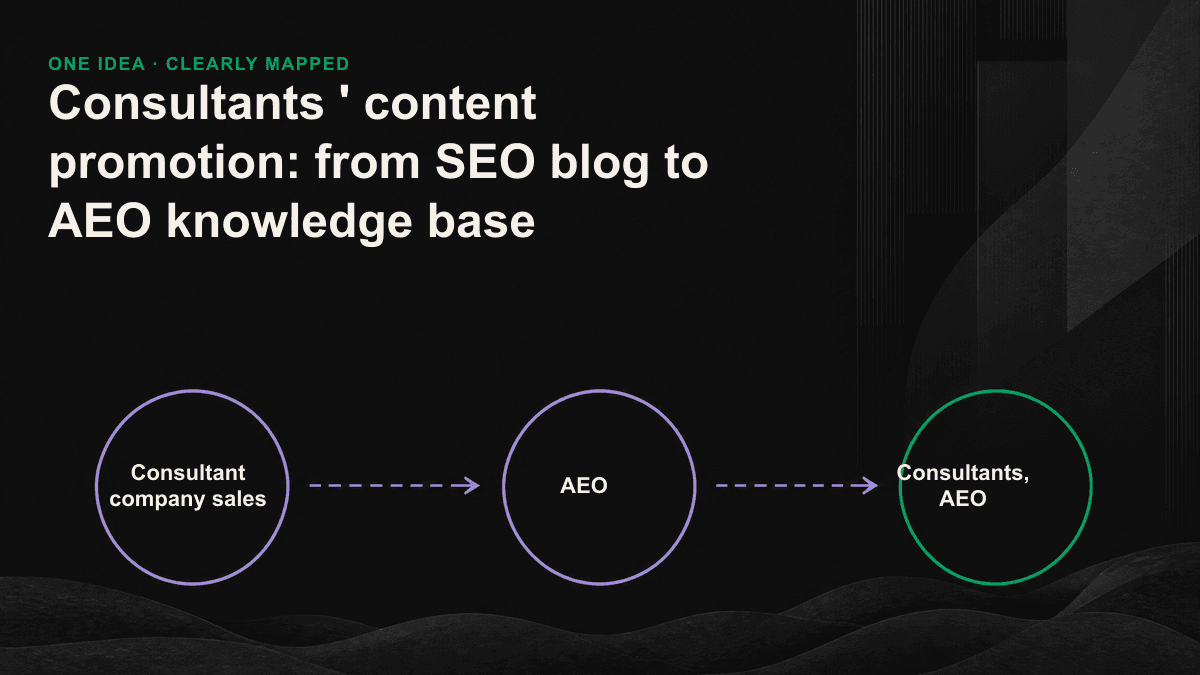
Four Types of Consulting Content to Rewrite First
Not every page deserves equal attention. A consulting firm with limited resources should begin with topics closest to a buying decision and most likely to appear in an AI question.
- Methodology: explain how the service works and how the approach differs from common alternatives. This language shapes how AI describes the firm.
- Selection criteria: “How do I choose an X consultant?” is often the first question a prospect delegates to AI. Your expertise should be a source for that answer.
- Industry insight and data: first-hand observations are scarce, differentiated evidence that AI engines are more willing to cite.
- Cases and outcomes: present publishable results as a clear situation, action, and result instead of a collection of promotional adjectives.
How to Tell Whether AI Is Citing Your Firm
Traditional SEO measures rankings and organic traffic; AEO measures mentions and citations. On a regular schedule, ask ChatGPT, Perplexity, Gemini, and Google AI Overviews the questions prospective clients use. Record whether the firm appears, how it is described, and which competitors appear beside it. Because manual sampling is laborious, an AI visibility monitoring system can repeat the process consistently. The useful metric is no longer keyword position but the share and context of citations across a core question set.
Where to Begin
A consulting firm does not need to rewrite the entire site at once. Choose the five questions clients ask most often that also sit closest to a decision. Use the five steps above to turn them into self-contained knowledge units, then check after two weeks whether AI answers have changed. To see which questions competitors currently own and which of your pages receive no mention or citation, book a 30-minute GEO diagnostic. We will test the firm's real questions and identify the gaps worth addressing first.