A two-thousand-word article may yield only one citable passage. The problem is often format rather than substance: AI systems prefer clearly structured passages with firm boundaries, while a linear narrative can bury its most useful facts in the middle of a paragraph. The engine can read the page but cannot extract a clean answer. Content reuse solves that problem by reshaping the same knowledge into FAQs, lists, and tables that machines can lift easily. The goal is to multiply the chances that the original article appears in ChatGPT, Perplexity, and Google AI Overviews, not to produce a second article with less effort.
Why does AI engine prefer to be detached?
A generative engine does not read an article from beginning to end and summarize it. It retrieves several highly relevant passages and combines them into an answer, so passage quality determines whether the page can be cited. A sentence such as "this topic can be understood on three levels, beginning with the background" offers little extractable value. "A GEO audit usually covers four checks: crawlability, structured data, answer density, and brand consistency" has a clear boundary and names the full list, so it can stand on its own.
This is the core of content atomization: tearing an article into an independent "atom of knowledge". Each atom answers a specific question, contains a complete link, and does not depend on the context. FAQs, lists, forms are valid because they are inherently atom containers.
Predator: What are the extractable atoms in a long text?
Read the original text and select each paragraph with a question: Will this paragraph answer the question that one reader will ask? Mark out the matching paragraphs, they're your ingredients. For example, in a long article about the GEO audit, these atoms are usually taken out.
- Definition: What is the GEO audit? Where is it with the traditional SEO audit? It's perfect for FAQ.
- Step: Which items will be examined sequentially by a review board? Other Organiser
- Comparison: What's the difference between GEO's content engine and the one-time pen?: appropriate for rewriting into tables.
- Numerical type: How long is the calendar, how many checks do you have? Other Organiser
- Other Organiser
The dot is produced as a matching table: the left is the original paragraph, and the right is the format that it best fits into. With this form, the rewrite is no longer based on feeling, but on putting each atom in the most fitting container.
Derived from long run FAQ: Renumber the narrative as a yes.
FAQ is the most popular reuse format since its structure directly corresponds to the way people type in AI -- a question. Rewrite three points. First, the question is in the real language of the reader, not in the commercial language: "How much time does it take to write the GEO audit?" rather than "exploring our trial schedule." Secondly, the first sentence of the answer concludes by putting the most critical facts and numbers at the top of the line, followed by the link, because the engine often draws only the first. Thirdly, each answer is 40 to 80 words, long enough to be self-sufficient and short enough to be quoted in the whole paragraph.
Do not forget to put on the FAQPage structured data. It's better to rewrite, and without the schema tag, the engine reads you at a higher cost. Content atomization and structure are a group, and the missing side is a pity.
Derived lists and tables from long run: to make comparison and step readable
The list is "sequence" and "co-column" and the form is "multidimensional". In the long text, "first, next, last" paragraphs can almost be upgraded to a numbered list; and "A is better for a given situation" paragraphs can be upgraded to two or three columns. In rewriting the sentence, the sentence is drawn from the table (for example, “Application team, output speed, maintenance costs, GEO effects”), and then added to the list, a comparison that the reader was supposed to put together in his own head, which became a quick look.
Format is not decorative. The same fact, the words can only be quoted once, and there are three entries to be taken out of the list.
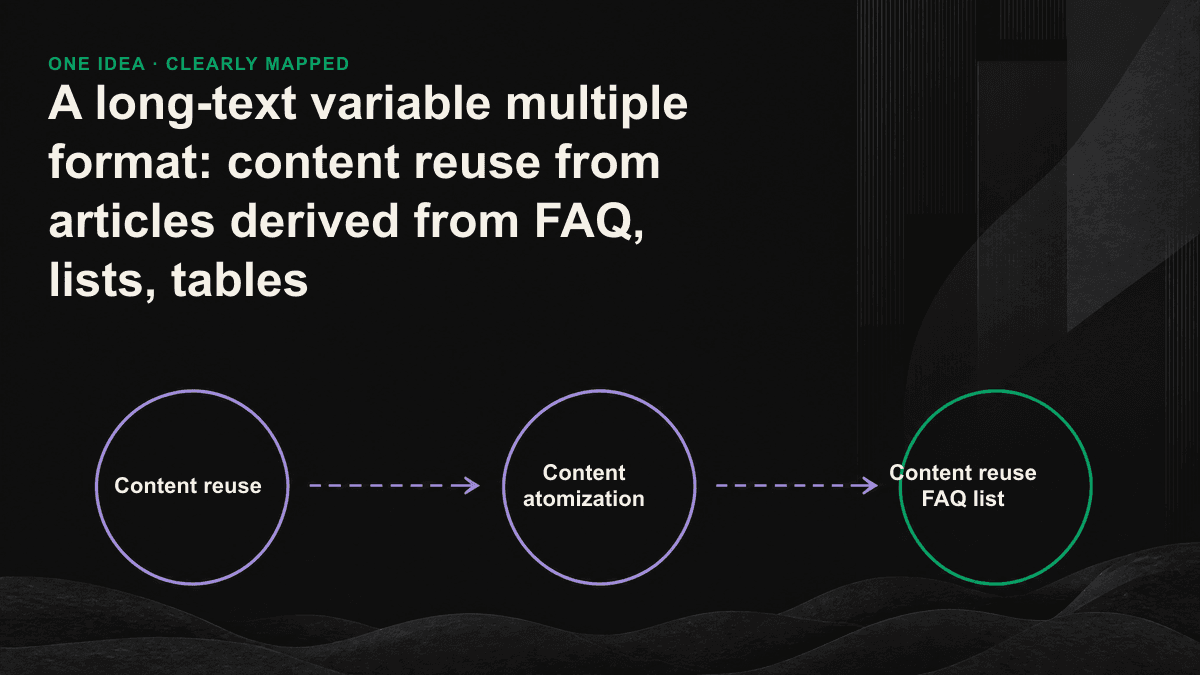
One original, multiple locations: not just a new article.
The derived FAQ, List, Table, best practice is not to create a new article, but to spread out to the most relevant locations. FAQ can either directly supplement the original text or remove the corresponding product page or price page; a more appropriate table can be placed on the service help page so that the reader who is evaluating can read the difference on the spot; the step list can be set up as a short teaching page and link to each other. The same knowledge appears at several entrances on the site, the overstretched inquiry is far broader, and the engine may have access to you under different problems.
This is also what Tenten GEO's content engine is doing: instead of producing a few more articles a month, it's atomizing and re-distributing the existing content bank system, increasing the frequency of what has been written. The long run is often the most undervalued asset.
Avoiding the three usual reuse traps.
- Direct copy: pasting the original paragraph into an FAQ preserves its slow setup and dependence on context. If a source fact dates from 2011, keep that date, but rewrite the answer so its conclusion still stands alone.
- Water for formatting: Not every paragraph should become a list. Hardly group two items into lists, stuff things that are not comparable into tables, only dilute density. Format for service content, not reverse.
- Rewriting doesn't matter if it's consistent: if the same number or definition is different in FAQ, form, text, the AI engine detects a contradiction and reduces trust in you. After atomization, we have to match the facts.
A process that can run today.
Pick a long article that you stand on top of, or most representative of, the core service, to tear it down to five to ten atoms with a previous table of points, each into a FAQ, list or table, to add the FAQPage label, and to spread over to the relevant page and to make a chain. After one run, you have a copyable template, followed by the ten most valuable pushes to the repository.