The content is not a product of "distribution is done" but of the assets that are dying every day. The problem with most B2B teams is not that they produce too little, but only when the organic traffic drops by 40 percent, the keyword slips from third to ninth, and it's only then that you're saved -- when Google has re-evaluated your authority, and the AI engine has changed its source of reference. What really needs to be done is to consider recession as a pre-set state, with a warning system that lights in the early stages of the downturn, rather than waiting for quarterly reports to break the cliff.
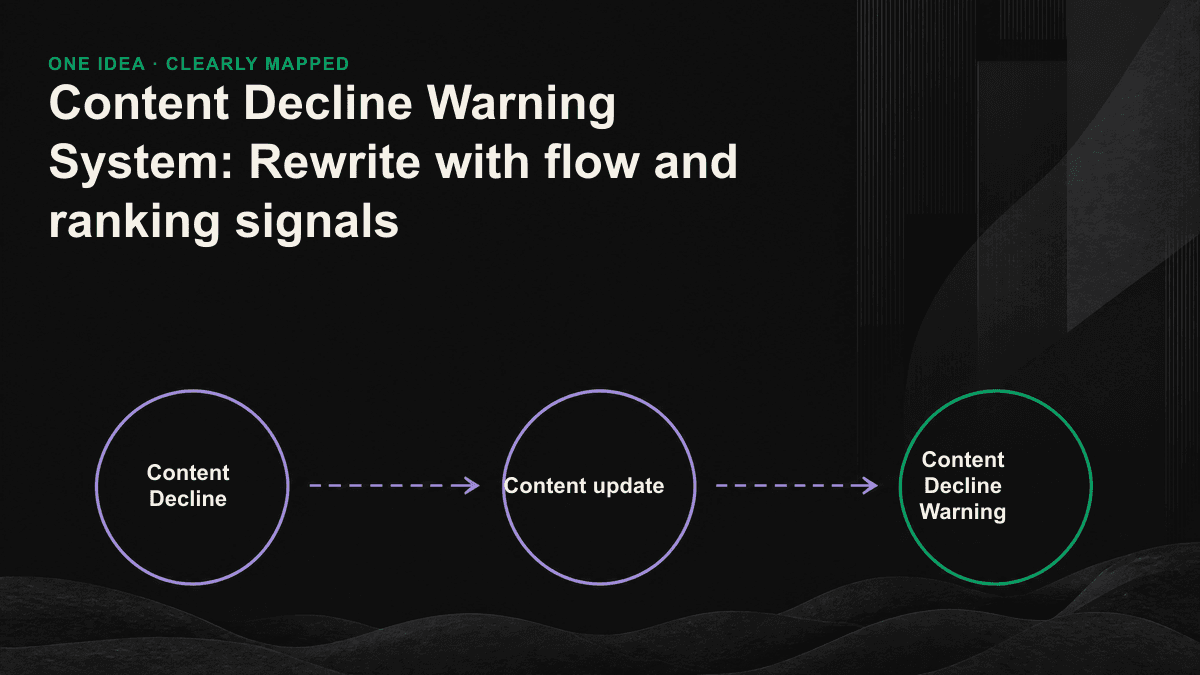
Recession is the fate of content, not an accident.
After an article was published, the competition that it faced changed every week. The competition has updated a more complete version, the search has moved quietly, the product code has changed, the number you quoted has expired, and Google’s core update has been re-washed every few months. The combination of these forces will allow a second-ranked article to fall slowly in six months, and the process will slow down until you do not see it in a single-day data. By the time you "felt weird," you've usually accumulated losses for three to six months. So the question is not whether the content will decline, but whether you can find it before it falls to the bottom.
The first four warning signs appeared.
A recession doesn't happen once, it leaves a trail in order. You're not monitoring the final flow figures, but the lead indicators that move earlier than the flow. The following four signals follow the appearances: the more advanced, the more expensive the response time.
- The ranking area is down, but the click is still missing: when the keyword slides from 2-3 to 5-8, because longtails and brand traffic are on the line, the overall click may have fallen a little. This is the first and most easily overlooked signal. Using the "average ranking" of Search Console is much more sensitive to the month than to traffic maps.
- The exposure is still there, the viewing rate is gone: the impressions of the same page are even and even rising, but the CTR is down, comparing your title and description to the updated contestants on SERP, or being squeezed by AI Overviews.
- Interoperability points are weak: shorter stay times, lower scroll depth, fewer internal connections, usually mean that content has fallen behind what users really want to know now.
- The AI engine no longer quotes you: in ChatGPT, Perplexity, Google AI Overviews, asking questions about your goals, found sources instead of competitors. This means that your content is losing its weight in the formative search, which often happens when the traditional ranking is not clear.
Set the doorbell: What numbers should light red lights
The alarm system is valuable for "auto-judgment" and not on a weekly basis. You need to map out a door that triggers action for each pointer, so that the system can push the rewrite page into your eyes. The following is the starting point that we used to deploy on behalf of our clients, and you can adjust it according to industry competition: the average ranking on the main page is down by more than 3 in 28 days, or CTR is lower by 20 per cent than in the first 90 days, or natural clicks are down by more than 15 per cent for two months, and any one set is on the list of "waiting trial". Write these conditions into the Luke Studio or a schedule of Seach Console API, better than anyone's instincts.
AI's engine age.
Traditional recession monitoring only looks at Google rankings, but now there's a big loss where you can't get your analysis tools. Users ask questions in the AI assistant, get answers and go. Your page is read, but it's not lit. This means that you need to track the Quoting Rates: On a regular basis, the main generating engine is asked with a set of fixed target questions to record whether your brand and page appear in the answer and are quoted in the square. The early sign of the loss of authority in the AI search -- that's what Tenten's AI visibility monitoring is doing -- turns cross-engine visibility into numbers that can be traced every week.
From warning to action: rewrite or rewrite?
The signal light does not mean that everything is rewritten from the beginning. It depends on the value of the page. The same marked page can be placed in much different ways:
- A small update: The content structure is still right, but the numbers are out of date and short of recent developments. New data, updated year, and a new change, usually stop bleeding in an hour or two.
- Rewrite: The search has shifted or the competition has given more complete coverage. This is a time to reset the list, fill out missing sub-topics, and add answers and lists that can be extracted cleanly by AI.
- Merge or phase out: two or three re-programming, diluting and weighting old texts, combined with a stronger home page, used the old URL 301 more effectively than their respective mandates.
Create your own alarm panel.
You don't need expensive tools to start. Send the search and web data of the Search Console to Locker Studio, using three tables: a ranking down, a CTR down, a click down, each with the front door and a colour mark. An AI citation tracking form is manually maintained and the main engine is swept every two weeks with fixed questions. This package, which takes less than an hour to maintain each week, can change your rewrite schedule from "by impression" to "by data." The real difference in content maintenance is not written by who, but who can fix the right page at the right time.
If you have dozens or even hundreds of articles in your hands, it's enough to judge which one is in recession and which one should be saved. If you want to know what pages you have on your site are being lost silently, and what is being quoted in AI, you can book a 30-minute GEO diagnostic session, and we'll use your actual data to create the best content gap worth rewriting.