The most dangerous place for content to decline is not three out of three, but the AI engine has removed you from the list of "referenceable sources." The article is still there, the page is not broken, the traffic is bleeding at both ends of the AI summary and the traditional search, and what you see backstage is just a slow, unprovoked curve.
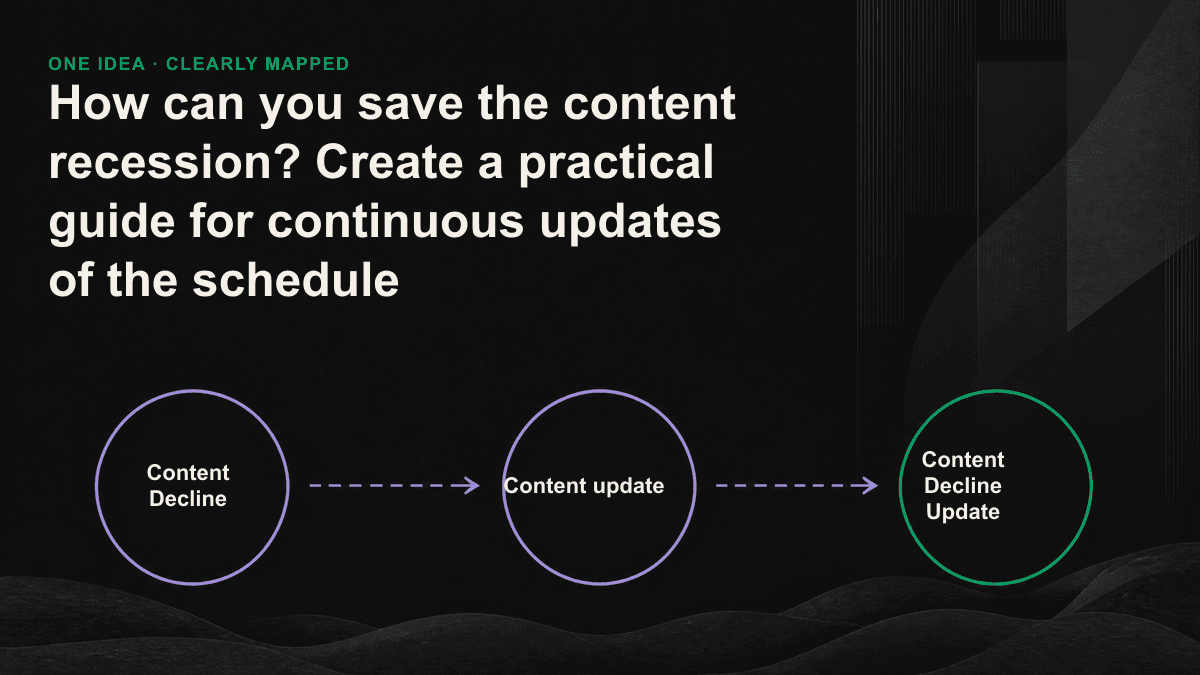
The content is declining on two levels in the AI era.
Traditional SEO decay is visible: keyword rankings and organic clicks fall in Search Console. GEO adds a second layer. When an AI engine generates an answer, it selects sources it considers current, credible, and factually consistent. If an article is two years out of date, its numbers no longer match reality, or a competitor publishes a more complete version, the model may stop extracting that passage. Search Console reveals the first layer; the second usually appears only through AI visibility monitoring.
Tenten often faces a situation when clients are audited: two years ago, a support article with a large number of queries, the traditional ranking was only a few, but questions were asked about ChatGPT, Perplexity, and the quotes were converted into competitions. The text is correct, it's just that the "exhaustible" is taken as a reason to be downgraded.
First of all, identify three recessions and not rewrite them all.
It's the most wasteful way to rewrite everything down. Classify before moving.
- De facto recession: price, version, statistics, years over. Minimum cost of processing, best reward, first priority.
- Competition Decline: The content is correct, but the competitor writes deeper and more clearly. It's not a few words to add depth and facts.
- Intentional recession: the searcher has changed what he wants, or the question has been answered directly by AI. Maybe change angles, or merge a few.
Three kinds of treatment are completely different. The de facto recession may require a few numbers and dates; the intentional recession may be repositioned as a whole. You'll spend a lot of time rewriting what you actually need to fine-tune.
Decision to update order with a fractional table
The core of the schedule is sorting, not "update everything." Three points are given to each election article: business value (with no questions, no responses to services), recession extent (how much traffic and how much is quoted), and up-to-date costs (how much is actually going on). High-value, high-recession, low-cost ranks ahead, save them first.
This table doesn't have to be complicated. A trial sheet is enough. The point is to rerun every season so that the sequence reflects the latest situation, rather than the impression of which one to save first. It's always your "remember" article, not actually lost.
Create an updated schedule: fixed rhythm plus trigger check
Updates can't be done only by thinking. With two orbits - fixed rhythm responsible for system scans, trigger check responsible for instant reaction.
- Season: Rerun the score sheet, pick out the top 10 to 15 to update the column.
- Monthly: Check the factual correctness and date of the first 20 high-value articles.
- When triggered, the affected page is checked as soon as the product is recast, price adjusted, algorithms or AI engines are substantially updated, competitions are released.
The rhythm has to be right for the team. A two-person content team, with a solid update of 12 articles a season, far more than 40, but only 8 cases were completed. The value of the schedule is to keep running, not to look good on the list.
Where are you actually going when you update?
The update is not a new release date, but the model looks at the content itself. In fact, one needs to examine on a case-by-case basis: whether the core conclusions at the beginning are still valid, whether numbers and years are updated, whether new questions have emerged in the past year or not, whether each paragraph can be extracted cleanly (self-contained, well-argued), and whether the title corresponds to the language that the user is really asking.
How do you know if the update works?
Traditional indicators see if rankings and natural clicks have recovered. GEO has to look at one level more: two to four weeks after the update, using target questions in the main AI engine, to see if your brand or page has been re-referenced. This thing can't be traced by Search Console, by a fixed AI. Without measuring, your new schedule is just labor, not strategy.
The content is more of a store than an asset that will appreciate. The inventory needs to be put together, replaced, replenished; it's only slow to pass.
Content decline cannot be cured, only managed. The real difference is: do you have a schedule at the main drive point, or do you wait until the questions drop? If you don't know which articles you're quietly losing citation in the AI engine, you can schedule a 30-minute GEO diagnostic session, and we'll use AI visibility monitoring to help you catch the worst and most deserving of help.