The content update should not have a one-week period. The idea of placing the entire blog in a "rewriting every season" is accompanied by two mistakes: to allow the otherwise stable foundational teaching to be carried over and over again, and to keep the content of prices, tools, platform functions, and so on, and misreading the AI engine. The correct approach is to rank each piece according to the rate of natural decline and give it to different frequencies.
Fixed weekly update, actually resource mismatch
Most teams have a long calendar of content: each article is followed by a "six-month review" reminder, and the time has come to do so. The problem is that the rate of recession has nothing to do with the date of distribution. A definitional article explaining what "GEO" means, more than two years later, requires only one sentence; a list of the best "AI Search Tool 2026" is wrong in three months. When you treat two people with the same period, the strength spreads on average where it is not needed, while the real pages of rotting pages do not come in. Add to the capture logic of the AI engine: when perplexity or ChatGPT quotes your page, they refer to the final physical update time and content consistency; a page that is outdated, quoted and gives the wrong answer, instead lowers the credibility of the entire domain in a model view.
Three speeds of content decline
Splits content into three categories, which is more practical than the theme. The same GEO theme, a definition and an annual comparison, can be eight times worse.
- Slow recession (definition, rationale, framework): Explains the substance of the concept, such as "What's AEO" and "how the vector search works." The core has remained unchanged for two or three years, fine-tuning only when there is an evolution of the arts or a new common understanding of the industry.
- Moderate recession (strategy, methodology, teaching): Process-type content such as "how to do GEO audits" The method is stable, but the tool's screens, operational steps, platform interfaces are increasingly out of step and require a physical calibration from six months to one year.
- Rapid recession (lists, comparisons, prices, data, annual trends): if the title contains years, "best" or "best" numbers or platform functionality matching, the life expectancy is in season. These are the pages that hurt the most because they are most often taken by AI to answer "which one to recommend."
Update frequency by type
Turning the three categories above to a specific rhythm, the team has a table that can be scheduled directly, rather than deciding which one to move today.
- Slow: once every 18 to 24 months, the whole view is updated only when the industry's consensus changes are defined.
- Medium speed: check every 6 to 9 months, with the emphasis on changing invalid screenshots, amending steps, adding new tools.
- Quick: every 1 to 3 months; year-type labels must be updated before the year goes by, and prices and functions change as soon as the difference is detected.
- Aberrant performance is first: any type of type that has a down- and down-graded reference on visible tracking or organic traffic, is adhesived and does not expire.
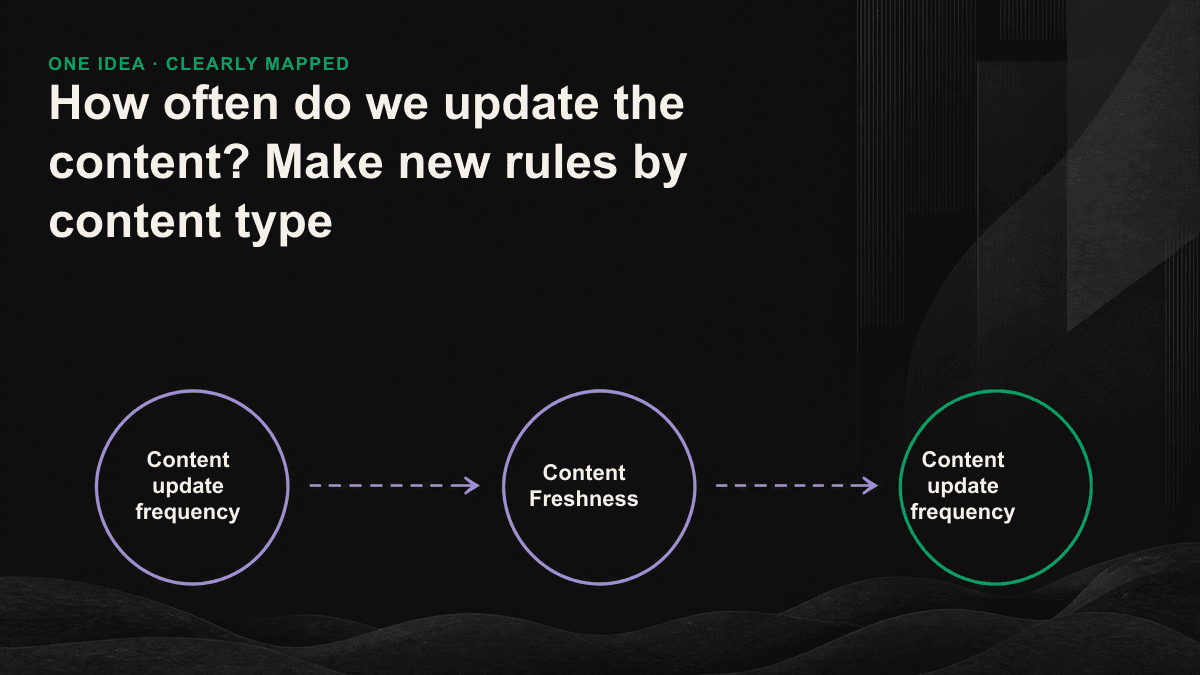
AI's engine cares, not just "changed dates."
A lot of teams mistakenly think that updating is pushing datemodified backwards. The search engine and the LLM would have recognized that. What is really fresh is the physical changes in the main body of the page: new paragraphs, changes in the number of times, additions to this year's cases, adjustments to the structure that make it easier to extract the answers. The change of time stamp, the fact that the text is in its original form, does not add points and may be interpreted as a manipulation signal.
Create a three-step program to update the program
You don't need a complicated tool to start with a trial. The key is to turn the update into a routine with trigger conditions rather than a big sweep that comes to mind at the end of the year.
- Categorize existing articles slow, medium or fast, and mark the last physical update date. This step usually leads to a series of high-risk pages that are "fast recessions but haven't moved for six months."
- Connect fast- and medium-decay content to observable signals: organic clicks, AI citation count, and target keyword position. Let the data trigger updates instead of relying on the calendar alone.
- Quantification: Taking the time of renewal as a fixed part of the content capacity usually captures 20 to 30 percent of total output. A team that writes only new articles and does not defend old ones will slowly eat up all the visibility that have accumulated.
The duplicate of old content tends to be more valuable than new content.
A page that has been recognized by Google and AI engines, accumulated external links and references, updated to be accurate and generally more efficient than writing a new article from scratch. And that's why Tenten's GEO content engine puts "sweet maintenance" and "new content" on the same line of production, rather than waiting for the page to rot and come back to fix it.
Content marketing is not a publishing industry, it's more like farming -- a poor harvest, nothing will grow next season.
I'd like to know how many pages in your repository are silently declining, and what high-value pages are worth saving, starting with a 30-minute GEO diagnostic session, and we'll use your real page to show how to grade and schedule.