Don't rush to reschedule. As soon as most B2B teams heard GEO, the first reaction was to plan a whole season of new articles, but the quickest thing to do was to get to AI, often the hundreds of old texts that you had published and never prepared for the AI engine. It's usually a small collection of assets that can be quoted in one step, and the cost of rewriting them is much lower than from zero.
Why do you think it's faster than new? Effect
When the AI engine extracts the answer, the preferences are clearly structured, the facts are dense, and the individual segments are self-contained. Your old text has long accumulated the weight of the theme, internal connections and external references that will take months for new articles to come back. The only problem is that these articles were originally written for Google's Blue Link: paragraphs are loose, conclusions are buried in the fifth paragraph, key definitions are scattered, and AI is hard to extract. If you put the existing content in a citation format, you can put it back on the base of trust.
Tenten helped clients with the GEO audit, and it was common to see that there were 120 articles in a repository, and that there were no more than 20. When the theme is over, traffic and conversion are close to zero. Half of the value of the count is to know what to change, and the other half to know what to put on and even to lay down.
Step one: make the entire database an operational list.
The dot is not the end of copying the URL to the trial scale. And you have to make a decision for every piece of the record, so that the categories and sequences that follow. After exporting the site map or CMS content list, the following information is added:
- URL, title, keywords for main objectives, distribution and final update date
- Organic traffic and conversion (forms, queries) for almost three months
- Are there any questions identified by the AI engine, using AI visibility monitoring or manually at ChatGPT, Perplexity?
- Type of content: definition, comparison, teaching, perspective, product
- Structure health: Is there a clear H2/H3, summary sentence, extractable list or table
- Factual novelty: numbers, versions, prices, whether the year has expired
Step 2: Categorize by "referenceable" rather than by theme
Subject grouping is useful when planning the SEO content, but to decide on the GEO reordering, the question is "a few steps away from being cited by AI." I'll divide it into four categories, each responding to different approaches and inputs:
- Ready to improve: the topic and conversion performance are strong, but the structure is weak. Add a summary sentence, split dense sections, and supply a useful list to make the page citable. Give these pages the highest priority.
- Potential type: The subject matter is valuable, but the fact is out of date or the content is thin and needs to be supplemented and rewritten, first and foremost.
- Merger: Several pieces of shallow text are on the same subject, and it is appropriate to add a single title to the title and clear up self-competition at the same time.
- Refrigerated: Time out, no traffic, not central services. We're not wasting the budget.
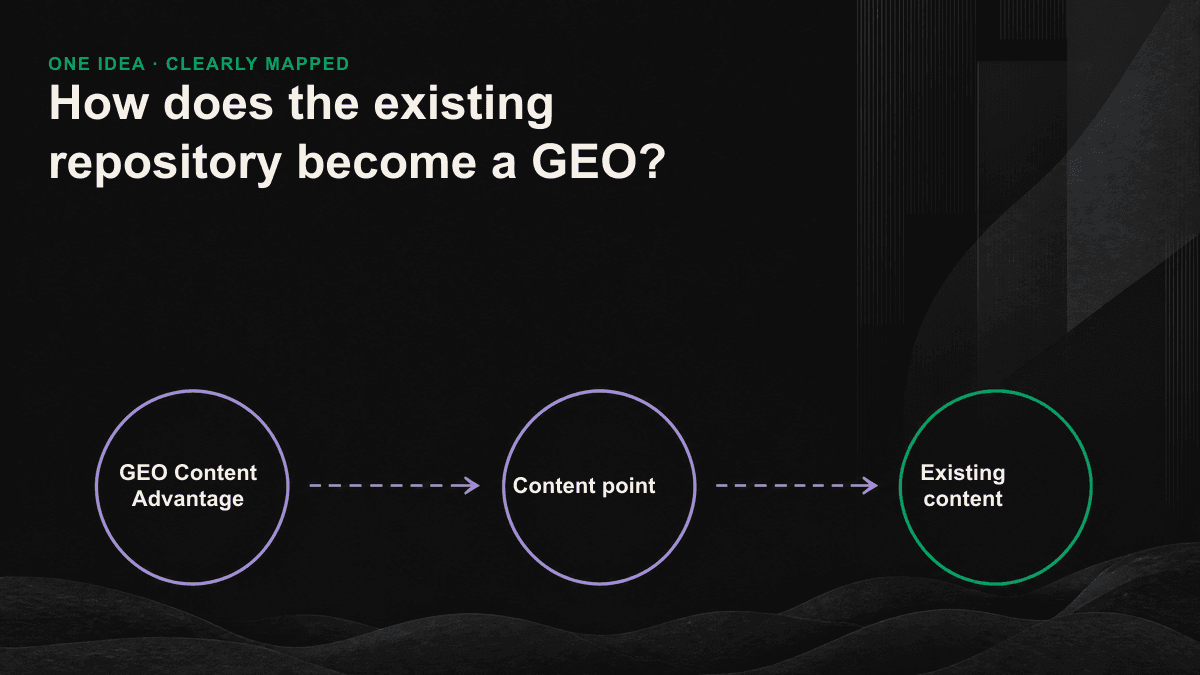
Step 3: Priority - Which one to start with
Sorting, sorting is actually halfway up. It's the front line, because it's the lowest input, the fastest recovery, and the team can see the first AI quotes in two or three weeks, holding up the budget. In practice, I will score each article with three dimensions: the cost of rewriting (lowest of the top), the value of the business (the subject is close to your fee service), and the frequency of the subject itself being asked in the AI engine. And the three multiply, and the first with high marks.
"This article, which AI will quote when answering any specific question, is not ready for inclusion in the list of jobs."
That's what forces you to push back from the question you really entered. If an article does not respond to any specific, business-intended query, it is mostly frozen and should not be ranked.
Rewriting an old one, it's actually these things.
GEO is not rewrite the whole text. The majority of war-style articles move in a few places, and the chances of being extracted are significantly increased:
- The first paragraph begins with a direct conclusion or definition.
- Every paragraph under H2 is self-contained, not dependent on the previous text.
- Change the contents of the row to a list or table to facilitate extraction of the entire paragraph
- Add a simple, verbal answer to the sentence that the reader really asks.
- Update all expired numbers, years and versions and mark the final date of update
- Add FAQPage, Article engine understanding content roles
From a one-time point to a running process
A corpus audit is not a one-time project. Facts age, engine preferences change, and competitors refresh their pages. Rerun the inventory each quarter, track which articles begin or stop earning citations, and reprioritize new gaps. Set aside 30 minutes for a GEO diagnostic session if you need to identify which existing assets have fallen behind and why.