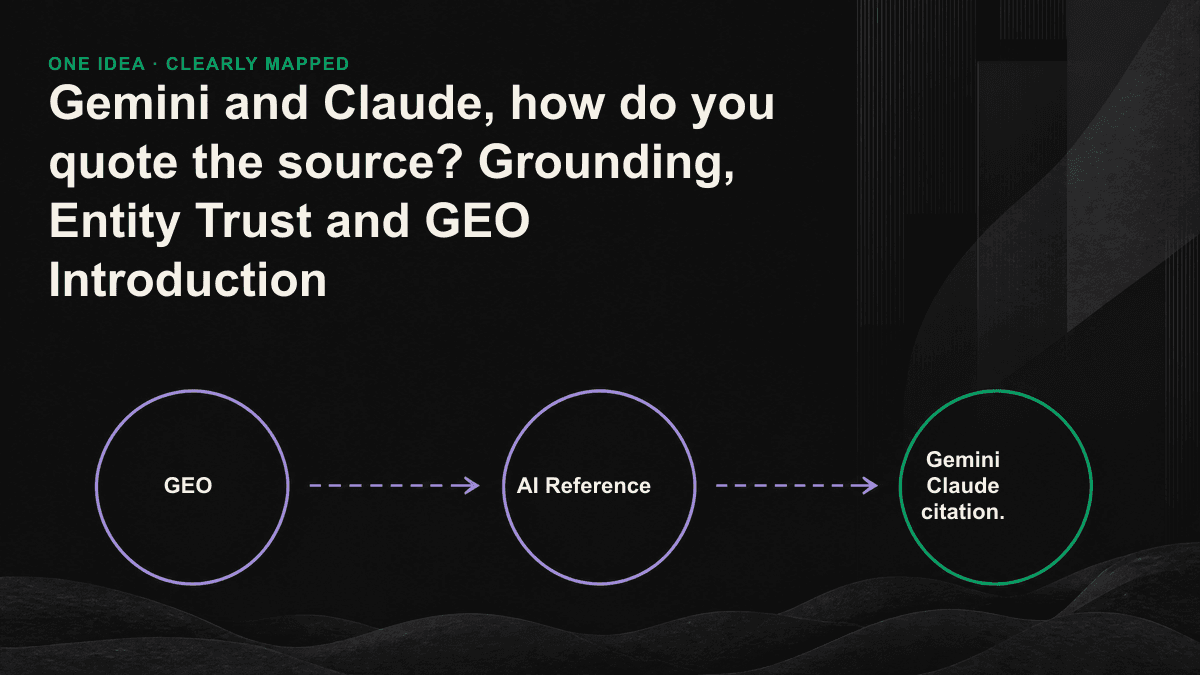
Gemini and Claude quotes the source in a different way, and understand the difference between this machine layer, which is the real starting point for GEO. It's almost irrelevant to be cited by AI in Google -- it's about whether the model can clean up a self-contained headline from your page, and it trusts the body behind it.
"Quote" in Gemini and Claude. Yes.
Gemini's quote is based on Google Search grounding. When your query requires immediate or factual information, Gemini triggers a background search, retrieves several paragraphs from the index, produces answers and appends the source as a reference link. It tends to integrate multiple sources and then labels which web page to which each sentence is directed. In the case of brands, can Gemini quote much depending on whether your content is included in the Google Index or whether that text is specific to users?
Claude has a different path. It retrieves data through a web search tool or search, refers directly to the original section and Attach a link to the source, which is conservative in its attitude - it prefers to prove clearly what it is, rather than drawing less or anything. When Claude works in a browsing situation, it anchors the answer on the page that it actually reads, not on the vague memories of training. This means that the text on your page must be able to be matched by words.
What's that?
Grounding is the binding of a model output to a verifiable external source. Without grounding, the model can rely only on old data from the parameter memory, which is easy to pass and can be hallucinogenic; and with grounding answers, immediate checking and attachments. Gemini uses Google to search as a grounding source, Claude uses its search and search tools, and the common premise is that your content must exist where they can and can be read.
- Read the user question and determine whether external resources are required. Feeds
- Triggering the search, maybe a search, or a call tool.
- Can not open message
- Pick out the most credible and answerable paragraphs to generate answers
- Attach the adopted paragraphs as references to the original source
Entity Trust: What makes a model believe who you are?
Entity trust is one of the most easily ignored and critical layers of GEO. The model determines whether to quote you, on the level of consistency of the brand, company or author across the Internet, rather than merely on a single page. When your corporate name, location, responsible person, description of service, contact information coincides with official websites, LinkedIn, product catalogues, and Wikipedia sources, the model is able to decipher these signals into a clear entity, and your confidence is raised by quoting them.
Scattered facts, inconsistent names across platforms, missing structured data, and no third-party verification all make a source harder to trust. Even an excellent article can lose the citation to a more ordinary competitor whose entity signals are complete and consistent. Content quality earns consideration; verifiable identity gives the model confidence to name the source.
Why does "first in line" not mean "quoted"?
Traditional SEO seeks ranking, GEO pursues extraction. The model answer does not care that you are the number one natural searcher, but it cares which text is the most direct answer to the current sub-question, the most self-sufficient, the best to move. A comment that requires readers to flip three lines to understand is almost unquoted for the AI engine, because the context is missing. It is much more useful to write the conclusions in front of each and every paragraph on its own than to fill the keywords.
GEO Introduction: Let Gemini and Claude take some of your pieces. Yes.
- Pre-emptive, self-contained paragraphs: first, conclusions and figures, and then a reason for any one to be taken out alone.
- Mark the entity and author: clearly label the company, author and service with structured data, so that the model can figure out who you are.
- Consistency across sources: official websites, LinkedIn, directories, community names and localizations are the same, strengthening entity trust
- Replace the text with a specific one: "Twenty days to complete the trial" instead of "quick completion" so that the specifics of the confirmation are quoted.
In addition to these four things, there are a few details that are often underestimated: the title needs to address directly the real questions the user will ask, not the marketing slogan; the content needs a clear update date to allow the model to judge whether it is new enough; and the adjectives should not be given because the proven facts are more easily used than the rhetoric. It's not hard, it's hard to keep doing it in a systematic way.
When we did the GEO audit for B2B SaaS clients, the most common problem was not that it was not good enough, but that it was the entity signals that were scattered, and the model could not spell "who is this company?"— Tenten GEO consultant team
Where do we start?
The first direct step is to pick out three questions that you'd most like to be cited by AI and actually ask Gemini and Claude who they're quoting now. If you're not the one who's quoting it, it's mostly the extraction of content or the entity trust of one of them. If you want to quickly see where your gap is, you can book a 30-minute GEO diagnostic session that you really care about, and we'll actually tell you what the model saw and what it missed.