You don't need to write a set of content for Gemini and Claude. These two engines have different ways of picking up answers, but they reward the bottom-up quality. Almost the same, the real difference falls on the last mile, not on the foundations. Split the budget into two pieces, re-write it for each engine, mostly to spend the power in the wrong place. The correct approach is to make one of the contents hard enough and add to the signals that the engines care about.
Two engines, two access logic.
Gemini tied to Google's Immediate Index. Through Google Search's grounding system, it pulls the page matching the condition into the resulting answer, so your page can be captured by Google, the ranking signal is weak, there is no structured data, the content is new enough, and the traditional SEO foundation still decides directly whether Gemini can't see you. If Google didn't even catch the page, Gemini hardly had a chance to quote it.
Claude's going the other way. It uses the web to search for immediate information, but it relies more on reasoning when organizing answers: which source is the clearest, most complete, most credible, and which one it refers to. It doesn't care who you are, it doesn't matter if you can just stand by the conclusion that it's being given to the user. The same question, Google ranked first, not necessarily the part Claude would choose.
We've seen a lot of team reactions that split up: one group of people study how to please Gemini, another group study how to be cited by Claude, and end up producing two pieces of fighting. The problem is that two pieces of content divide the entity signal and dilute the weight of each page, and none of the engines are convinced. Instead of cutting the resources in half, it would be better to concentrate the fire on a single piece that is hard enough to feed the engines.
Common floor: Can you get a clean one?
Both paths flow to the same problem at source: in your section Can't you get it out clean and stand alone? The ones that can get it out, both engines love it; those that can't get it out, both sides of it. It's a common ground, and it's worth covering it up and processing the details of the engines. It's easy to judge: copy any part of it alone, and if the reader doesn't have to look back and understand the context, it goes through.
- Paragraph self-contained: Each paragraph is read without reference to the previous paragraph and is included in the same paragraph.
- Proof of posthumous: give a specific number, time or context immediately after the point of view, without leaving a general cause of return.
- Practically the same: brand name, product name, exactly what you do, in the same way, both on the site and externally.
- The facts are precise: the verifiable details of the price, the rule, the date and so on are clear, and the fuzzy local engines do not dare.
- Update signal: The contents leave clear time marks and maintenance marks to convince the engine that it is fresh.
Entity Trust: Let the engine know who you are.
Before citing a source, an engine needs to establish who the publisher is and whether it is qualified to answer. That is entity trust. Keep the name, positioning, and area of expertise consistent across the website, third-party coverage, industry directories, and relevant communities. When Gemini's Google-based knowledge and the sources Claude reads return the same description, both engines have more reason to trust the publisher. Inconsistent names or positioning dilute that confidence and make another source easier to cite.
The point of disagreement is the last mile.
Gemini, on this side, you have to look at the presence in the Google Index: the structured data (FAQPage, Article type of schema), the clear title level, a reasonable internal connection, an acceptable page speed, and a steady rate of updates. These signals would have helped Google to prioritize, which directly affected Gemini's access to material. The tradition of SEO here is not time, but tickets.
Claude on this side, the point is, "Are you the best answer to this question?" It has a clear structure, valid reasoning and third-party evidence. It's not like it's full of keywords, so it's better to answer a question to the reader without having to open a second tab. Being mentioned and quoted by other credible sources will clearly increase Claude's chances of choosing you, and that's why it's important to run an external reference, just as important as writing your own story.
A layout of work streams
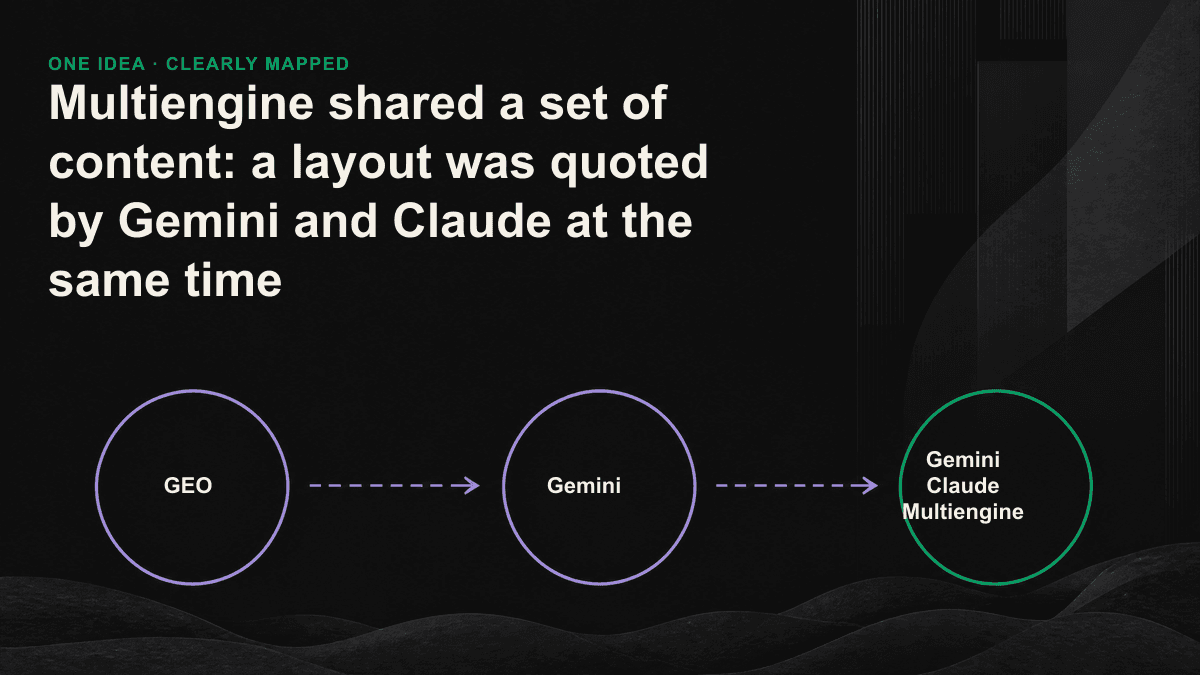
A layout is based on a core issue. Write a 40 to 80-word text that can be singled out for quotations, and put it on the page; then add evidence, context and structure to feed the paragraph into self-sufficiency; and make sure that this page is actually captured by Google and that at least one external source mentions you. The same text, for Gemini, gives index and signal, for Claude, clear and credible, and does not have to write twice.
Make a reality. A B2B SaaS wants to be quoted on the question of "how to select a contract management software". They don't need to write two. They write a page with 60 words, answer the three key answers to the selection, mark the page with a structure, add real comparisons and price margins, and get two or three industry media to mention the page. Three weeks later, Gemini began to quote the same text on both sides because Google recorded it, Claude, because it made it clear and had external evidence.
How do you know if it was quoted?
Last step is measuring, otherwise you won't know if the layout is working. Ask Gemini, Claude, Perplexity, whether or not they mention you, describe you by what location, and quote which page. That's exactly what AI visibility monitoring is seeing in tracking. Once you see a gap, like an engine that doesn't mention you at all, or a misposition that describes you, you know which foundation to fill. We'll run through your real problem group and show you the gap.