Gemini won't quote you, not how beautiful the official website is, but whether it will recognize your brand as a borderline "real." We took over a B2B SaaS client, and the network was better than the competition, but as long as we asked Gemini about its type, the answer was always three European-American rivals, none of them. It's not about rewriting the official list of references, it's about supplementing the Wikipedia and Wikidata structures, and matching the scattered official data into one entity. Three months later, Gemini, who had the same questions, replied that the company's name and connection would be stabilized.
Why Gemini's quote logic is different from ChatGPT
Gemini's answer is based on Google's grounding: it will look at Google on time, relying heavily on Google Knowledge Graph to judge who you are. A large part of the physical data of the knowledge graphping comes from Wikipedia and Wikidata. And that means one thing: if Google doesn't have you in the picture, or mixed you with another company, Gemini can hardly quote you steadily and correctly. ChatGPT prefers the language of training and the text of the web that is caught in the moment, while Gemini is clearly physical in nature. In the same article, the two engines will be treated differently for this reason.
Case background: The official website is very good, but it's not available in AI.
The client is a B2B API Monitoring and Observation tool, about four years old, with Taiwan's team, the main attack on the Asian-Pacific market, with dozens of business clients. When they come to us, the symptoms are typical: the problem is not the content, their blogs are updated, and the official online case is clear; the problem is that Google cannot spell a complete entity, "Who is this, what class is it, and who is it related," and Gemini is naturally not able to use it steadily. It's really stuck, it's a visible foundation, not content.
- In Gemini, asking "What are the API monitoring tools in the Asia-Pacific region", the answer is that there are a few large European-American factories whose clients are not on the list.
- Ask "What is it?" Gemini gives a vague description and even confuses it with a company with a similar name.
- Google Searches for brand names, no Knowledge Panel on the right, for Google has not yet taken it as a definitive entity.
- Official information is all set: company descriptions on official websites, LinkedIn, Crunchbase, GitHub are inconsistent, not even in the year of incorporation.
Three things we've done are important.
The GEO circle is very fond of saying, "Just go open a Wikipedia article," which is a misunderstanding. Wikipedia has a clear notability door, a non-reliable third-party reporting line, which can only be deleted and may leave a negative record in editing history. The true order of action is as follows:
- The company name, location, year of establishment and headquarters of the Unified Office, LinkedIn, Crunchbase, GitHub, and the structured data of the Organization (schema.org) are used to string these official files into one entity using sameAs.
- Complements the references to third party testimony. Helping clients access industry media reports, list entries, and public relations with known entities (e.g. integration partners), both as raw materials for Wikipedia attention and as a source of trust in knowledge graphs.
- The Wikidata project was created with a warrant and was sent to the wikipedia when the conditions matured. The Wikidata portal is low and feeds directly Google knowledge graphs, usually more effective than Wikipedia.
There is only one common goal for these three steps: let Google not guess. When official data, third-party reports, Wikidata, three sides point to the same entity, and the same way, knowledge graphs capture a high-confidence node, and Gemini quotes without missing you or identifying the wrong person.
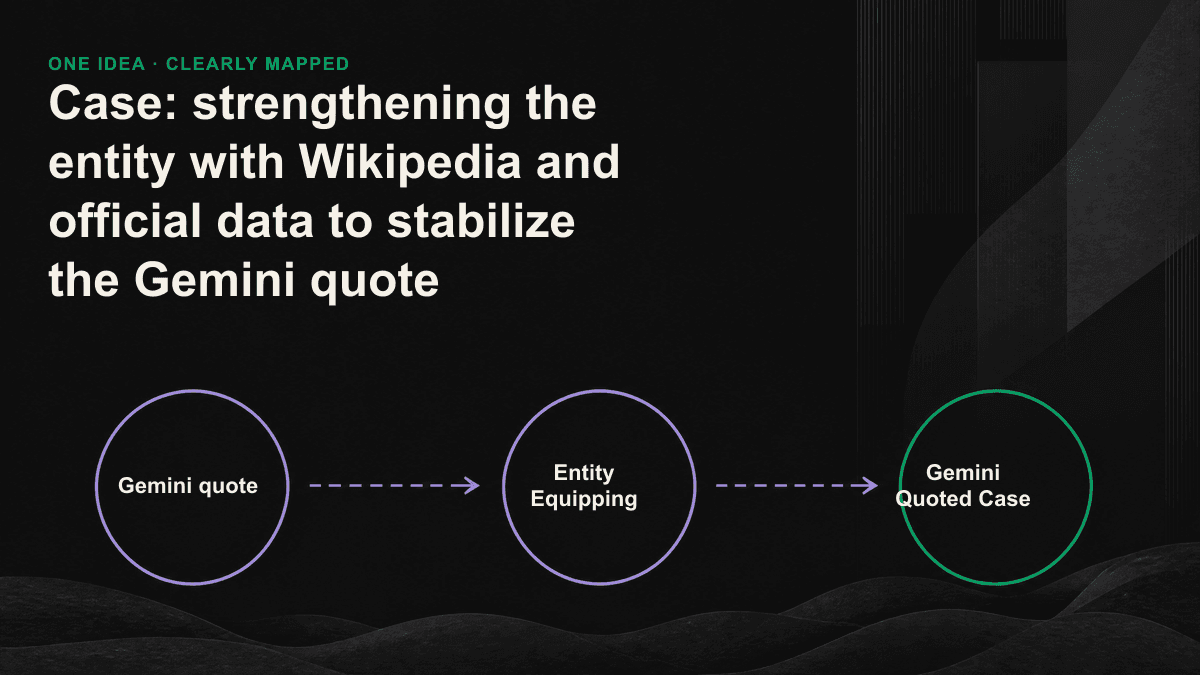
90 days later, Gemini's quote changed.
We use Brand Radar to track a regular class question on Gemini every week. The change is not overnight, but a gradual update of the knowledge graph:
- Week 3-4: Google search brand name begins to appear on the knowledge panel; Gemini's description of what is no longer confused with the same name company.
- Week 6-8: After the Wikidata project was recorded, Gemini started intermittently referring to clients in a list such as "Atta API Monitoring Tool".
- Weeks 10 to 12, from occasional to consistent citation: across the tracked question set, roughly two thirds of Gemini answers mention the company, usually with the official site or Wikipedia as a source.
Let Google make sure you're who you are, and Gemini will be willing to endorse you. In the reverse order, it's all a waste.— Tenten GEO consultant team
Three things you can check yourself first.
- Look for your brand name. Do you have a knowledge panel on the right? No, on behalf of Google, you haven't been considered a certain entity.
- Go to Wikidata and search for your company. Is the type of project, the network, the connection correct?
- Is the corporate description consistent on official websites, LinkedIn, Crunchbase? Gemini will lose faith in you as soon as he sees a contradiction.
Boundaries of the system: When is it useless?
Honestly, not every company does. If you have less than a year, without any third-party reports, pushing Wikidata and Wikipedia will be a waste of work, then you should start with a collection of quoted content and media footprints. The public brands of pure B2C also have different logics, and their reality is clear, and problems are usually perceived and emotional. This is the most effective scenario for physical strengthening, as in the case of the B2B company, which has real business, has a certain market and is not found in the AI engine. If you're looking for your own type in Gemini or Google AI, you find that the list is full of rivals, and the problem is probably not so much, but in real terms. You want to know where your knowledge gap is and what steps you're going to take to make it up, and you can book a 30-minute GEO diagnostic session, and we're going to use your actual quality questions, and we're going to see what Gemini is going to do now.