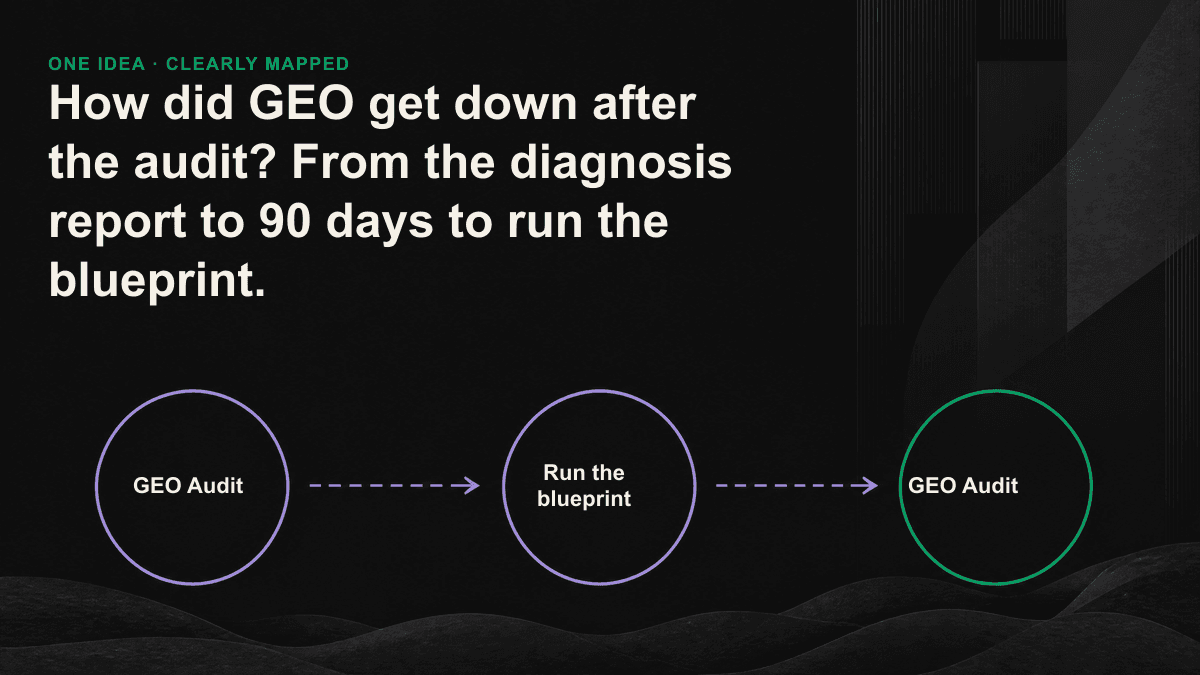
A GEO audit report does not in itself improve any visibility. What really makes the decision is the 90 days after the report was handed over to you, the order in which you fixed it. We've seen too many teams get dozens of pages of diagnosis, and it's stuck: they're all listed, but they don't know what to do first, which one can be later, which one should not be touched now. The audit of the real production is not a report, it's a sequenced implementation blueprint that can start tomorrow.
Step one: turn the report into a list of questions in sequence.
The audit reports are usually this long - dozens of findings spread over several chapters of technology, content, structured data, external signals, each marked red and yellow. It's a form that facilitates the delivery of counsel, but it's not for you. The first move to land is to level all discoveries into a list and add three more columns to each: how many quotes, how many working hours, and whether there are any forwards. Without these three columns, you'll have to choose the easiest to do first, and the easiest ones are not always the most important.
- Technical barriers: Accelerators can't catch, pages can't make out, structured data is wrong. They're the foundations, not fixed, and the rest of the text is blocked, and they have to be handled first.
- Content gap: Buyers ask questions, but you have no clean answers on your website. This is the body of the reference opportunity, which takes time to be effective and is suitable for progressing after technical repairs.
- Speculative signal: the extent to which third parties have mentioned, commented on, listed. It's the hardest thing to do on its own in the short term, usually in a longer rhythm, not in a 90-day critical path.
Top ten things out of "Quote Potential x Repair Cost"
After the list is leveled, you'll find dozens of to-dos, all of them over seasons. The sky map is meant to force you to give up. We're actually sorting with only two axes: how high is the potential for this thing to be fixed and followed by an AI quote or recommendation, and how many hours it's going to eat and how much time it will depend on. The first of these are the "high potential, low cost" at the top right corner. After they're done, you'll see the visible numbers start to move in the first 30 days, and you'll get patience at the management level for the more heavy work.
90 SkySchematics: Split into three 30-day blocks
Put the sorted results on the timeline and we're used to cutting into three 30-day blocks. This is not a hard rule, it is a rhythm that allows each stage to be delivered clearly and to be reported internally. At the end of each block, you should get a visual result, not a bunch of semi-finished products in progress.
First, 30 days -- clear the technical barriers.
The beginning of this month is just one thing: let the AI engine catch and read your website clean. Fixes the robots and rendering problems, completes the structured data, ascertains that important pages are read without JavaScript, and cleans up the obvious duplicate pages and orphan pages. It's not sexy, but it's the premise that everything else can be quoted. At the end of the month, you should be able to get a crawler report that proves that most of the technical lights turned green.
Second, 30 days -- filling the most valuable content gap.
Once the foundations are clear, the fire turns to content. Pick out the topics that have the highest potential from the sorting list and rewrite or rewrite them in a way that can be extracted cleanly by AI: a clear question with a self-contained answer, key numbers and situations that come close, and a title that directly addresses the buyer. This stage is not ambitious, and each article really answers the vague questions that a buyer would ask and the competition would answer. Tenten's GEO content engine is designed for this stage to create a realistic query gap for the content, not to be written by feeling.
Third, 30 days -- measuring, correcting, expanding.
Third month put the focus back on measurement. Reset the mainstream AI engine with a fixed list of questions, comparing it to the Day 0 benchmark, to see which subjects have actually increased the citation rate and which have not yet been moved. It's moving, it's representing the right direction, it's adding the same content; it's not moving, the back check is not in place, or it's cutting the angle. At the end of the 90-day period, what you want is not "completed," but a curve that speaks to the business community, with a list of what to do next season.
How do you know the blueprint really works?
Don't use the "number of tasks accomplished" to measure landing effects. That only proves you're busy. The real focus is on three outcome indicators: the AI in the fixed list of questions, the ratio, the actual traffic and queries brought in by the quoted page, and the variation of the technical health score. All three are looking at Day0 benchmark trends. If there's no movement in the three-month citation rate, the problem is usually not execution, but the initial sequence -- you probably spend your working hours on low-potential items.
The value of the audit is not how thick the report is, but whether it can be turned into a list of "first 10 things." No reckoning in order is but an expensive source of anxiety.— Tenten GEO
Turning the audit report into a 90-day blueprint, the hardest part is not to execute, but to rank -- to decide which ten items to do, which can wait. If you've got a report that doesn't know where to start, or if you haven't done an audit, and if you want to see what your gap is, you can schedule a 30-minute GEO diagnostic session; we'll use your own website and ask questions, and we'll put you in a sequence in which you can start work immediately.