General SEO tests tell you the number one in Google, GEO audits tell you how ChatGPT, Perplexity and Google AI Overviews describe your brand now, whether or not you're listed in the answer or not. The former measures your position in the blue link list, and the latter measures whether you are quoted in the generated answer. These two things are no longer the same thing, but most B2B SaaS are still trying to solve an unsolved problem with a ranking report.
Why can't the ranking report see your real gaps?
The traditional SEO test assumes a world view: user search, see ten links, click one. So it looks at keyword rankings, organic traffic, labels, internal-link structure. The logic is half out of effect in the generation search. When potential clients asked Perplexity, "Who are the GEO agents in Taiwan for B2B SaaS," the answer was to add a line and three brand names, and there was no fourth. You either said that or it didn't exist. The ranking report doesn't tell you this because it doesn't even ask about models.
Tenten was the most common difference in the client's initial diagnosis: the client's page was in the top three of Google's ranks, self-identifying SEO health, but the same question was thrown to ChatGPT, and the answer was three competitions, none of which had been mentioned at all. No problem with ranking, zero visibility. This gap can only be seen by treating the model as a target, actually asking and recording answers.
8 Delivery discrepancy statement
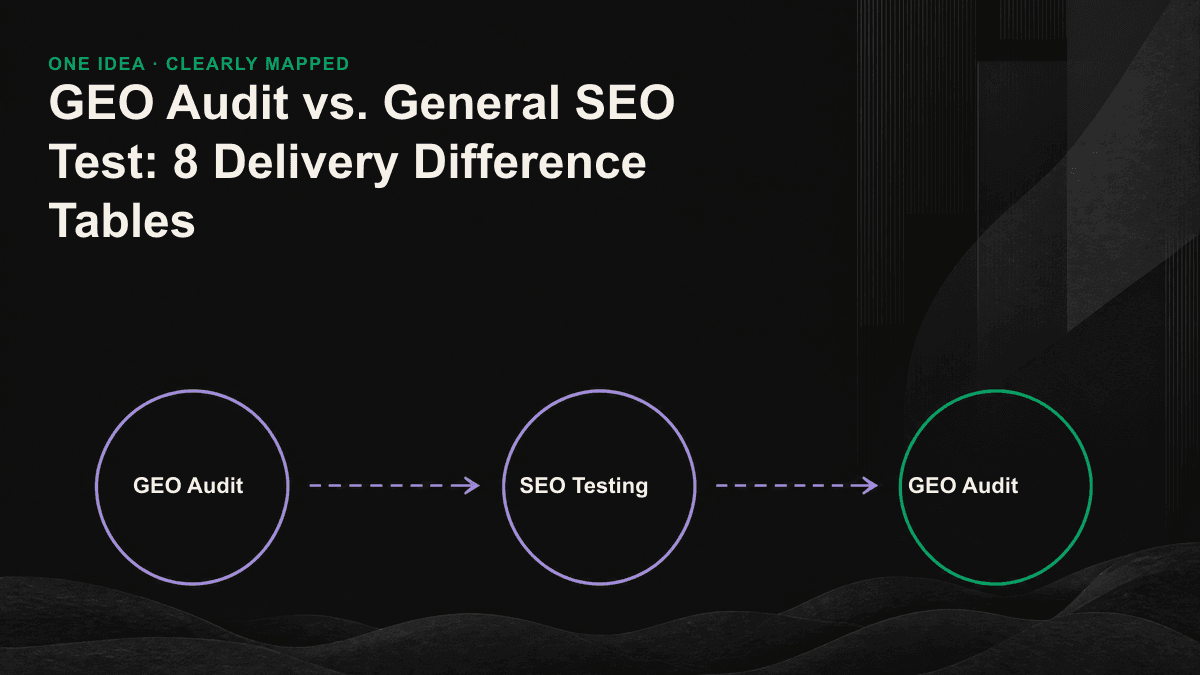
Turns out that the difference is not in detail but in the whole measure. The following eight items are actually different in the report when delivering GEO audits and regular SEO tests:
- Audit target: SEO inspects pages visible to Googlebot; a GEO audit tests how ChatGPT, Perplexity, Google AI Overviews, and Gemini actually answer questions about the brand and its core topics.
- Core metrics: SEO tracks keyword rankings, organic traffic, and click-through rate; GEO tracks citation rate, share of mentions, and whether AI describes the brand accurately.
- Content assessment: SEO checks titles, word count, and internal links; GEO checks whether a model can extract each paragraph cleanly and whether it contains clear definitions and citable facts.
- Structured data: SEO uses schema to earn rich results; GEO uses it to help models identify entities, resolve ambiguity, and align facts.
- Authority signals: SEO counts backlinks; GEO examines how review sites, industry lists, forums, and wikis describe the brand because these third-party sources shape the model's understanding.
- Competition visuals: SEO is higher than who; GEO is better than who was named and who was jumped in the AI answer.
- Factual correctness: SEO, whether or not the model is wrong about you; GEO Audit has captured AI's account of your errors, such as the time-fixing, the error function, the non-existent limitations.
- Delivery and action: SEO gives a list of issues; GEO gives a list of gaps in order of business impact, plus 30 days of reparable sequence.
One of the easiest to ignore: AI is making a mistake for you.
The ranking test never addressed correctness, because Google just lined up your page and didn't rewrite your content. The generative AI engine will. It makes a statement about the information scattered everywhere, and it is likely that in the course of the process you will be able to present your three-year-old offer, a plan that has gone down, or a complaint from a forum. For B2B, an AI answer that doubles your monthly cost, or says you don't support a function, kills more than two people in the ranks, because buyers believe it before they enter your website. The GEO Audit will list these errors by article, identify the source, and let you know which third-party signal you should fix.
How do you change the indicator from "rank" to "quote"?
SEO's success looks like a rising ranking curve. GEO's success has been different: you're following a set of practical problems, whether your brand has been quoted in multiple engines, multiple inquiries, and whether the number of competitions has declined. This requires a fixed set of questions, repeat queries, comparable logs, not one-off screenshots. AI visibility monitoring of Tenten is doing this continuous measure to make "Is there any more mention of us this month" a number that can be answered than a sense?
The difference in delivery determines what you can do the next day.
A good SEO test gives you a list of technologies that can be repaired: these tags, these internal linkss, these images. A good GEO audit will answer three questions: "Ai, where's the missing? Tenten's 30-day GEO audit makes these three issues a priority route, rather than losing a $200 to-do to make you guess what matters. The difference is not that the report is thin, but whether it tells you where to go next.
If you already have a SEO inspection report, and you're not sure if it covers the AI engine, you can take 30 minutes to do the GEO diagnostic session, and we'll actually ask you about some mainstream engines with your brand, and you'll see half of the map that the ranking report doesn't see. Want to know your gaps, welcome to the appointment.