DIY GEO’s biggest myth is that “saving agency monthly fees” is directly considered as “saving money”. In fact, you're just switching the cost from cash to internal manpower hours and mistimes. The real decision is not to outsource, not how much budget you have, but whether there's someone in the team who can stabilize the production structure every week and can be drained clean by the AI engine. If you don't, the low agent will pay for three months.
Let's split the hidden costs of DIY.
A lot of the founders were just looking at agents when they calculated the GEO costs, but forgot to give their own time to money. If you're asking for a monthly sale of 60,000, she'll have to call two days a week to study GEO, rewrite the content, stare at Schema, chase the AI engine, and the human cost of these two days alone is close to 24,000 a month, which is not yet the cost of the opportunity that she was supposed to do.
More importantly, the rhythm. GEO is not a project that ends with a series of articles. It needs to continuously monitor which queries are cited by ChatGPT, Perplexity, Google AI Overviews, which do not, and then go back to repair. This monthly cycle of work is the real price of DIY, which usually does not appear in the first line of any trial.
Do it yourself, you really have to do four things.
Open the GEO to see that DIY means the same person (or team) is carrying four powers at the same time:
- Technical infrastructure: Change the site to an AI crawler-readable structure - clean language labels, FAQPage and Article Schema, llms.txt, and the rules of robots that do not block the AI crawler.
- Rewrite: Replace the page originally written for the keyword ranking with an answer paragraph that is "self-contained and can be directly quoted" instead of reading it through the context.
- Visibility tracking: regular use of real prompts to ask home AI engines to record whether brands are mentioned, described, and covered with competition.
- Sustained: monthly changes in content and structure based on tracking results. This ring is most often omitted, but the most decidedly defeated.
Looking at each item alone, the difficulty is not so scary. The problem is that these four things have to be in place over time. Any break-up would be half the input: Schema did a good job, but the content was still a good word, and the engine couldn't get to the point; the content was fine, but nobody tracked it, and you never knew if you'd made progress.
GEO’s doorbell is not a single skill, but it requires four capabilities to be in place at the same time and for a long time. And that's why "getting someone to do it" almost fails.— Tenten GEO consultant team
Outsourcing agent, what did you buy?
A decent GEO agent who sells not "writing for you" but three things you don't have in the short term. The first is the interpretation of which page structure is easily quoted, and which content formats are completely non-eating on specific engines, which are intuitively developed after dozens of stations, not by reading two blogs.
The second is an existing tracking tool and process. You're going to put yourself in a cross-engine brand of visibility monitoring, just design prompt collections, run schedules, organize actionable reports, a small project. The agent turned this into a standard procedure, and you got the conclusion, not the original sheet. And the third is speed -- it decides whether you'll be registered by the AI engine before the competitor reacts, or three months later.
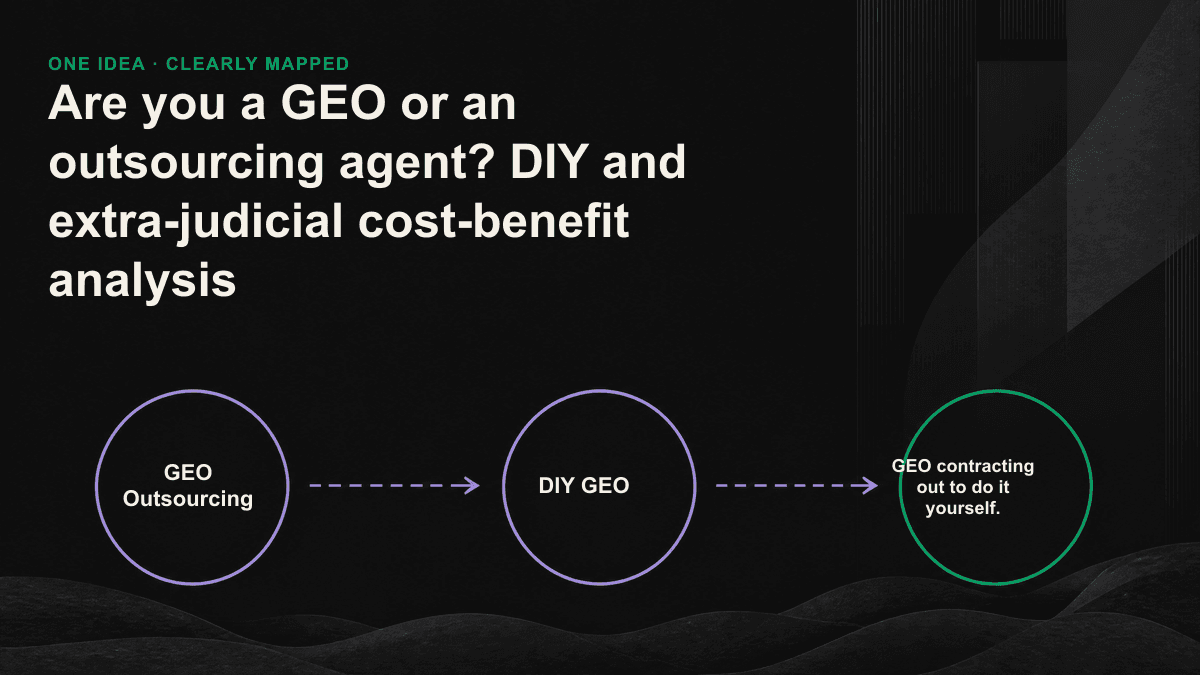
A decision sheet: When to do it yourself and when to outsource.
Rather than asking which one, it would be better to follow its own conditions. DIY is reasonable:
- There are already people in the team who are familiar with technology, SEO and content strategy and who can make regular calls every week, not "off time."
- The product is of cold quality, and the competition hasn't started to do GEO, and you have time to try it.
- What is more needed in the company's current phase is the ability of the interior minister, not the short-term results.
On the other hand, when these signals appeared, the rates of outsourcing were clearly higher:
- You're in a class that already has competitors that are frequently quoted by the AI engine, and every night for a month, the gap is harder to track.
- No one in the team really understands schema, content extraction and cross-engine tracking, equals starting from zero.
- You need to show a measurable change in visibility within a season to the boss or the investor.
The best solution for B2B SaaS is actually mixed mode.
In practice, the most cost-effective is not pure DIY, but cut it apart. The agent was asked to do a one-time re-engineering (technical review, content reconstruction, tracking system set up), to match the foundations once; then routine content production and monitoring, and then return to the internal team for protection. You buy judgment and start speed, and save long monthly consultancy fees.
Tenten GEO's 30-day audit was designed to do this: first, in a month, you get your technical gaps, your content to extract, and your real visibility in the various AI engines, and hand over a list that you can do directly. Then you'll have to do it yourself, or you'll keep going outside, on clear grounds, not on feelings.
Three most common DIY miscalculations
The first mistake was to think that GEO was equivalent to writing more blogs. The content is not the point, but whether or not it can be extracted cleanly; ten articles that do not answer the question do not match a properly structured FAQ. The second miscalculation was that it was not tracked after completion, and three months later it was impossible to say where it was going or where it needed to be repaired. The third error is to underestimate the sustainability of maintenance - the behaviour of the AI engine has been changing, the practice that worked last year may fail this year, and the DIY team can easily stop after the project is over.
Whatever path you choose last, the first step is the same: know where your gaps are. If you're not sure if you're going to invest in manpower or budget, you can book a 30-minute GEO diagnostic session, and we're going to use your real brand and type, show you how the AI engine describes you now, and tell you what to do with outsourcing.