To get the content cited by ChatGPT, Perplexity, Google AI Overviews, the most inefficient start-up is to rewrite the entire site. Most of the B2B sites are not "not good enough" for their real necks, but are spilling power on hundreds of pages on average. A more realistic approach: first, to find a small group of pages that are close to the quoted door, and to concentrate resources on pushing them past the line, without touching the rest. That's how the page came out.
Average force equals no force
Suppose you have 300 blog posts. If the team decides to "write it all once", it'll be 1,200 hours each, close to six months of professional capacity. By the time you move to 200, the market language, product positioning, and even the capture preferences of the AI engine in the first 50 pages may have changed. And more importantly, there's a real chance that 300 of these articles will be cited by AI, usually less than 20 percent. The only way to decorate is by 80%, because no one asks about their subject.
GEO's resource allocation logic is not exactly the same as SEO. The tradition of SEO is that you're able to build up with a long tail flow, and there's a spot on the eighth line, and the AI engine is close to the winner -- under the same question, the model is usually only three to five sources, and it's zero exposure without being selected. So "priority" is not a sub-point, but a prerequisite for whether this whole thing will be rewarded. We'll start with the sequences, and every hour after that, we'll get the tweezers.
Quote four signals of potential.
To determine whether an existing content is worth changing first, I use four visual signals. They don't need expensive software, and they can be estimated with your existing analysis backstage and several manual tests.
- The subject is being asked: Is this the question of whether your potential client will really throw it at AI? Enter the 20 to 30 real client sentences in ChatGPT and Perplexity to see if the model will open up and quote who.
- There is already a ranking foundation: this page has advanced or has a steady exposure of 20 people in Google, the theme-related and authoritative signals have been recognized, and adaptations have the lowest international costs.
- The structure is easily extracted: can it be sliced into a question, an answer? There is a column, a definition sentence, a page with a clear number that is easier to extract than a long narrative.
- Do you have an exclusive view or data: Is there first-hand data, an execution case or a process that no one else can copy? That's why the model picks you up between sources.
Of the four messages, the "subject is being asked" and the "you have an exclusive view" decision to quote the ceiling; the "grounds already ranked" and "structures are easy to extract" determine how hard it will take to transform. Give each article 0 to 3 points to each of these four items, which will soon be able to draw out a sorting list. The point is that it's not the point, it's the point that it's forcing you to translate "I feel good" into a comparable number.
Cut the list into three ladders.
Play the score, don't rush to change from the top. The better way to divide the content is to divide it into three ladders based on potential x cost, and to decide actions, not just sequence.
The first tier is high potential and low cost: buyers ask about the topic and the page already has a foundation in Google, but its structure needs work. Add a direct answer near the top, turn the main points into a clear list, and include FAQ structured data. That often takes only two or three hours, making these pages the best place to start within 30 days. The second tier is high potential and high cost: the topic matters, but you lack strong original material. Add interviews, cases, and data, then place the work in the content engine's production schedule. The third tier is low potential: buyers rarely ask AI about the topic, or major media and official documents already dominate it. Freeze those ideas for now.
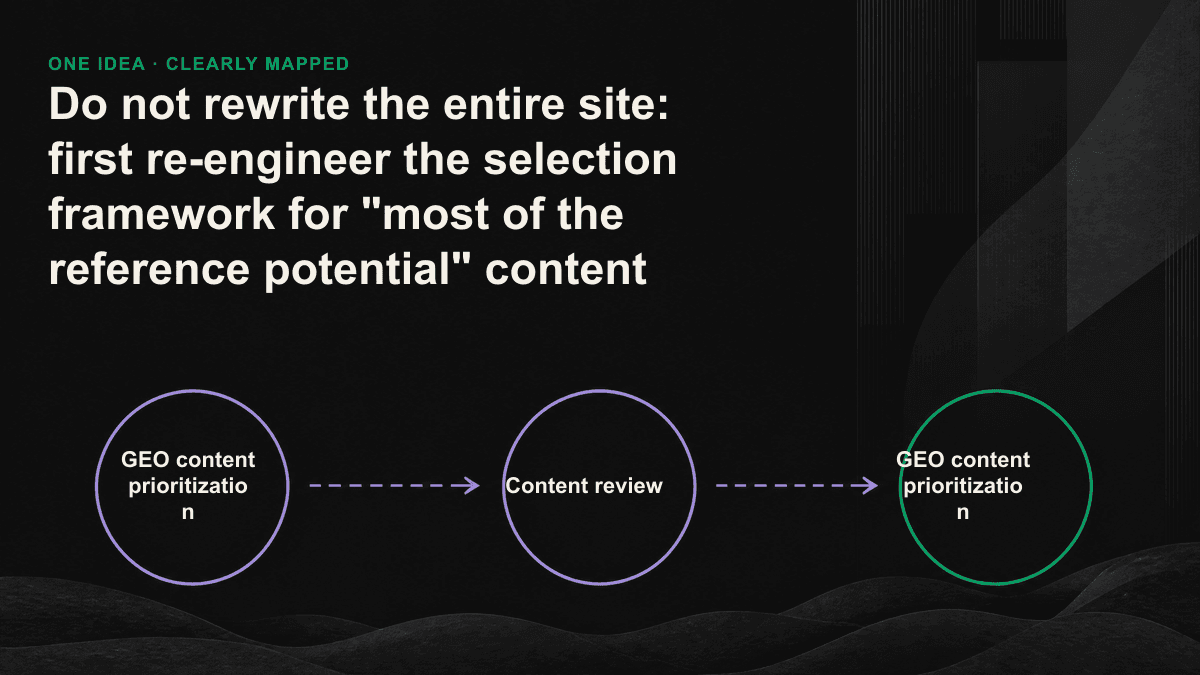
The order of execution in 30 days.
Turning the ladders into an enforceable schedule. First week predation: export all pages, run four signals at a time, circle 10 to 15 articles from the first stage. In the second to third weeks, the batch was re-introduced - each section answers the presumable summary of the core question, resets the entire column and tab, adds FAQPage structured data, and confirms that robots and llms.txt did not keep AI crawlers outside the door. In the fourth week, the changed page was thrown back to Perplexity and ChatGPT, and the same clients were tested for the same sentence and recorded whether or not it had been quoted or quoted as the basis for the next round.
The good thing about this process is that it's self-correcting. You don't use guesses to determine what's useful, but you use real AI answers every 30 days to test the hypothesis and then copy the valid modification to the second tier. Tenten, in his GEO audit, used a similar rating form to mark "the 15 that should only be touched this season" instead of submitting a 200-page report requiring a rewriting of the entire site. The list is short, it's done; it's done before it can be quoted.
Don't make it a one-time thing.
The reference preferences for the AI engine will change, as will your product and client. The topic that was put on the third stage today may become the subject of questions next season because of a new feature. The practical rhythm is to run again every season and keep the list moving, not crucify it as an annual plan. The real value of ranking comes from your willingness to continue cutting down things that are not worth doing, rather than listing more.
If you're not sure where you're standing, 15 of the closest to the quoted doors, you can run your own scores with these four signals. We'd like to have a list of fine-tuning actions along with a 30-minute GEO diagnostic session -- we'll use your real clients to ask, show how this sort of sequence falls on your website.