The decision to "build or out" is that most companies miscalculate the cost structure from the outset. They focused their budget on "make GEO work," but did not leave any resources for "continuing." GEO does not start where it really eats manpower, but follows each week the changing logic of ChatGPT, Perplexity, Gemini, Google AI Overviews. Once the content is put in place, the quote will drop after three months. So the question is, which way are you going to keep up with multiple engines for a long time?
Just figure out what to do, GEO.
Before comparing the two models, open up the job. The GEO is not the end of "writing a few articles that will be cited by AI", it is a continuous line of production across content, technology and tracking. Any stoppage will be visible and open.
- Content Restructuring: Replace existing pages with the structure of paragraphs that can easily be extracted from the AI engine to complement definition, comparison and specific numbers.
- Entity and structured data: Create physical links between brands, products, characters, and complement Schema to make sure the engine knows who you are.
- Multi-engine monitoring: Following up on the same set of questions in ChatGPT, Perplexity, Gemini, AI Overviews.
- Quote fixation: When an engine no longer quotes you, it is judged to be content, source weight or competition, and then reset.
- Update rhythm: The AI engine prefers information that is recent and that is subject to back verification, and the old page needs regular visits.
Real cost of building a team.
The benefits of self-building are straightforward: knowledge stays within the company, reacts quickly, and can be posted with products and sales. The price is for you to get a team of people across the border. GEO needs an editor who understands the content strategy, an engineering resource that can change Schema and the page structure, and someone who can look at the engine's responses every day. In Taiwan, a person with a SEO base and willing to study GEO, with a monthly salary of around 60,000 to 90,000, is unable to carry out technical and monitoring at the same time, and in the end only half of everything.
Another account that is often missed is learning the curve. GEO does not have the best ten years of stability, and ChatGPT's citation logic may be different this and last season. The first six months of the self-constructing team were almost wrong, and the quality of production during this period was usually not as good as that of an external team that had already run dozens of projects. You're paying for the opportunity, in addition to your salary.
Real costs and risks of outsourcing
Outsourcing is equivalent to skipping the search period. A multi-engine agent with a reusable diagnostic framework, monitoring tools and content template, usually allows the first pages to start being quoted in four to eight weeks. The risks are equally real: brand language needs to blend, and agents must not understand your products as well as insiders at first; if outsourcing is to be treated as a "package article", the delivery can easily become a superficial and unquoted content.
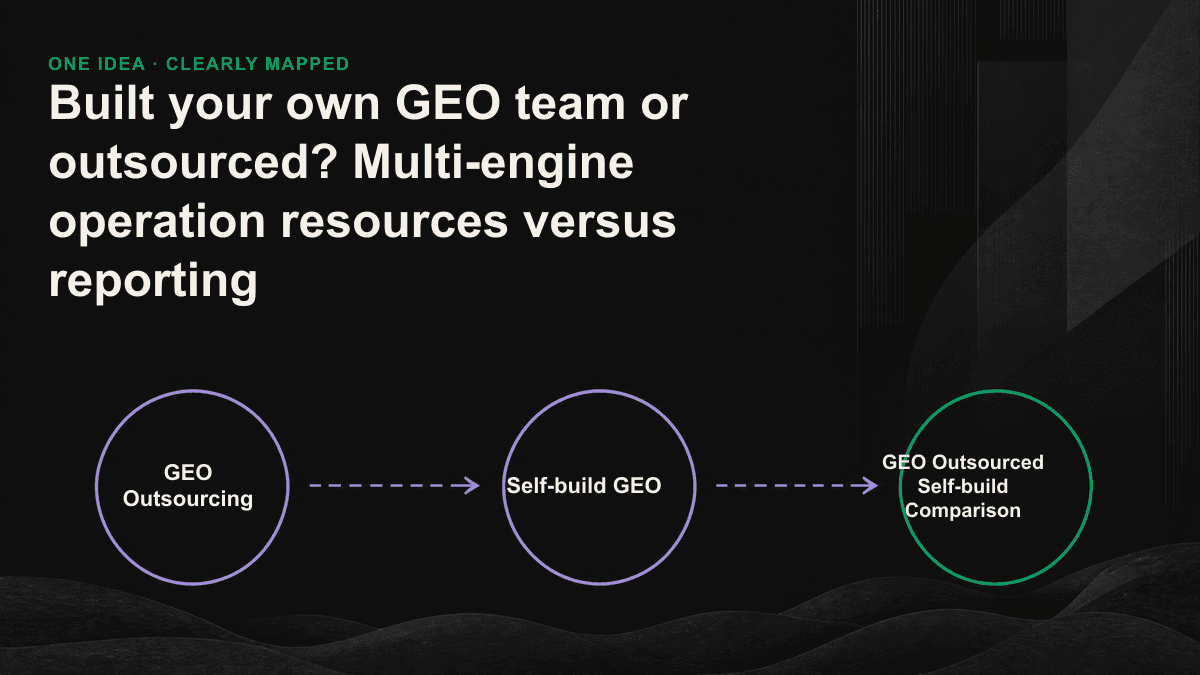
Multi-engine operation to tilt the scales towards outsourcing
If you only care about Google a pipe, the self-built door is not really high. It's the "multi-engine" word that opens the gap. ChatGPT, Perplexity, Gemini, Google AI Overviews, and even Grok, have different data sources, references and updates. The same article was quoted in Perplexity and does not guarantee that it will also be in ChatGPT. Five or six engines are running at the same time, which is equivalent to maintaining five or six monitoring and adjustment processes at the same time.
That's the easiest place for a self-building team. The inner group of two or three people usually takes care of only one or two main engines, with the rest of the grass. The external team, with multiple clients serving at the same time, has a fixed cost of tools and monitoring, with low international costs for a few engines. The greater the number of engines, the greater the scope benefits of outsourcing.
How's the presentation? Look at these variables first.
The presentation depends on two things: the cost of visibility for units and how long it takes to see results, rather than on who's low monthly cost. Put the following variables in, and the answers usually come out.
- Number of engines: Only Google leans towards self-building; three or more engines are to be run, outsourced or mixed.
- Content inventory: There are a large number of pages to be rewritten and the batching process for external teams is faster; from scratch, the gap between the two has narrowed.
- Internal manpower: the three roles that fit together, engineering, monitoring are suitable for self-construction and are stuck without a single angle.
- Time pressure: Need to see a reference to growth before outsourcing; one year to grow and build one ' s own.
- Knowledge-deepness: Trying to develop GEO into a long-term core capacity, considering hybrid models, allowing outside teams to run with insiders.
Mixed mode: the actual solution of most SaaS
Apart from pure self-building and pure outsourcing, most of SaaS ended up in the middle. The approach is to build a multi-engine diagnostic, monitoring and content framework, led by an external team in the first three to six months, with one to two internal colleagues running with each other; once the process is stable, the internal team can follow routine monitoring and updates, the maintenance company can be reclaimed, and the external team can be moved back to a position where strategy and suspicion are difficult to resolve. You buy speed and methods, and you leave your abilities behind.
Either way, you need an honest picture of the situation before you decide: how far you're being quoted in the engines, where the gaps are, how much resources you need to make up. When this map is completed, the answers to self-construction or outsourcing often surface. If you want to get it quickly, you can schedule a 30-minute GEO diagnostic session, and we'll run over the visibility of your multiple engines with Brand Radar, and decide whether to do it or give it to the team.