Decide whether the GEO should be outsourced or done on its own, but not in a hurry. The first question that really needs to be asked is whether there's a piece on your hand that can be taken out of time and rewritten as an "AI" engine. Most of the B2B teams are not budget-bound, they're 200 blog articles that have been accumulated for three years. There, there's not one character's job description that says, "It's up to ChatGPT to quote these things." The choice of outsourcing and self-programming becomes clear.
The work of GEO's retrofitting, more than expected.
A lot of people think of GEO as "a new article," but it's a different thing to change the content. It is to re-construct your existing assets: to remove extractable paragraphs, to add clear answers, to add structured data tags, to make sure that each page responds to a specific question linguistically, and to follow up on whether the content is quoted in the generative AI engine. It's not inspirational work, it's process work. It requires a willingness to spend a regular week on a list of pages rather than waiting until time is available.
The cost of doing it on its own is almost entirely hidden in time.
The biggest self-generated misunderstanding is that it is "free" because it is not paid for by agents. You actually pay for the team's opportunity. A medium-sized repository, assuming 120 articles need to be adapted, will take one or two weeks to determine what should be handled first. After that, each piece was rewritten, marked, validated, and trained for about one to three hours. It's usually more expensive than outsourcing on the price bill, but it doesn't appear on any bill.
- Content Policy Man: Determining which themes have visibility value and which buys
- Deep editor: rewrite existing articles into structures that can be extracted cleanly by AI
- Technical manpower: handle structured data, server rendering, page capture
- People who understand GEO: Configure and interpret AI visibility monitoring's visibility tracking, determine whether the modification works.
- Project Manager: Let the top four really move each week, not line up behind the to-do. Hey.
The problem is that most of the B2B teams do not have these five roles, and even if they do, they are already full of daily work. The GEO has been transformed into a kind of "all agree that it's important but always next week".
It's not labor, it's judgment.
If outsourcing is just handing over the list above to someone else, it's of limited value and you could hire a contract. The real cost-paying part is judgment: what's worth saving, what's ahead of you, your brand. Where are you absent from the AI answer, why the competition is quoted and you don't. These findings are based on experience with enough cases, rather than teaching literature. A good agent saves what you've been learning for six months.
It's you who outsources that you don't have the judgement and the discipline, not the bullshit you don't want to face. The first makes you faster, the latter just move the problem to someone else's desk.
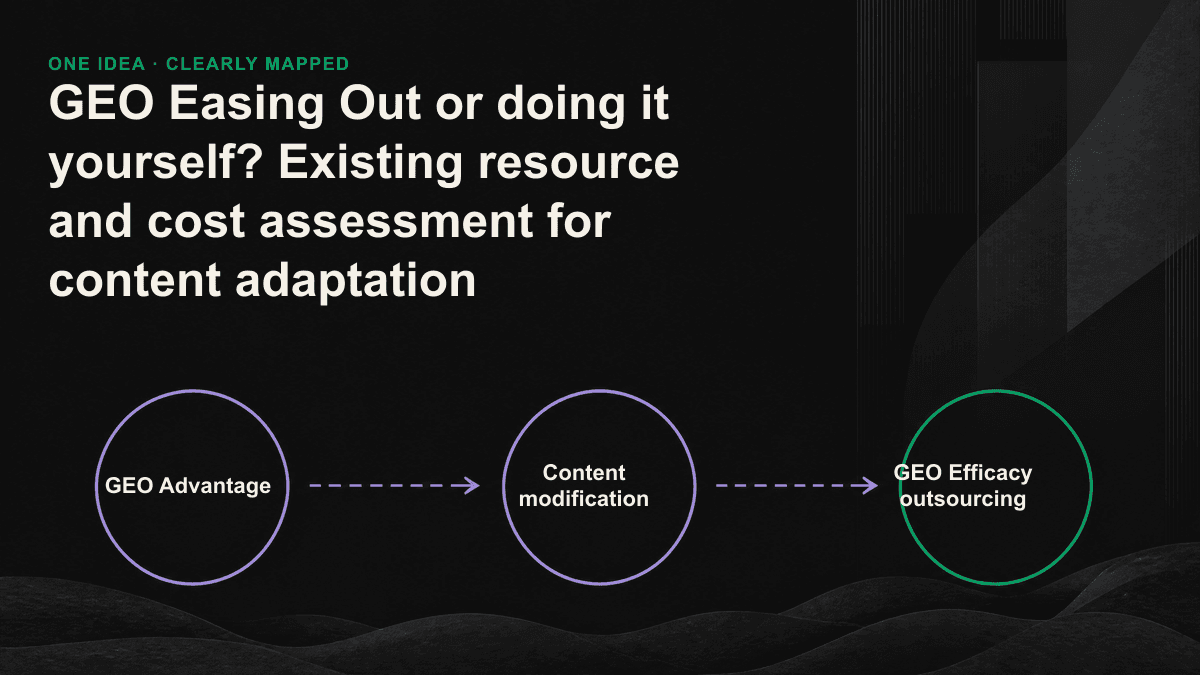
An honest cost comparison
Compared with the same 120-part repository. Self-production: Assuming that a senior staff member is responsible for approximately 40% of working hours, three months of running, and sporadic technical support, the internal cost of the actual input usually falls on hundreds of thousands of yuan, and the quality of the product depends heavily on the understanding of GEO. Outsourcing: One-time GEO audits plus continuous re-engineering of content engines at the expense of transparent, delivery rhythms and visual tracking data. The apparent cost of outsourcing is both visible and more expensive; but the difference between time, learning curves and the cost of delay is often absent.
What's right for you?
- You already have the inside manpower to understand GEO and his time can be really cleared out.
- The repository is small (e.g. within 30) and can be covered by one-time filing
- You want to keep this in the company for a long time, and you're willing to cover the slower study costs ahead.
- Your subject is highly specialized. It takes a long time for external writers to get into the situation.
What's going on?
- The content is huge, piled up for years, and no one inside has a consistent time frame. Rice
- You need to see a change in visibility within a season, and you don't have time to find out.
- You're not sure what you're missing in AI.
- What you want is something that can be tracked and questioned, not "do it."
The best solution for most teams is mixing.
In practice, pure self-production or outsourcing is not the most common answer. The more effective approach is to divide the work: let the outside world do a GEO audit to determine the gaps, priorities and methods, and demonstrate how the first set of contents should be changed; and then hand over the duplicated execution process back to the internal team so that they can process the rest of the content according to the same set of criteria, keeping only strategic calibration and visibility tracking from the outside. So you can buy judgment and leave execution at the firm, and the cost structure is less than full outsourcing.
First the gap, then the division of labour.
Whether to argue with him in the conference room about outsourcing or doing it on its own, let's turn the question upside down: your current brand, in the answers to the ChatGPT, Perplexity, is there anyone who lost it to? The answer will determine directly how much you're going to invest, what you're going to do, and what you're going to do, and what you're going to do, and what you're going to do. If you want to see where your gap is, you can schedule a 30-minute GEO diagnostic session, and we'll use your real content to point out where it's worth making.