A GEO investment cannot be justified by asking only whether ChatGPT mentioned the brand. An attribution model carried over unchanged from 2011 will miss most of the journey. Useful ROI analysis connects model visibility and citations to visits, qualified pipeline, and closed revenue without pretending every step is directly observable.
Why is this "rank" not the right order?
The tradition of SEO's ROI logic is straightforward: it's the first page of the key line, the flow of nature grows, the transition follows. The chain broke in the AI engine. Users get a complete answer at Perplexity or ChatGPT, and the problem is solved on the spot, probably without a single click on your website. The organic search conduit for GA4 does not see this, and the source is often mislabeled as direct.
The opposite direction is also distorted. Once cited by AI, it's worth no less to embed your brand in the answer to the user's decision; but your dashboard will not have any digital beat. If you're just looking at the rankings or just hitting, it'll make the GEO's performance an unclear account. If you want to get it right, you have to admit that AI's visibility happens on a layer-by-layer basis.
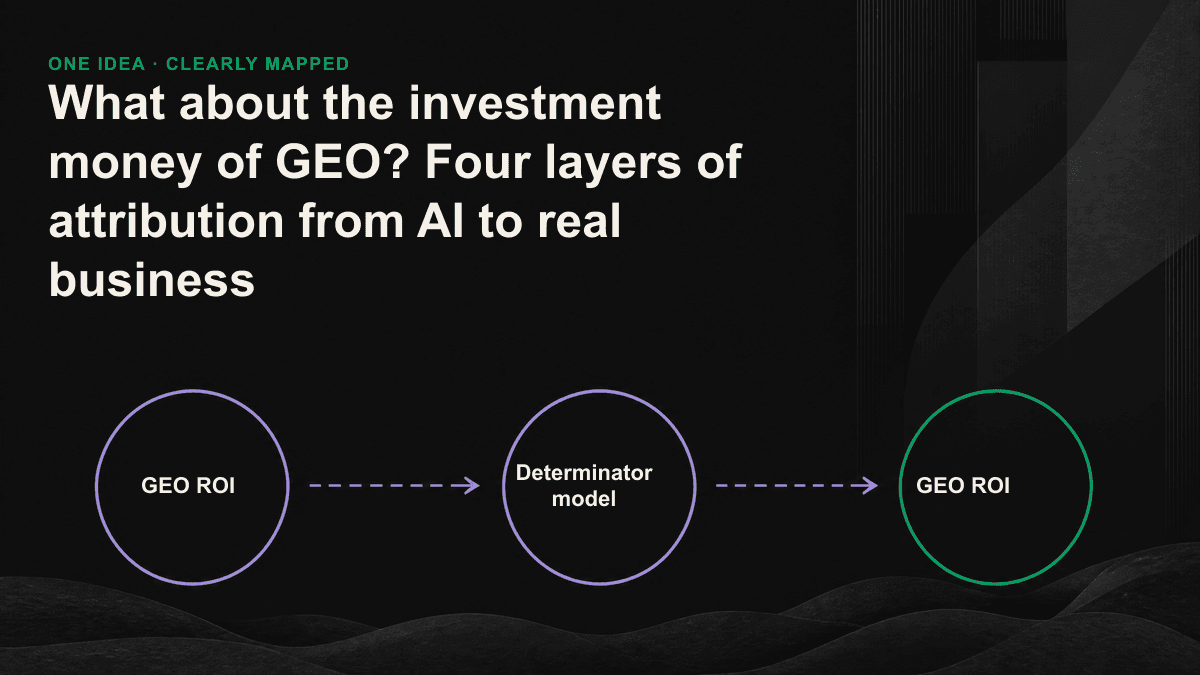
Break AI Visibility into four layers of funnel.
When we're doing the GEO audit for our clients, we always cut the visibility to four levels. Each layer is a necessary condition for the next layer, any layer leaks, and the inputs are wasted.
- Retrieval: Did your content get captured by a model search conduit into the candidate source? We're not going to the election, we're not going to talk.
- Reference Layer (Citation): In actually generated answers, the model does not quote you, quote you in what tone, and ranks in a few sources.
- Click on the level: The actual traffic of users from AI to your website.
- Business level (Pipeline): These visitors end up filling out forms, pre-ordering consultations, entering into a deal with a higher amount of money.
What do you have to measure on each level?
The four layers each respond to different measurements and cannot be seen with the same indicator.
- Research Level: Run a number of target problems using a visible tracking tool like AI visibility monitoring to measure the proportion of your domain in the selected source. It's a line pointer, usually the first move.
- Quoting level: Tracking the `citation ratio' In 100 related questions, you were quoted several times, your competitor was quoted several times, and your tone was recommended or reversed. This is the level of the deal.
- Click on the floor: In GA4, in a formal expression, separate sources such as perplexity.ai, chat domain, gemini, etc., into an "AI assistant" conduit, so that they do not sink into direct.
- Business Level: To kidnap visitors from AI sources in CRM, using a land page and UTM, marking the business segment and the amount.
A attribution formula that can be applied directly
After measuring the four layers, the skeletons of ROI are really simple: GEO ROI = (the value of the weighted conduit of AI-GEO total input) ÷GEO total input. The key is the word "weight". AI quotes create brand spills, and many values do not happen by a last click, so the contribution of GEO will not be too thin, except for the amount of the hard-core transaction, to add the "quote exposure x average brand contact value".
A 90-day reality.
A B2B client of SaaS, for example, ran like this. The first 30 days of the GEO audit, which identified 40 decision-making issues, found that only 6 of them would be quoted in the brand, with a rate of 15 per cent, most of them behind their competitors. Over the next two months, the content engine produced 12 clean extracts from the gap. By the 90th day, the citation rate was pulled to 41%, and the monthly flow of AI assistant conduits grew from almost zero to over 300 hits, nine of which went into CRM and kidnapped three qualified businesses. With hard credit, the value of these three weighted conduits has covered the entire season of the GEO input, and the brand spill has not been accounted for.
It is not the number of times quoted, but the tone. To be quoted as a counter-reference, it's a negative score, but it's a beautiful tablet with only a second count.
Three most common attribution errors
Most GEO performance reports are not impossible to do, but rather failures in the way of attribution, which makes the right effort a mess.
- Put AI referral all into direct, so the whole AI conduit doesn't exist on the report, and the effect is nothing.
- Only a few times, without reference to the tone and sorting of the reference, the negative reference should be considered a positive addition.
- Rui is judged by a single January number. The AI citations have a cumulative effect, and it takes time for the content to be firmly recorded, and the early conclusion of the case will underestimate the real return.
By connecting these four layers of funnels and the weighting formula to your current GA4 and CRM, GEO is no longer an inexplicable marketing fee, but an investment that can be compared to other pipelines. We'll run on your own target problem site once and show you the gap.