Google AI will break a user's question into dozens of sub-surveys at the backstage and then spell out a paragraph from different sources as an answer. So you're not going to be the "one page for one keyword," but the "one paragraph for one sub-question." In this event, there is little opportunity to be quoted.
How does the AI mode work?
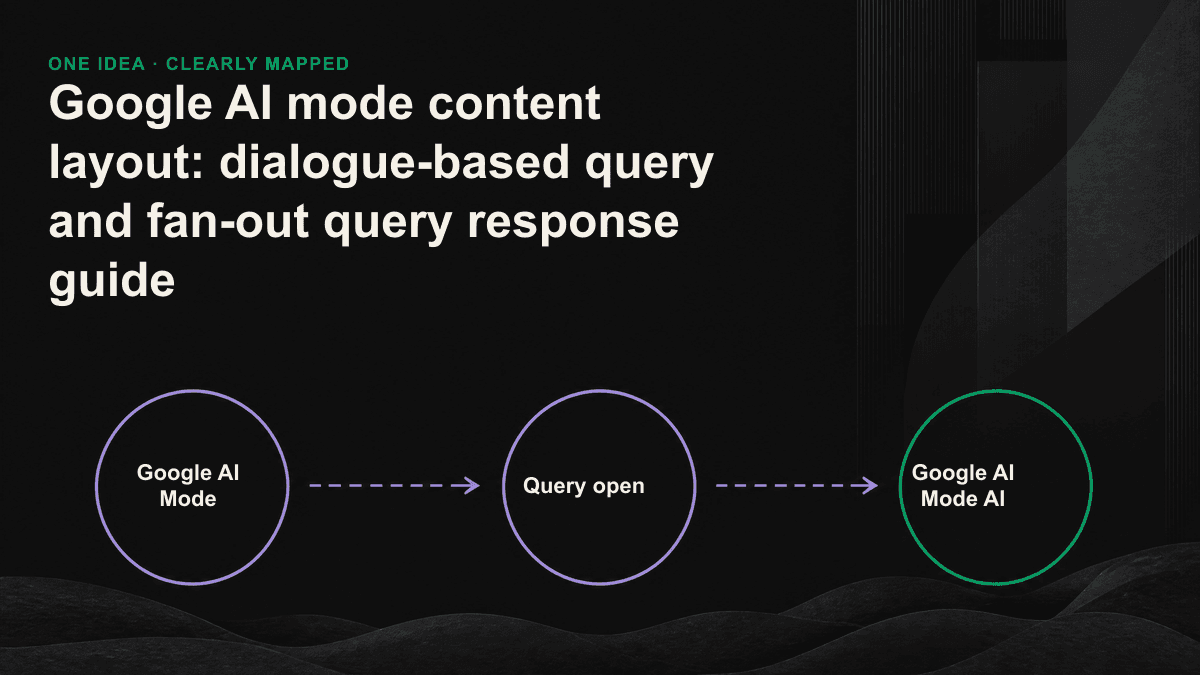
The AI mode is driven by Gemini, the essence of which is a conversational interface, where the user can ask one after another. It is run by `Query Opens': tearing a sentence into a set of sub-Querys that are relevant to the language, sending it in parallel to the Google Index and the Immediate Network, taking back the selection paragraphs and handing them over to the model. AI Overviews is the summary above the result page, mostly responding to a single query. The two share the same paragraph-level extraction logic, but the AI model is more advanced, more asked and more demanding for content coverage.
In traditional SEO, number one on the page decides whether it has traffic. In AI mode, the page is not "ranked", but a section of it is not selected for the answer. The page may be cited for the precision of a paragraph on a sub-survey, but not even the top ten in the natural order of the main query. This is why the extracting unit becomes a paragraph, not a whole page.
Draw a question about fan-out first.
Before you do it, you can list a core question in which sub-questions. Gemini is almost certain, for example, with the usual B2B SaaS "how to use the marketing tool" At the same time, ask: what are the main options, what are the respective price ranges, what is the ability to integrate, how many teams fit, how long it takes to get in, how to connect with CRM, what are the limitations of free programs, and what is the common understanding of users to evaluate. You're going to have to do as much on this map as possible, not just hand over a general overview.
- Definition and premise: what is this, what conditions are needed first?
- Compare and replace: what are the options, where are they different, who is more appropriate?
- Operation and step: what to do, what to order, where to see mistakes
- Cost and time: how much, how long, how much money? Fine.
- Border situation: inappropriate scenes, risks and constraints
- Entity Relationship: Which brands, platforms, concepts this tool or methodology relates to
Make these queries the skeleton of content. Query for each rule, responding to a paragraph on the page that can be read on its own: a small and clear label, a text that directly gives the answer, supplemented by a number or list if necessary. So when the model opens up the search, it's clean enough to pull out the section, without having to spell out what you're talking about in three words.
Let the paragraphs be taken out alone.
Can a paragraph be quoted and the key is to read or not read after it leaves the context? A few specific approaches: the subheadings use the question directly or explicitly, and do not use adjectives as the title; the first sentence of the paragraph finishes the answer and puts the reason behind it; the number, unit, condition in the same sentence does not allow the model to be extrapolated; the comparative content is presented in lists or tables, and the difference is not hidden in the narrative.
Preface the answer for the second and third sentences.
AI mode is a conversation, and users rarely ask and leave. After asking "How to choose", the next line is often "what's good with X and Y" and "What's good with Y?" and "Do you have cheaper alternatives?" These questions are predictable because they follow the same policy path down. After answering the usual second and third level questions directly in the same content set, your domain is more likely to be quoted over and over again in the entire conversation than to appear in the first answer.
This also changes the particle size of the content. Instead of writing a long article that wants to cover everything, the theme should be broken down into a collection of content: one that deals with core issues, several of which go into a single query line, and links them together with a clear internal link. For readers, this is a good read structure; for AI mode, this is a map of the whole extended answer.
Alignment with physical and structured data group models
Before the model fixes the answer, it will confirm whether the source quoted is the same entity. If your brand, product, method name is not consistent inside or off the site, the model is difficult to match with a particular query. What can be done: using a single physical name on the key page, supplementing the Organization and FAQPage structure, making each term clearly defined when it first appeared. This will not be "higher" directly, but will increase your chances of being properly classified and selected.
I don't know if it works.
The traditional ranking tool does not see a query extending to this level. What you really want to pursue is whether or not the answer to the AI-style answer to your core questions and its pursuits quotes you, quotes which paragraph, addresses which sub-questions. This requires real questioning of the responses of the major engines and regular reruns to see how coverage rates change with content. The Brand Radar of Tenten is doing it to keep this matter going -- to mark your visibility gap in the AI answer, so that the content can be strengthened in order.
The AI model will not put you in the answer because you're stuffed with a few keywords, it will only pick out the part that most independently responds to a particular inquiry. Pick one of the most important questions for your business, open it up and check every item for a clean answer. You want to know where your gap in the six AI engines is, you can schedule a 30-minute GEO diagnostic session, and we'll show you with your actual questions.