The value of internal connections is no longer the old algorithm logic of "priority from home page to home page." Today, LLM leads the answer, and it's more like a map: you connect to the machine, and these pieces belong to the same knowledge system, and you have a system depth on the subject. An isolated and good article would not add to your power, but rather allow Google and LLM to judge you as "understand the subject."
This is a practical guide. When we were doing the GEO content for B2B SaaS clients, the internal link was almost a piece of reworked for every audit because most teams wrote a lot of articles, but never organized them into a structure that a machine could read.
Why is LLM special for the jungle?
Traditional search engines are linked to transfer weight and climb path. LLM's search and generation is one layer more: it determines whether your content is connected to one another and whether it covers a subject that is mostly oriented. When a set of pages are cross-referenced and revolving around the same core concept, models are more likely to be seen as a credible source of knowledge than a random web page when they are used to enhance their production.
In other words, the jungle link gave the machine two signals. First, the theme is clear: this page is about the different sides of the same thing. Second, deep-seated proof: instead of writing the keywords of a shallow article, you have added definitions, practices, comparisons, cases, common problems. This is what the AI engine values when selecting a reference.
How does the pillar page divide with the jungle page?
There are two roles in a health theme cluster. The Pilar page deals with a broad theme, long, broad, defined framework, and answers, "What is this, why is it important, and what is it?" The cluster pages each go into one sub-theme and answer a very specific question, like how a certain approach works and how two options are chosen.
The connection rules are simple, but many websites are backwards. Each of these pages must go up and back to the backbone page, so that the machine knows which system it belongs to; the support page must go down to each of the pages under its flag, forming a complete overlay; and the related web pages must be linked across the board, but only when the tone is really relevant, not for the sake of linkage.
If an article can't be linked to a single article on the subject, it usually means that your content is not in the jungle, it's just a bunch of pieces.— Tenten GEO's content review is often concluded.
Implementation: five mandatory connecting actions
Here are the actions that we're going to check every time we build or re-establish the jungle. You can take it directly to your existing library.
- In the first half of each episode, a natural sentence goes back to the pillar page, not at the end. Both the machine and the reader tend to believe that the link in the early part of the text is central.
- The pillar page maintains a complete list of sub-links, which are added to each new jungle page to ensure that there are no orphan pages (there are no internal links pointed at).
- Cross-links are linked only to neighboring brother pages, such as the "Inner Linking Strategy" to "Silver Writing" and "Themes Cluster" instead of hard-linking to unrelated price pages.
- Use narrative anchors to make the link itself clear about what the target page is talking about, and avoid words like "get to know more" that have no information about machines.
- Regular inventory of links and re-directional links is conducted, and any site changes are corrected to point to its internal connection, or the crowd will break.
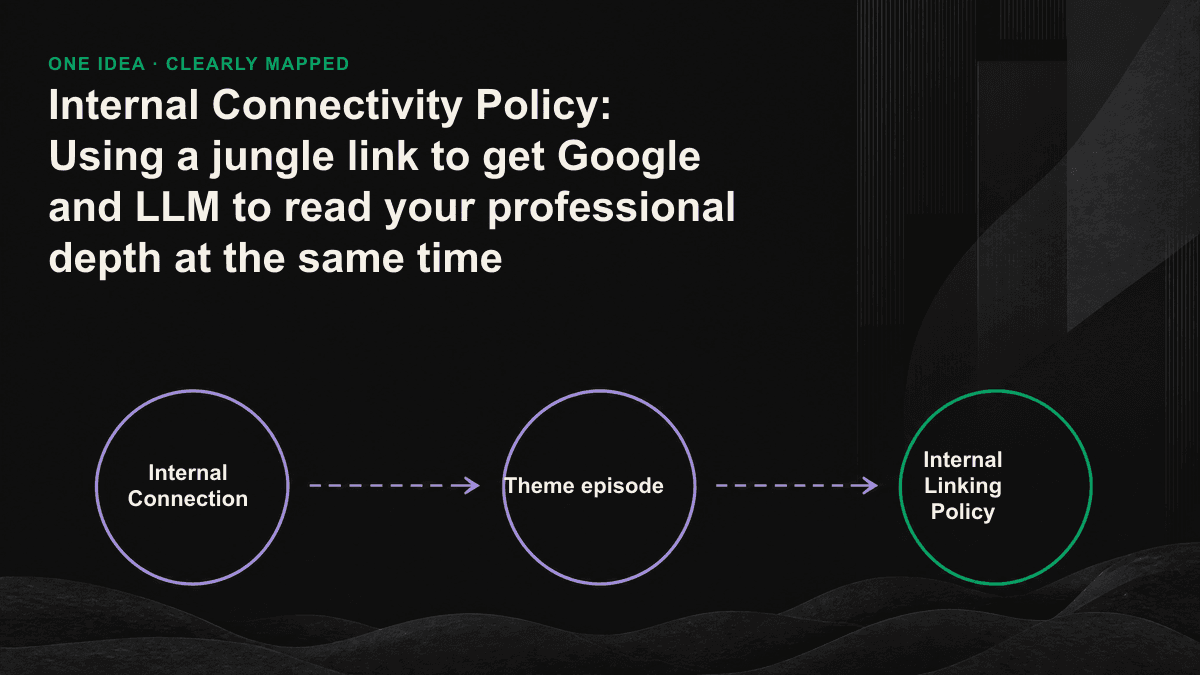
The anchor will be written to the machine as well.
The words are the most underestimated part of the internal connection. It also undertakes two things: to tell readers what they will see in the past and what the theme of the machine's page is. The ideal anchor text is a descriptive phrase that naturally incorporates the sentence and contains the core concept of the target page, but is not mechanically filled with keywords.
For example, it says, "I want to know more about here" and says, "We've talked in another article about how to boost the pull rate of the AI engine with narrative anchor." The latter has allowed LLM to align links, context and target pages in the analysis of the page, which directly helps it to determine the relevance of content.
Frequent errors and how to avoid them.
The first most common error is the connection overdose. A text was inserted into five or six links, which diluted every link and interrupted reading. The principle is that each section focuses on one or two really related links.
The second error is that a web-based tail link is considered a theme link. With the same links at the end of the page, the machine knew they were templates, with low weight and medium. What really works is the link in the text, in the context. The third error is that it's downline, not backline, with a bunch of sub-pages attached to the pillars, and separate pages, and it's difficult for the machine to put them together as a cluster.
Where do we start?
Don't have to rebuild the entire site at once. Pick a theme that you most want to be cited in the AI engine, first by creating a support page that links the articles in question to each other, then reconnects them horizontally, and then lists the missing sub-topics as a list. One theme is solid, and it's much more useful than half a dozen themes.
If you want to know how many orphan pages and jungle structures your content currently has, Tenten GEO's content engine service will enter the entry point from the link diagram. If you want to look at the whole gap, you can also schedule a 30-minute GEO diagnostic session, and we'll take your website directly to see where the problem is.