When the AI engine decides which source to use, it takes this "recent maintenance" as one of the sorting signals. But most B2B sites either leave a date or update time. It's hidden in a line of plain text, so Google, Perplexity, ChatGPT can't read you just changed. The result was straightforward: you did your best to update the content, but you did not get the visibility that the update would have brought.
Why is AI engine interested in new content? degrees
The generative AI engine will try to find a source that can reduce the risk of error when it sets the answer. A post on the theme 2026, which quotes a two-year-old book about price fixing and downgrading, is a high-risk material for models. He'd rather skip you and grab a piece of what looks like someone's defending. Newness is not the only factor in ranking, but it is clearly high on the subject of "themes will change over time" (fixing prices, rules, tool functions, platform algorithms). The GEO domain is itself the most typical example: best practices written six months ago may be past today.
There's an easily overlooked gap here. Human readers can read you overwrite the paragraph, but the machine only recognizes the signal. If you don't mark "the last update" in a way that you can read, then in crawlers and models, you stop this article on the day it was published.
Correct approach to updating date marks
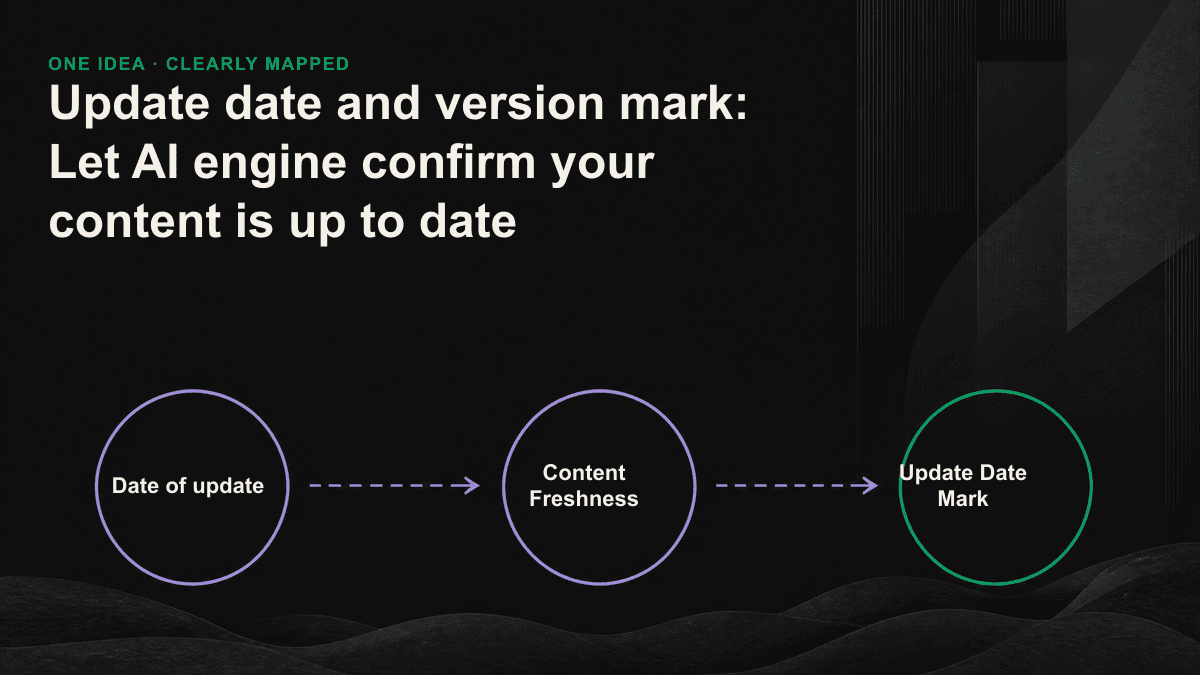
The update date is to be both readers: one machine, one human. Both sides are in place, the signal is complete.
- Structured data are skeletons: in Article or BlogPosting Schema, datePublished and dateModified at the same time, and dateModified in ISO 8601 format (e.g. 2026-07-02T09:00 +08:00). Only the date of release, lack of date Modified, was not told of your update.
- Visible dates must be aligned with schema: the visible "Final Update: July 2026" on the page must match the date Modified in schema. The conflict will weaken trust, and Google may simply ignore your date.
- The date is near the beginning of the article: place the update time below the title, above the text, rather than plugging the page. The opening position is a direct quality signal to the reader, and a model for extracting content is more easily connected to the subject.
- Don't fake updates: it's short-sighted to change a label and a year from 2025 to 2026. The crawlers will be compared to actual content variations and long periods of "fake and fresh" will erode your credibility.
Version mark: More convincing than a date
The date only says "when," and the version label says "what has changed." A short change log (changelog) is more important than a single time stamp for technical, tool-type, or time-efficient content that requires readers' trust. It makes people and machines see that you don't change at hand, but you stay in school.
Keep the process light. Add a small block at the beginning or end of the article and explain the change in one or two lines. For example: "July 2026 update: Added a section on AI Overviews citation mechanics and corrected the previous explanation of dateModified." You do not need a complex version-number system; readers need to know what changed. After three or four meaningful updates, the record becomes a trust signal that shows both readers and models the page is actively maintained rather than abandoned after publication.
Let the machine actually read the details of:schema
Many websites think it's enough to write "last update" on the page, but if it's just visual text, but no match for the date Modified field, crawlers may still not get a clear signal when they grab it. On the other hand, schema is marked, there are no visible dates on the page, and human readers are unable to confirm and trust. We'll do both together. We don't have one.
The four most common mistakes.
- Use the distribution date as an update -- there's only one date field, and the engine always thinks you haven't moved.
- The update date is hidden at the end of the page - too deep a model to extract content is not easily connected to the subject of the article.
- Visible date and schema fighting -- one writing in June 2026, one writing in 2025, instead of causing mistrust.
- A fake update to refresh the freshness - no physical content changes but changes the timing, short-term useless, long-term discredit.
Turn the update into discipline, not a one-off move.
Updates the real value of the date mark, not in a single article, and do you have a regular back-to-back rhythm? To pick out the 10 to 20 core items that are either in traffic or have the highest visibility, a quarterly review of whether the information is accurate, whether there is a new platform to change it, whether the price and functionality are expired. Update datemodified, visible dates and changes in the log simultaneously. The action in Tenten's content engine is standard process -- content does not end when it's released, but sustains, giving AI reason to think of you as the most up-to-date and credible source.
If you're not sure if your core content is "live" in the eyes of the AI engine or "sitting on the day of the release", you can start with a note: see which high-value articles are missing date Modified and which updates are not read by the machine. If you want to know where your new gap is, it's not worth it.