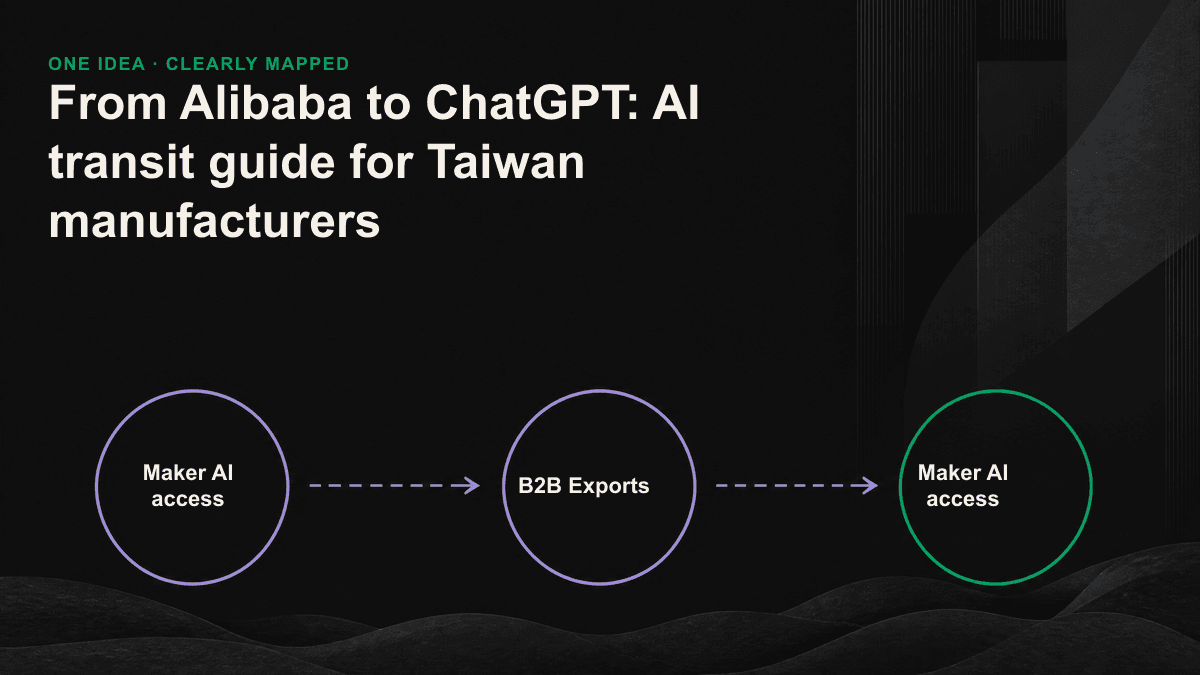
An overseas buyer may now begin outside Alibaba by asking ChatGPT which Taiwan factories can meet a specification, hold the required certifications, and accept the minimum order. If the AI shortlist omits your company, the RFQ never reaches your inbox. The first stage of B2B procurement has quietly moved from platforms and trade shows into a chat window, while many Taiwan manufacturers have not noticed their absence.
The Buying Journey Changed Before the Channel Strategy Did
For the past 15 years, a typical Taiwan manufacturer listed catalogs on Alibaba or Global Sources, paid for exposure, and waited for inquiries. That channel still works, but a new stage now comes before it. A procurement engineer in Europe or Southeast Asia may ask AI to narrow the field to three to five options before issuing an RFQ. The question might require a Taiwan or Southeast Asian factory that holds IATF 16949 certification, makes automotive connectors rated to 125°C, and accepts an order of 5,000 units. AI returns the candidates; the buyer then verifies them on a platform or Google. Entering that first list determines everything that follows.
Alibaba Provides Traffic, Not Ownership
The platform model has a structural weakness: the assets a supplier builds there do not belong to the supplier. Stop the subscription and exposure disappears. Product information and technical answers remain inside the platform's format and domain, where AI may not retrieve them or associate them with the brand. The platform also compresses engineering capability into a comparison table dominated by price and MOQ. Even a 20-year history of tooling experience, yield control, and material-substitution knowledge becomes invisible.
- Content remains on the platform's domain, where AI may not retrieve it or attribute it to the brand.
- Buyers compare price and minimum order while the supplier's engineering value is flattened.
- A platform algorithm controls exposure, leaving the supplier without an owned content asset that gains value over time.
- Once payment stops, visibility falls to zero and no compounding value remains.
How AI Decides Whether a Manufacturer Is Worth Recommending
A language model does not know a manufacturer by intuition. It relies on cleanly extractable information from product pages, technical papers, application notes, certification lists, and real cases. Those sources need clear structure, factual claims, and visible attribution before a model can cite them. Many Taiwan manufacturers have only a 10-year-old image-heavy site with awkward English and a platform storefront. AI cannot understand the first or reliably attribute the second. It therefore recommends competitors, often factories in China or India, that publish technical evidence clearly on their own domains.
Turn a Product Catalog into Citable Technical Content
The core transition is to turn knowledge hidden in engineers' heads and quotation sheets into public, searchable material. Rewrite a parameter list around buyer questions: operating-temperature range, achievable tolerance, certifications, and common applications. Give each question a clean answer that stands alone. Application notes, material and tolerance comparisons, written summaries of certification and test reports, and specific customer situations are precisely the sources AI needs when answering a procurement question. Publish them on the company's own domain with clear structure.
Four Practical Steps for Taiwan Manufacturers
The goal is not to abandon Alibaba. It is to shift the center of gravity from rented platform traffic to owned assets. Build the foundation first, then expand the content.
- Create a structured English site. Give capabilities, products, certifications, and cases their own pages with clear language and facts AI can extract.
- Turn invisible engineering knowledge into content. Explain tolerances, material substitutions, yield control, and industry applications in self-contained passages.
- Complete the factual signals with schema. Keep company details, certification numbers, capacity, and addresses consistent and machine-readable.
- Monitor AI visibility continuously. Test natural procurement questions across several engines and check whether AI mentions the company accurately.
Monitoring is the easiest of these four steps to skip and the most damaging to ignore. Manufacturers often finish a website redesign without ever checking how AI describes them. Visibility changes when competitors publish new material or models update. Without measurement, the company is investing in a black box.
Measure the Gap Before Deciding How Much to Invest
Before rewriting a page, establish the current position: which suppliers AI names for the category, which capabilities it misses, and which facts it gets wrong. Tenten AI visibility monitoring turns the frequency and accuracy of those mentions into a baseline that guides the content plan. Book a 30-minute GEO diagnostic session to run real purchasing questions for your product category and see how AI currently understands the business.