AI's visibility can be measured, and the results are often far from the brand's own imagination. The most common difference was when we made the initial benchmark for B2B SaaS clients: the marketing team was convinced that it "should have been mentioned when ChatGPT asked questions about it" and that, after a group of representative questions, the citation rate tended to fall in a single-digit percentage, while the competition was firmly on the list. It doesn't mean a mark, it's a number that can be repeated.
Why can't it be considered productive?
The answer to the generative AI engine is random. The same question is asked three times, and the language changes and the source of the quote may change. You asked your own account yesterday about the appearance of the brand, probably because the model read your browsing, or just because the sample was hit. The result of a single account, a single account, a single word is considered to be "we're visible" and it's the same as a dice count to judge the dice as unfair. To talk about results, we have to fix the measurement so it can be repeated.
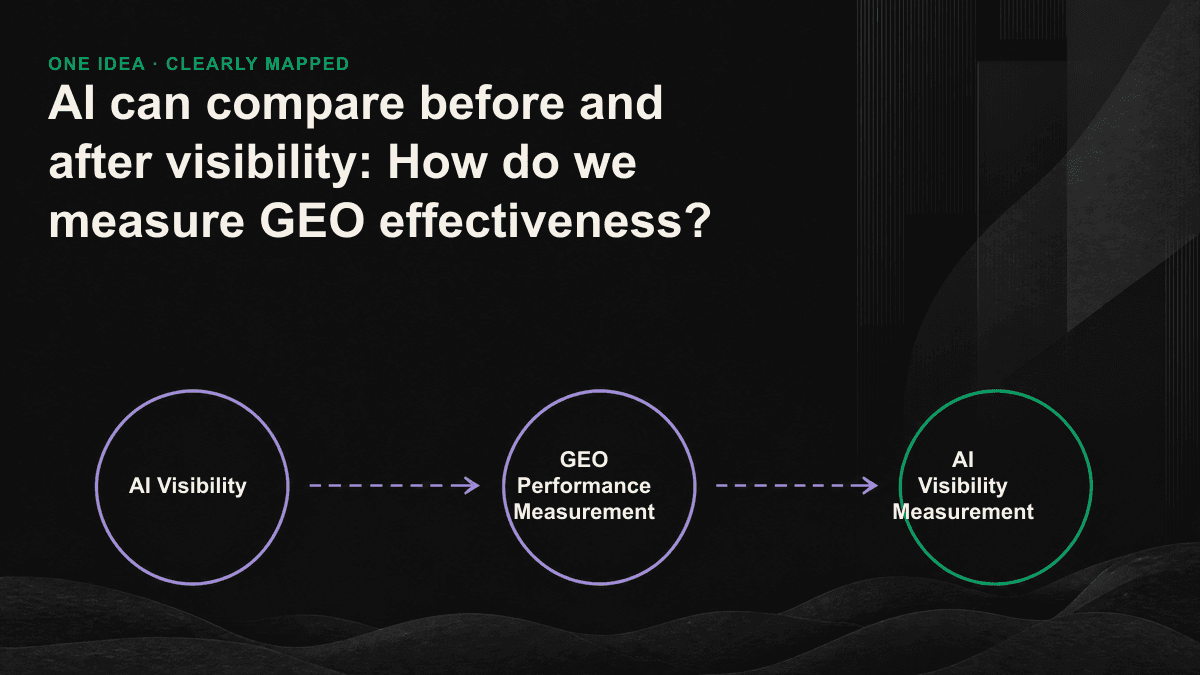
We measure four core indicators of AI visibility.
Visibility is not a number. It's a set of complementary indicators. If you look less, you can get the wrong optimism or pessimism. Here are four of the things we've been tracking in the GEO audit, each with a definition that will help you to follow your own approach.
- Citation Rate (Citiation Rate): In a set of regular representative questions, AI answers explicitly mention or quote the proportion of your brand/content. This is the most intuitive sign.
- Model volume (Share of Mode Voice): In the same set of questions, you are mentioned as being the proportion of the previous competitions. The answer is "The same question, the model is more popular."
- Quote situations and locations: Are you recommended first, on the list, or are you only brought in in reverse or on foot? The three types of business have a one-size-fits-all difference.
- Source Retroactivity: Is AI connected to your website or content, not just the brand name? It can be traced back to the opportunity for this exposure to turn into traffic and subsequent interaction.
Before and after the match is credible, lock the baseline to death.
The area before and after comparison is most prone to error is not "back" and "front". If the baseline line is not strictly applied, the subsequent growth figures are meaningless. We set three things: questions, engine and account conditions, sample numbers. Question collections usually range from 40 to 80 topics, covering terminologies, comparative questions, painful situations and questions with brand designs, and once the case is settled, they will not change. Each of these issues runs in the clean environment many times, and several engines, such as ChatGPT, Perplexity, Gemini, Google AI Overviews, are recorded, because cross-engine results are often inconsistent and one can be seen to be wrong.
What was a 30-day-old match?
An example of a client who works as a developer tool is how to read the comparison report. On the baseline level, we're asking 60 questions across four engines five times each. Prior to the intervention, there was an overall brand citation rate of about 11 per cent, with comparative questions (e.g., "What size of the X and Y team is appropriate") almost zero, and the source is even less traceable: most of them mentioned as brand names and not reconnected. This means that the model knows it exists, but does not have enough material to quote it into the recommended answer.
The next 30 days, we're going to make a comparison of the structure of the gap, write the product location and suitability into clean paragraphs, and fix a few technical problems that keep crawlers out of focus. Using the same set of questions and retesting the same conditions, the overall citation rate rose to 27 per cent, and the comparative problem went from almost zero to stable, with retroactive references coming up. The point is not that a number is beautiful, but that four indicators move in the same direction together: this precludes the possibility of “just the right results”.
The most credible signal for visibility growth is that several independent indicators rise at the same time under a fixed method, rather than a single pointer jumps in a single query.
Don't be fooled by a single inquiry: the usual measuring trap.
We've seen too many teams take one screenshot for results, and we take another one every other week to say back off. Generating answers would have floated, using screenshots to make decisions that would have been carried away by information. The second trap is to look at a single engine; perplexity often quotes it as a source, and ChatGPT talks about it, and if you just look at the engine that's good for you, you'll overestimate its visibility. The third trap is to ask one-sided questions about what one wants to win, and how this line can grow does not represent the real market.
There's also an easy point to ignore: visibility and transformation are not the same thing. To be cited by AI is the tip of the funnel, which increases access to the consideration list and does not guarantee a deal. So we're going to look at the visibility indicators and the subsequent web sites, and we're going to look at them separately, and we're going to avoid using exposure growth to explain changes in performance, or vice versa.
From measurement to action.
Measurement does not raise visibility per se, it just tells you where the gap is: whether the model doesn't know you at all, or whether it knows you but has no material to quote, or if it has content that you can't read. The three causes of the disease are completely different, and the wrong medicine is a season wasted. Set the baseline line and define the indicator clearly, and each subsequent content or technical adjustment will be effective rather than less. And that's what Tenten's AI visibility monitoring is doing: making AI visible into a curve you can read and follow. If you want to know where you're at, what kind of gap you're in, you can schedule 30 minutes for a GEO diagnostic session, and we'll run a baseline with your real questions.